Martin,
Sounds like a nice set up. I don't have a display?? I am going to check today if my controller is near the charger on starboard side like you stated. I have the lithium battery option maybe it removes display
Which wouldn't make sense.
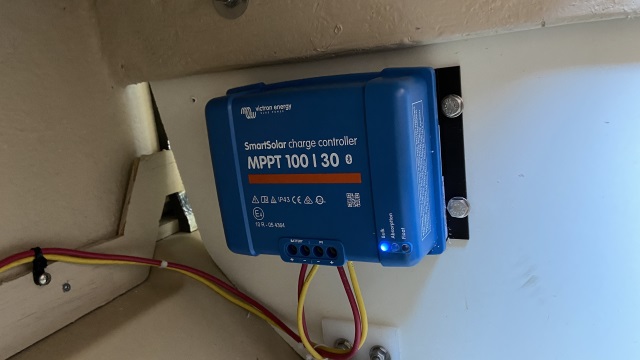
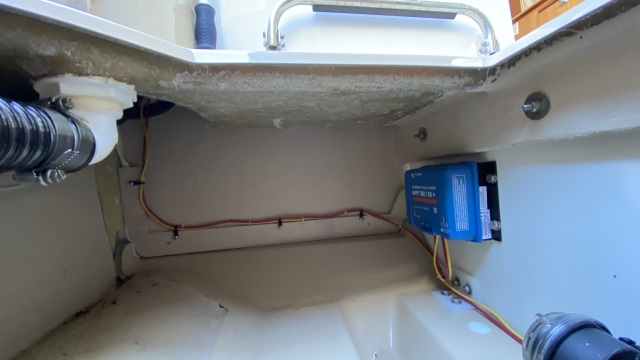
The original Morning star duo remote display is still in our cave. It no longer functions as I replaced the Morning Star Duo PWM controller with a Victron MPPT 100/30, but I'm still using the factory solar panel. The Victron MPPT solar controller I access on my phone via bluetooth. It keeps track of the past month or so of sunlight and total watts captured per day. That's where the numbers in my previous post came from.
I uploaded a screenshot of my phone showing full sun, full clouds/rain, and partial sun from last week's halibut fishing trip.
http://www.tugnuts.com/gallery2.php?g2_itemId=79316
Here's a screenshot showing current wattage from the sun. (full sun, great day!)
http://www.tugnuts.com/gallery2.php?g2_itemId=79319
I knew the factory panel wouldn't be enough for our needs and 6 months ago I knew almost nothing about solar power. Upgrading to the Victron solar controller made it easier for me to see what's going on with the existing panel I have. I look outside at an overcast day and wonder how many watts would I actually get. I've been trying to understand how I should size our replacement panel(s). I've figured out that our daily electrical consumption/needs are a little over 100amps per day. To get 100 amps per day I need about 400 watts of solar. (Rule of thumb for the Pacific NW: Take the wattage of the panel, divide by 4, and that's how many amp's you can expect to get in a day, talking averages). 400 watts/4 = 100 amps. Divide by 2 or 3 for really sunny days, which is what we all hope for when boating.
Or another way to calculate solar, the Pacific Northwest sees about 3.57 hours of sun a day during the summer months. (400 watts * 3.57 hours of sun / 12 volts = 119 amps). For this, you have to research the area you live in to find the average sunlight in a given month. The angle of the sunlight to the panel matters a lot. During December and January, solar is nearly useless in the Pacific Northwest. (I didn't see our panel produce more than 40 watts then on a clear sunny day at high noon).
Sun hours per day (as an example, there are many sites that publish this type of data).
http://www.bigfrogmountain.com/SunHoursPerDay.html
I'm just waiting on the mounting brackets and Solar MC4 waterproof connectors to arrive to install our new panels.