2015 R31 D4-300 Replacement Turbo

calcman05

Active member
Joined
Feb 3, 2024
Messages
44
Fluid Motion Model
R-31 CB
Vessel Name
DINGLEHOPPER
My boat (2015 R31 with D4-300) is being serviced and my turbo needs to be entirely replaced. It is a Volvo part number 3887963 but unfortunately it runs $4500. I have found a Borg Warner replacement model 53269987105 that says it's a factory fit for that OEM model and its about $2000 less. Any advice here? Should I just go OEM and pay the premium or try the much cheaper Borg Warner replacement?
1000004168.png
.

 
Last edited:
This is not speaking specifically to the D4
Many people choose after market turbos for replacement in the trucking industry. I lost the turbo in my ‘07 6.7 Cummins and my Ram dealer got me a replacement that interchanged with the factory one for 1/2 the money. It ran just fine. Sometimes they even run better.

YMMV
 
Can it be rebuilt? I had a shop in Arkansas rebuild one of mine and it turned out fine.
 
I ended up buying the Borg Warner. Shop says it should work great, we'll see! I'll report back.
 
I ended up buying the Borg Warner. Shop says it should work great, we'll see! I'll report back.
How did your Borg Warner turbo work out? I have an R29S that looks like it needs a turbo replacement. RPMs limited at 2500 and boost pressure capped at 9psi. Have done the easy things - fuel filters, air filter and made sure turbo blade spins freely. Trying to evaluate alternatives.
 
How did your Borg Warner turbo work out? I have an R29S that looks like it needs a turbo replacement. RPMs limited at 2500 and boost pressure capped at 9psi. Have done the easy things - fuel filters, air filter and made sure turbo blade spins freely. Trying to evaluate alternatives.
I made some phone calls after posting this and talked to a few shops that said there was a good chance that Borg Warner is the manufacturer of OEM turbo, just painted Volvo color. I ended up buying the Borg Warner off ebay and it was legitimate and fit perfectly. The shop that installed it has no issues and it's been working well since.
 
Many of the components on the Volvo Penta D4 / D6’s were not manufactured by VP. For example, the high pressure, common rail fuel injection system is Bosch. Another example is the starter, which is Mitsubishi. The reverse gear / transmission is ZF. List goes on… You can directly cross-reference part numbers for many of the VP subsystems to the original manufacturer.
 
I made some phone calls after posting this and talked to a few shops that said there was a good chance that Borg Warner is the manufacturer of OEM turbo, just painted Volvo color. I ended up buying the Borg Warner off ebay and it was legitimate and fit perfectly. The shop that installed it has no issues and it's been working well since.
Very helpful. Thank you!
 
Here's the link to the one I bought. If anyone wants to buy from this shop/link, double check the parts number is correct since I purchased in Oct 2024.

 
Just curious, how many of you have had to replace your turbo on your D4-300 (or similar)? Ours just kicked the bucket at just under 650 engine hours, and upon removal of the exhaust elbow and inspection of the exhaust turbine, I found one of the turbine blades partially missing. The turbine, volute discharge, and exhaust elbow were not very coked up at all, and the turbine was spinning freely. I always bring the engine up to 3,150-3,200 RPMs for 5-10 minutes before ending the day after a few hours of slow-boating at 1,600 RPM, and we pretty much do a mix of slow and fast boating during every outing. So glad it wasn't the compression turbine!
 
Just curious, how many of you have had to replace your turbo on your D4-300 (or similar)? Ours just kicked the bucket at just under 650 engine hours, and upon removal of the exhaust elbow and inspection of the exhaust turbine, I found one of the turbine blades partially missing. The turbine, volute discharge, and exhaust elbow were not very coked up at all, and the turbine was spinning freely. I always bring the engine up to 3,150-3,200 RPMs for 5-10 minutes before ending the day after a few hours of slow-boating at 1,600 RPM, and we pretty much do a mix of slow and fast boating during every outing. So glad it wasn't the compression turbine!
I replaced mine three years ago - was having spin up issues then one of the turbine blades broke. Once that happen it required replacement - no turbo "parts" are available. I installed a new VP OEM turbo charger. If you have a fan blade missing, unfortunately you are in the "replace it" category.

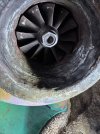
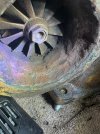
Three years later, I was having similar problems with the new turbocharger. Now the turbocharger would spin up only when the engine was just started, but if you slowed down, it would not spin up again until the engine was off for some time. It was initially upsetting that this $4K turbo lasted less than 500 engine hours. I pulled the turbo off the engine, and this is what I determined was happening - the amount of engine exhaust build up around the exhaust fan blade was the problem, not the turbocharger itself. The turbo housing is cooled by the coolant water circulating through the engine. The turbo fan in the exhaust is not cooled thus it heats up and the fan blade metal expands relative to the turbo housing. Thus, it was not freely spinning once it got heated up. It was nothing mechanical wrong with the turbocharger. However, the exhaust deposits in the inner bore around the fan blades on the exhaust side are seriously baked into place - and required me using a vibrating tool to chip away at the deposits. I then used a Dremel tool to remove the deposits where the tips of the fan blades rotate, being careful to not touch and damage the fan blades. After several hours of this chip away process, I had achieved adequate clearance for the exhaust fan blade to rotate freely again. The key is dealing with the problem before a fan blade gets damaged.
 

Attachments

  • Turbocharger After Picture.jpeg
    Turbocharger After Picture.jpeg
    755.6 KB · Views: 46
  • Turbocharger Before Picture.jpeg
    Turbocharger Before Picture.jpeg
    871.6 KB · Views: 53
I replaced mine three years ago - was having spin up issues then one of the turbine blades broke. Once that happen it required replacement - no turbo "parts" are available. I installed a new VP OEM turbo charger. If you have a fan blade missing, unfortunately you are in the "replace it" category.

Three years later, I was having similar problems with the new turbocharger. Now the turbocharger would spin up only when the engine was just started, but if you slowed down, it would not spin up again until the engine was off for some time. It was initially upsetting that this $4K turbo lasted less than 500 engine hours. I pulled the turbo off the engine, and this is what I determined was happening - the amount of engine exhaust build up around the exhaust fan blade was the problem, not the turbocharger itself. The turbo housing is cooled by the coolant water circulating through the engine. The turbo fan in the exhaust is not cooled thus it heats up and the fan blade metal expands relative to the turbo housing. Thus, it was not freely spinning once it got heated up. It was nothing mechanical wrong with the turbocharger. However, the exhaust deposits in the inner bore around the fan blades on the exhaust side are seriously baked into place - and required me using a vibrating tool to chip away at the deposits. I then used a Dremel tool to remove the deposits where the tips of the fan blades rotate, being careful to not touch and damage the fan blades. After several hours of this chip away process, I had achieved adequate clearance for the exhaust fan blade to rotate freely again. The key is dealing with the problem before a fan blade gets damaged.
Interesting assessment about your turbo. I've never seen a brand new one, so I don't know what the blades, or the clearance between the blades and the volute, are supposed to look like, compared to ours with 650 hours on it. I didn't notice any performance issue with ours until the second it failed; it made an abrupt whistle sound, almost sounded like a fitting blew apart, which is the first thing the VP service tech had me check. All connections were tight. Saw the partially-missing turbine blade after removing the exhaust elbow. It didn't appear that we have excessive carbon deposit build-up based on other pics I've seen, but maybe it's enough that the turbine blade hit it after heating up & expanding. I'm looking forward to discussing it with the VP technician once when they replace the turbocharger in a couple of weeks. Like you said, once a blade is damaged, it's pretty much a full turbocharger replacement. It's making me rethink having a saltwater boat with a turbocharger, though I think there would be a lot more online if VP turbos were only lasting 600-1000 hours in saltwater environments.
VP D4-300 Turbo Photos - 26-0824 (9).jpg
VP D4-300 Turbo Photos - 26-0824 (16).jpg
VP D4-300 Turbo Photos - 26-0824 (14).jpg
VP D4-300 Turbo Photos - 26-0824 (15).jpg
 
Both sets of images above look suspiciously like salt water spray is making its way back into the turbo. Historically both Mercruiser and Yanmar had to redesign the mixing elbows to eliminate that problem.
 
I replaced mine three years ago - was having spin up issues then one of the turbine blades broke. Once that happen it required replacement - no turbo "parts" are available. I installed a new VP OEM turbo charger. If you have a fan blade missing, unfortunately you are in the "replace it" category.

Three years later, I was having similar problems with the new turbocharger. Now the turbocharger would spin up only when the engine was just started, but if you slowed down, it would not spin up again until the engine was off for some time. It was initially upsetting that this $4K turbo lasted less than 500 engine hours. I pulled the turbo off the engine, and this is what I determined was happening - the amount of engine exhaust build up around the exhaust fan blade was the problem, not the turbocharger itself. The turbo housing is cooled by the coolant water circulating through the engine. The turbo fan in the exhaust is not cooled thus it heats up and the fan blade metal expands relative to the turbo housing. Thus, it was not freely spinning once it got heated up. It was nothing mechanical wrong with the turbocharger. However, the exhaust deposits in the inner bore around the fan blades on the exhaust side are seriously baked into place - and required me using a vibrating tool to chip away at the deposits. I then used a Dremel tool to remove the deposits where the tips of the fan blades rotate, being careful to not touch and damage the fan blades. After several hours of this chip away process, I had achieved adequate clearance for the exhaust fan blade to rotate freely again. The key is dealing with the problem before a fan blade gets damaged.
What would cause that much carbon build-up? Poor fuel or fuel mixture? Is it speed related? It doesn't seem logical that RPM's would have to be consistently maintained above a certain level in order to prevent that? Does anyone know if there is a service bulletin on it? Thanks.
 
Interesting. My fan blades look to be further recessed into the turbocharger body than yours. There is carbon buildup around your blades - it is hard to see but if you started aggressively hacking at it with a vibrating tool - the carbon will flake off. When you get down to metal then you will start seeing metal on metal sparks. That is when I knew I had gotten rid of the carbon buildup. I don’t think it has much to do with saltwater corrosion - my turbo housing was not suffering from rust, only carbon buildup.
 
...I don’t think it has much to do with saltwater corrosion - my turbo housing was not suffering from rust, only carbon buildup.
Didn't say anything about corrosion. Saltwater in a hot exhaust flow can vaporize and leave salt crystals behind. Mixed with carbon some hard funky deposits can form. Carbon tends to be softer and removable with solvent. Years ago sulfer produced similar crystaline deposits but not nowadays with ULS diesel.
 
Back
Top