
You are using an out of date browser. It may not display this or other websites correctly.
You should upgrade or use an alternative browser.
You should upgrade or use an alternative browser.
Question for any who tow a trailered classic R27:
- Thread starter Poppa Ron
- Start date
Trisailor
Well-known member
- Joined
- Jul 8, 2017
- Messages
- 156
- Fluid Motion Model
- R-27 Classic
- Hull Identification Number
- FMLT2720H011
- Vessel Name
- Fancy Nancy (2011 R27)
2011 R27 with Yanmar 4BY2-180. I lighten the load as much as possible. 1/2 or less fuel tank and 1/2 water tank. Empty black tank. The two solar panels on the boat roof maintain the house batteries so the fridge stays cold. Lower the mast/radar, I even add a small lashing to the mast between the handrails for side to side motion. Remove the bimini and secure the frame. Carry a 6 ft ladder on the swim step for access to the boat when stopped. If the truck stop or rest area is comfortable, I'll overnight on the boat. There are several favorites along the I-10 corridor. I put an insulation (bubble wrap) blanket over the windshield; under the canvas cover as protection from rocks. To secure the boat to the trailer, two 3 inch ratchet straps (Husky brand) are used; one across the stern over the cleats and one over the bow (over the anchor). So far, I have about 5k miles on the boat trailer (triple axle) towing with a 3/4 ton diesel truck from Ca to Mississippi, Virginia back to Miss, the home to Ca. I did a 1/4 of the loop. I have since upgraded the brake system on the trailer from surge brakes to electric over hydraulic so I can use the trailer brake controller in the truck, gives a bit more piece of mind when backing down a ramp. Next project is to wire the boat trailering lights into the trailer light wiring. Maybe add a camera system to the stern of the boat to see behind the trailer. It's also a good idea to clean the bilge and bottom of the boat so the watchdogs for invasive species don't get excited. Along I 10 there are no marine inspection stations, but I have seen several on different ( non boat) trips up in Northwest states.

scross
Well-known member
- Joined
- Jan 30, 2015
- Messages
- 2,187
- Fluid Motion Model
- C-28
- Hull Identification Number
- FMLC2831A717
- Vessel Name
- R-25 Classic - Sold
- MMSI Number
- 367719470
What Brian said with a few more tips.
1. Strap the stern of the boat to the trailer. We have used either strapped the aft side cleats to the trailer frame
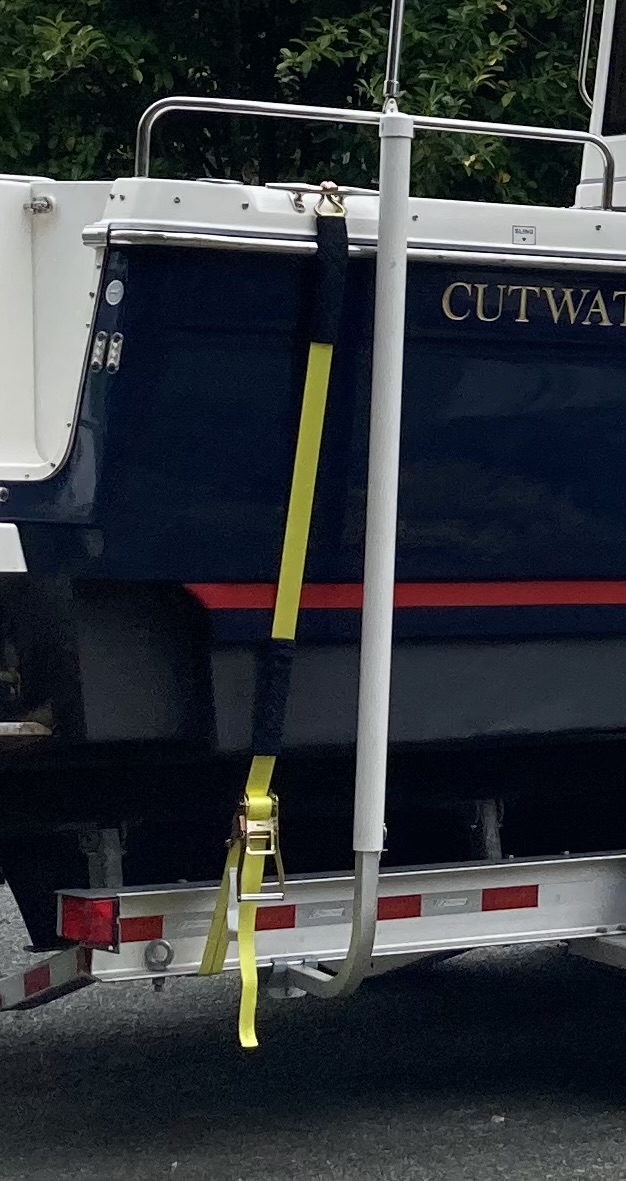 or we the use one long strap going side to side to the trailer frame. I use cut out wash mits to protect the boat gel coat from any strap rub.
2. Secure everything inside the cockpit and cabin. You won’t believe how much the contents can get thrown around on rough roads.
3. Obvious but make sure all vents and side windows are closed and locked.
4. Lock refrigerator closed.
5. At every stop measure tire and bearing temps on the trailer. Do a walk around the trailer to be sure everything is ok.
6. The boats are built with running lights on the stern. Plug your trailer’s flat-4 plug into the boats flat-4 connector. Usually the boats plug is in the anchor locker and the trailer plug is at the top of the hand winch tower. Recommend this even if not planning to tow at night.
Safe travels.
1. Strap the stern of the boat to the trailer. We have used either strapped the aft side cleats to the trailer frame
2. Secure everything inside the cockpit and cabin. You won’t believe how much the contents can get thrown around on rough roads.
3. Obvious but make sure all vents and side windows are closed and locked.
4. Lock refrigerator closed.
5. At every stop measure tire and bearing temps on the trailer. Do a walk around the trailer to be sure everything is ok.
6. The boats are built with running lights on the stern. Plug your trailer’s flat-4 plug into the boats flat-4 connector. Usually the boats plug is in the anchor locker and the trailer plug is at the top of the hand winch tower. Recommend this even if not planning to tow at night.
Safe travels.
Poppa Ron
Member
- Joined
- Sep 8, 2026
- Messages
- 5
- Fluid Motion Model
- R-27 Classic
- Hull Identification Number
- US-FMLT2712H
- Vessel Name
- OSPREY
2011 R27 with Yanmar 4BY2-180. I lighten the load as much as possible. 1/2 or less fuel tank and 1/2 water tank. Empty black tank. The two solar panels on the boat roof maintain the house batteries so the fridge stays cold. Lower the mast/radar, I even add a small lashing to the mast between the handrails for side to side motion. Remove the bimini and secure the frame. Carry a 6 ft ladder on the swim step for access to the boat when stopped. If the truck stop or rest area is comfortable, I'll overnight on the boat. There are several favorites along the I-10 corridor. I put an insulation (bubble wrap) blanket over the windshield; under the canvas cover as protection from rocks. To secure the boat to the trailer, two 3 inch ratchet straps (Husky brand) are used; one across the stern over the cleats and one over the bow (over the anchor). So far, I have about 5k miles on the boat trailer (triple axle) towing with a 3/4 ton diesel truck from Ca to Mississippi, Virginia back to Miss, the home to Ca. I did a 1/4 of the loop. I have since upgraded the brake system on the trailer from surge brakes to electric over hydraulic so I can use the trailer brake controller in the truck, gives a bit more piece of mind when backing down a ramp. Next project is to wire the boat trailering lights into the trailer light wiring. Maybe add a camera system to the stern of the boat to see behind the trailer. It's also a good idea to clean the bilge and bottom of the boat so the watchdogs for invasive species don't get excited. Along I 10 there are no marine inspection stations, but I have seen several on different ( non boat) trips up in Northwest states.
I am continually amazed at how many ex-sailors there are on this forum, thanks guys, good tips all.What Brian said with a few more tips.
1. Strap the stern of the boat to the trailer. We have used either strapped the aft side cleats to the trailer frame View attachment 28175or we the use one long strap going side to side to the trailer frame. I use cut out wash mits to protect the boat gel coat from any strap rub.
2. Secure everything inside the cockpit and cabin. You won’t believe how much the contents can get thrown around on rough roads.
3. Obvious but make sure all vents and side windows are closed and locked.
4. Lock refrigerator closed.
5. At every stop measure tire and bearing temps on the trailer. Do a walk around the trailer to be sure everything is ok.
6. The boats are built with running lights on the stern. Plug your trailer’s flat-4 plug into the boats flat-4 connector. Usually the boats plug is in the anchor locker and the trailer plug is at the top of the hand winch tower. Recommend this even if not planning to tow at night.
Safe travels.
zzr7ky
Well-known member
- Joined
- Sep 4, 2024
- Messages
- 72
- Fluid Motion Model
- R-21 EC
- Hull Identification Number
- FMLT2113H213
I like to monitor tire and hub temperature with a hand held temperature sensor. Also just walk around the whole rig before getting back in. We stop every 2 hours for a quick walk.
Poppa Ron
Member
- Joined
- Sep 8, 2026
- Messages
- 5
- Fluid Motion Model
- R-27 Classic
- Hull Identification Number
- US-FMLT2712H
- Vessel Name
- OSPREY
Might add, that was an admirable stretch of land and water you undertook, zzr7ky.I certainly agree with all that!
Last edited:
Trisailor
Well-known member
- Joined
- Jul 8, 2017
- Messages
- 156
- Fluid Motion Model
- R-27 Classic
- Hull Identification Number
- FMLT2720H011
- Vessel Name
- Fancy Nancy (2011 R27)
Thanks. I certainly got the chance to get to know the boat and all its idiosyncrasies and noises well. And practice all my single-handed boat handling skills in a varied set of weather conditions. The windshield wipers actually work. The trailering part was relatively easy other than having a truck with a 400 mile fuel tank and me with a 20 mile bladder......Turns out most rest areas average 35 miles (or more) apart.
2011 R27 with Yanmar 4BY2-180. I lighten the load as much as possible. 1/2 or less fuel tank and 1/2 water tank. Empty black tank. The two solar panels on the boat roof maintain the house batteries so the fridge stays cold. Lower the mast/radar, I even add a small lashing to the mast between the handrails for side to side motion. Remove the bimini and secure the frame. Carry a 6 ft ladder on the swim step for access to the boat when stopped. If the truck stop or rest area is comfortable, I'll overnight on the boat. There are several favorites along the I-10 corridor. I put an insulation (bubble wrap) blanket over the windshield; under the canvas cover as protection from rocks. To secure the boat to the trailer, two 3 inch ratchet straps (Husky brand) are used; one across the stern over the cleats and one over the bow (over the anchor). So far, I have about 5k miles on the boat trailer (triple axle) towing with a 3/4 ton diesel truck from Ca to Mississippi, Virginia back to Miss, the home to Ca. I did a 1/4 of the loop. I have since upgraded the brake system on the trailer from surge brakes to electric over hydraulic so I can use the trailer brake controller in the truck, gives a bit more piece of mind when backing down a ramp. Next project is to wire the boat trailering lights into the trailer light wiring. Maybe add a camera system to the stern of the boat to see behind the trailer. It's also a good idea to clean the bilge and bottom of the boat so the watchdogs for invasive species don't get excited. Along I 10 there are no marine inspection stations, but I have seen several on different ( non boat) trips up in Northwest states.
Thank you for sharing your tip about using bubble wrap! We haven’t picked up our Ranger Tug yet, so I’m not sure what size or width of bubble wrap to purchase. If anyone has any recommendations on the best size to use, I’d really appreciate your advice. Thanks in advance!
MJ
MJ
Trisailor
Well-known member
- Joined
- Jul 8, 2017
- Messages
- 156
- Fluid Motion Model
- R-27 Classic
- Hull Identification Number
- FMLT2720H011
- Vessel Name
- Fancy Nancy (2011 R27)
Home Depot or Amazon sell a relatively inexpensive silver bubble wrap insulation roll. It can be cut to size with ordinary scissors. I use the same piece for under the canvas externally or inside while at the dock. A couple of pieces of velcro tape hold it to the mouse fur.
Cajun
Member
- Joined
- Jan 19, 2026
- Messages
- 23
- Fluid Motion Model
- R-27 Classic
- Non-Fluid Motion Model
- C-Dory 22
- Vessel Name
- Genuine Hawken
Hi Scross,What Brian said with a few more tips.
1. Strap the stern of the boat to the trailer. We have used either strapped the aft side cleats to the trailer frame View attachment 28175or we the use one long strap going side to side to the trailer frame. I use cut out wash mits to protect the boat gel coat from any strap rub.
2. Secure everything inside the cockpit and cabin. You won’t believe how much the contents can get thrown around on rough roads.
3. Obvious but make sure all vents and side windows are closed and locked.
4. Lock refrigerator closed.
5. At every stop measure tire and bearing temps on the trailer. Do a walk around the trailer to be sure everything is ok.
6. The boats are built with running lights on the stern. Plug your trailer’s flat-4 plug into the boats flat-4 connector. Usually the boats plug is in the anchor locker and the trailer plug is at the top of the hand winch tower. Recommend this even if not planning to tow at night.
Safe travels.
I have been using the stern eyes to strap the boat down to the trailer eyes. I run the straps along the stern through gaps in the swim deck. I also use a bow strap from the bow eye to the trailer frame. I'm hesitant to use the stern cleats with all of the bouncing up and down on the road. What do you think about that?
Thanks for getting back to me so quickly! I found this at Home Depot: 8 Pack 20.5 in. x 4.5 ft. Radiant Barrier, Reflective Bubble Insulation Sheet. Do you think the dimensions would work for the Ranger Tug windshield, since you mentioned it’s easy to cut to size? Just wanted to check with you before I buy it. Thanks again for the tip!Home Depot or Amazon sell a relatively inexpensive silver bubble wrap insulation roll. It can be cut to size with ordinary scissors. I use the same piece for under the canvas externally or inside while at the dock. A couple of pieces of velcro tape hold it to the mouse fur.
scross
Well-known member
- Joined
- Jan 30, 2015
- Messages
- 2,187
- Fluid Motion Model
- C-28
- Hull Identification Number
- FMLC2831A717
- Vessel Name
- R-25 Classic - Sold
- MMSI Number
- 367719470
The stern tow rings are obvious strong points to anchor the boat to the trailer. On my boat the route from the tow rings to the trailer frame is a pretty convoluted path to a trailer cross member. It would put a lot of aft loads on that trailer cross member which, in my opinion, is not a good thing.Hi Scross,
I have been using the stern eyes to strap the boat down to the trailer eyes. I run the straps along the stern through gaps in the swim deck. I also use a bow strap from the bow eye to the trailer frame. I'm hesitant to use the stern cleats with all of the bouncing up and down on the road. What do you think about that?
I went with a strap that is vertical to prevent vertical bouncing on the trailer. If you were concerned about the strength of the cleats carrying that vertical load, I’d suggest one long strap starting at one side of the trailer frame, running up through one cleat then pulled across the cockpit through the opposite side cleat then down to the opposite side of the trailer frame. Doing that would remove the role of the cleats to everything except just guides. We did just that in our R-25 Classic.
CaspersCruiser
Well-known member
- Joined
- May 11, 2016
- Messages
- 979
- Fluid Motion Model
- R-27 Classic
- Hull Identification Number
- FMLT2709G112
- Vessel Name
- Cookie
- MMSI Number
- 368203460
I’ve been doing that with a heavy duty ratchet strap on my 2012 R27 for nine years of ownership and 15,000 miles of towing. The stern doesn’t budge. Some trailers may not have points positioned for strap attachment, but they wouldn’t be hard to install. The OEM EZ Loader trailer that came with the boat had two large ring eyes positioned for the strap. Last year, I replaced the trailer and had the builder put tie-down points positioned for a strap.…… I’d suggest one long strap starting at one side of the trailer frame, running up through one cleat then pulled across the cockpit through the opposite side cleat then down to the opposite side of the trailer frame….
Trisailor
Well-known member
- Joined
- Jul 8, 2017
- Messages
- 156
- Fluid Motion Model
- R-27 Classic
- Hull Identification Number
- FMLT2720H011
- Vessel Name
- Fancy Nancy (2011 R27)
I just laid the sunbrella windshield external cover on the insulation and cut it to fit. I figured one layer is enough since the boat sits high enough on the trailer that most road debris doesn't get near the windshield.Thanks for getting back to me so quickly! I found this at Home Depot: 8 Pack 20.5 in. x 4.5 ft. Radiant Barrier, Reflective Bubble Insulation Sheet. Do you think the dimensions would work for the Ranger Tug windshield, since you mentioned it’s easy to cut to size? Just wanted to check with you before I buy it. Thanks again for the tip!

John Cortesy
Active member
- Joined
- Oct 27, 2024
- Messages
- 35
- Fluid Motion Model
- R-27 (Outboard)
- Non-Fluid Motion Model
- Wellcraft 22 Walkaround
- MMSI Number
- 338457987
We are just starting our boater-homing journey. We catch ourselves doing things wrong every day but as time goes on it is fewer and fewer.
We use a bow eye strap to keep the front from bouncing. The stern eye straps work fine on the trailer mounted retractable ratchets. This image shows my canvas up over the cockpit but now we take it off for every highway trip.
You can buy a trucker's (long wireless range) backup camera and mount it in the cockpit of the boat. Mount the monitor with a suction cup on the windshield of the truck so you can see behind you while driving. You can also move the monitor to the helm for when you are boating. The swim ladder is awkward when camping. Carry a step ladder in the bed of the truck.
Sometimes you get to choose where you stop and sometimes it is chosen for you. enjoy life's adventures.
-
Tugnuts.com is the community hub for Ranger Tug, Cutwater, and Solara owners. Since its inception in 2008, the Tugnuts forum has grown into an active and thriving community of more than 9,000 members. It serves as both a meeting place for the best boating community online, and an invaluable archive of information.
- User menu