Additional solar panel

Joined
Nov 10, 2021
Messages
6
Fluid Motion Model
C-24 C
Non-Fluid Motion Model
Sumerset 80x 16
Awaiting delivery of a 2023 RT 27 LE OB and looking to add another solar panel to optimize my onboard battery charging capability.
Can anyone provide me with the name/model of the onboard solar controller currently being installed in the RT27 LE ? Or better yet, has anyone added an additional solar panel using the same controller? If technically possible would like to add another solar panel ( same make/model) as the factory installed panel. If hook up in series and the existing controller supports the additional panel would not have to rewire. Welcome your feedback.
Paul from Hartwell
 
Hey Paul

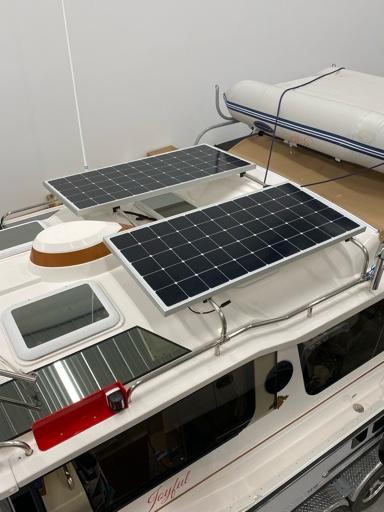
Can’t answer your questions exactly, but we just upgraded our 2021 RT27OB (Northwest edition). I used a pair of 24v panels in series (200 watts each) and a Victron smart solar charge control unit (100v 50 amp). Same wiring. Love the Victron app on my iPhone. As an aside, I also installed a smart battery monitor so I can keep track of all things battery related using the same app. Happy with the result. Now all we need is some Sun up here in rainy Bellingham WA.
bb4e1e401b0e63d5eb38dd4e094757a9.jpg


Sent from my iPhone using Tapatalk
 
Paul on Hartwell":43508vuj said:
Awaiting delivery of a 2023 RT 27 LE OB and looking to add another solar panel to optimize my onboard battery charging capability.
Can anyone provide me with the name/model of the onboard solar controller currently being installed in the RT27 LE ? Or better yet, has anyone added an additional solar panel using the same controller? If technically possible would like to add another solar panel ( same make/model) as the factory installed panel. If hook up in series and the existing controller supports the additional panel would not have to rewire. Welcome your feedback.
Paul from Hartwell

This answer assumes you're getting the LE with LFP batteries.
It's a Kisae DC to DC Charger (50amp).

It looks like this, and I believe it's in the port lazarette.
https://www.kisaepower.com/products/dmt1250/

The RT27-OB LE with LiFEPO4 batteries requires an MPPT style solar controller. The charger/controller RT is using is a combination 12 volt DC to DC charger. It has 2 inputs and 1 output. The output goes to the LiFEpo4 batteries. The two inputs's, one comes from solar, the other comes from the engine (indirectly, via an ACR that then goes through a voltage sense regulator).

Channel 2 (Solar array) on the DMT1250 supports up to 50VoC (open circuit voltage) at 30amps max. This equates out to about 500 watts of solar with 12 volt panels (per the manual). 775 watts max using 24volt panels (in parallel only).

The two CMPP22200S (200 watt) solar panels I installed on my boat have a VoC of 38.9 (Nominal of 33 volts at 6 amps). They would work, however, they'd have to be installed in parallel, not in series. (Have to keep the open circuit voltage below 50 volts.

The DMT1250 DC to DC charger will accept input from either the engine or solar, but not both at the same time. If the engine is running, the engine is charging the batteries. If the engine is turned off, then solar is charging the batteries.

If your LE doesn't have the LFP batteries, then I believe it's the normal Duo PWM controller that the NW editions come with. The Duo PWM controller supports up to 280 watts of solar using 12 volt panels.
 
Thank you both for the responses. Martin, once again you provide new insights and teachings. I think the Victron MPPT controller and the solar 200 Watt solar panels are certainly the A+ way to go. But sounds like I can also purchase two 200 watt solar panels, and hook up in parallel and still not have to rewire or change the current charging configuration. The rest remains the same. Moving forward on adding 2 additional 100 Ah Lithium battery’s to the six on the LE. Now need to think on how to optimize the charging aspect.
Thank you again …. Paul
 
I am in no way an expert on solar panels, but I have heard that if you hook them up in series and there is a shaded portion on one, it will adversely effect the performance of the other. Sounds like you decided to go with a parallel hookup so you avoid this issue.
 
S. Todd":bm4f58d4 said:
I am in no way an expert on solar panels, but I have heard that if you hook them up in series and there is a shaded portion on one, it will adversely effect the performance of the other. Sounds like you decided to go with a parallel hookup so you avoid this issue.

Some solar panels have circuitry built in that allows them to resist shading.

The photo cells are connected in series throughout the panel. Thus, shading would easily break the circuit and reduce output significantly. Shade resistant panels are built with bypass diodes which allow the current to skip over shaded regions of the panel. Still reduced output because not all photo cells are working, but not as significant as a panel which doesn't have bypass diodes.

Connecting the panels in series provides higher voltage which reduces the amperages for the same amount of power. Amps create heat in the wire due to resistance, heat is lost power. Also, if you wanted higher wattage panels, which means more amps, the RT27-OB came with #10awg wire that's rated for about 30amps.

347 watts = 63.56 volts at 5.5 amps = 13.14 volts at 25.8 amps.
https://www.letsgochannelsurfing.com/solar-power?pgid=kxcvhybj-e3b2d40a-5305-4797-b4fa-ab84c1c54656

For the purposes of our boats I don't think it really matters much. The biggest problem with solar on a boat is space to mount them. Series or parallel is really a decision made by the owner based on the solar controller they have (have to stay within the open circuit voltage limitations and amperage limitations of the wire). You can do parallel with a set of Y cables, or you can do in series... either way, you shouldn't need to run new solar wires throughout the boat.

I wired my 2x200 watt panels in series, the panels I purchased are shade resistant, and I get all our electrical needs met with solar. The RT27-OB doesn't really have a shading problem up top where the panels are mounted.

https://www.letsgochannelsurfing.com/solar-power?pgid=kxcvakr2-256ffab8-5fa0-4439-acb0-b857554b0c4f
 
Back
Top