Can you run a bilge heater off the inverter overnight?

DC3

Active member
Joined
Nov 25, 2020
Messages
28
Location
Lake Lanier, GA
Fluid Motion Model
C-32 C
Hull Identification Number
FMLT32C07H12
Non-Fluid Motion Model
Crest 230 tri-toon; BW 130 Super Sport
Vessel Name
Blue Heaven
MMSI Number
338546431
Hi everyone,
We own a 2022 C32 C docked on Lake Lanier in north Georgia, where we keep her in the water year-round. Due to unusually low water levels this season, we've relocated to a neighbor's dock without shore power access.
Current conditions: Water temperature is holding around 45°F, but air temps are forecast to drop to 23°F by the end of the week.

Winterization steps taken so far:
Flushed the freshwater system with RV antifreeze.
Engines remain in the water during sub-freezing temps to prevent damage.
The generator hasn't been winterized since we are using it to top off the batteries and run the heat when we are on the boat. For now, I've got a small space heater running in the bilge, but I plan to upgrade to a dedicated bilge heater before the deep freeze hits. On our previous 2012 R25, we used a 400-watt Caframo unit, but it only lasted two seasons and didn't provide much warmth—I'm eyeing something in the 700-watt range this time.

Key questions:
Is it feasible to run a bilge heater overnight via the inverter without draining or harming our four house batteries (3 years old)? If so, I'd fire up the generator each morning to recharge them.

I'd greatly appreciate any recommendations for reliable bilge heaters in that wattage—something more durable and effective than the Caframo.

Thanks in advance for your insights!
Best,
Dick
 
I use an Xtreme 800W heater in our engine compartment. (on shore power)

I'll defer to an electrical expert but to get 800W from your battery 800 W / 12V = 67 amps. 12 hours overnight would be 800 amp hours plus the inverter consumes some power. So I'm thinking not a good idea.

This is an interesting video on the topic

 
Last edited:
Maggie Anne has it right. The math is pretty straightforward. Under Watt’s law, watts = amps * voltage. The batteries are 12 volts. Depending on the setup you have, the amperage could differ. If you have the LiFePO4 upgrade, it might be 600 amp hours? I’m not sure, because I’ve never been on that boat, but that’s what is on the newer Ranger Tugs in the same class. If you do the math 600 amps hours at 12 volts = 7,200 watt hours, if (a) the batteries are charged to 100%, and (b) their capacity hasn’t degraded at all. 7200/800 =9 hours under those circumstances.

Theoretically, yes, you could do that, but it’s likely you’ll drain the batteries before you get to come back and re-charge them, and any other draw, like Maggie Anne says, will lower the time you get. Solar will give you a small amount of recharge, if the sun is up, but since it’s overnight and in the winter, you probably won’t get much from that.

I’d either look for more batteries, a different solution, or a shore power hookup. Heaters draw a lot of power. Converting electrical energy to heat energy is not a very efficient process.
 
Thank you for the reply. I am not really good on the math for watt and amps.
The Xtreme heater is what I was looking at on Amazon but was not sure which size I would need. Which Fluid Motion boat do you have?

Does anyone see an issue with running the generator overnight? The C32 has a gas Westerbeke generator. I do not plan to stay on the boat due to the possible carbon monoxide issues.
 
Last edited:
We have the R43 CB. We run the Xtreme heater in the bilge/engine compartment and a couple of Caframo heaters in the cabins. The engine compartment in that boat is large so we felt we needed the larger 800 W heater, but the bilge compartment in the C32 is smaller so perhaps the 600 W unit would be sufficient.

Our generator runs on diesel and uses about 1/2 a gallon per hour. I haven't run it unattended but have run it continuously for 5-6 hours at a time so theoretically should be OK
 
When you’re doing the calculation remember to think about inverter efficiency. Manufacturers typically advertise 90-95% but that’s at rated maximum output. It declines as the unit is either under or overloaded. A 2000W inverter outputting 600W could well be only 80% efficient. That’s an approximation by me so check the manufacturers website and look at the efficiency curve for the unit you have installed.
 
Thank you for everyones input. Now that I understand the math of the inverter and batteries, I will be using the generator.
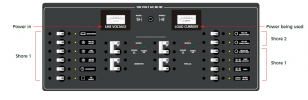
After further investigation, I found the Inverter only powers the left side of the panel and will not power the right side of the panel. The bilge heater is plugged into the cockpit grill outlet which is on the right side of the panel.

1765131572782.png
 
can you plug directly into the generator? Also some inverters have a 120v outlet built into the unit that you can plug directly into.
 
Are you wanting to run a bilge heater in the engine area or are you wanting to heat the cabin with an electric heater?

If you're just trying to protect the generator since it's not winterized, then I'd probably just winterize the generate after each use. It only takes a small amount of RV antifreeze to run through the sea water system.

If you do run the generator all night, it will create enough heat inside the entire bilge area to keep everything in the engine bay well above freezing and there wouldn't be a need for an electric heater. (assuming generator is in the engine bay similar to the R-31)

If you're wanting to keep the cabin warm, I'd just run the Webasto heater if you have one installed. Set the thermostat to whatever temp you want and it should do a good job of keeping the cabin warm.

If your boat is going to be at the neighbors dock for a while, I'd recommend installing a monitor to keep an eye on the bilge temperature. It's nice knowing the temp at all times, plus you'll be alerted to a potential freeze situation should your heat source quit working. Sensar Marine is a good option: https://sensarmarine.com/en-us/products/boat-bilge-monitor
 
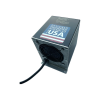
This is the one I'm thinking of, TWIN HORNET 45 700W. It's spendy ($299 on Amazon) but part of what you're buying is peace of mind. They have a 10 year warranty now. They have automatic temp control, 40-46F so you don't have to worry about the setting. I like the idea of just running the "WeBlasto" but ours has a minimum setting of 60F which is overkill for here in the PNW. Another feature I like about the Hornet though is it has a 25' power cord, no extension cord necessary for us.
1765549961947.png
 
This is the one I'm thinking of, TWIN HORNET 45 700W. It's spendy ($299 on Amazon) but part of what you're buying is peace of mind. They have a 10 year warranty now. They have automatic temp control, 40-46F so you don't have to worry about the setting. I like the idea of just running the "WeBlasto" but ours has a minimum setting of 60F which is overkill for here in the PNW. Another feature I like about the Hornet though is it has a 25' power cord, no extension cord necessary for us.
View attachment 26708
We just bought the same. Really happy with it so far. We also have the webasto heater but the minimum setting on ours is 41 so we leave that on as well, for the cabin.
 
Back
Top