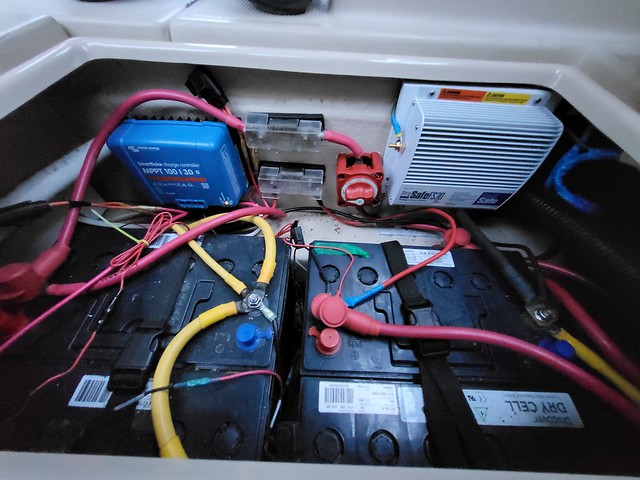
has anyone installed galvanic isolator on R-25sc?

wa7pug

Well-known member
Joined
Apr 25, 2023
Messages
131
Fluid Motion Model
C-26
Vessel Name
Pau Hana Too (or PHT for short)
I am looking for good place to physically mount the thing / electrical installation is gedunk but finding a "right" place for it is not so forthcoming to my feeble brain .......
 
R31 owner with generator and obviously an inboard so locating near the ELCI is not completely practical, installing my Galvanic Isolator in the Port Lazaret as Promarnier recommends an operating temperature below 130ºF.

Additionally they recommend.

Professional Mariner would also recommend that you place the galvanic isolator in a dry
location that has ventilation and is as close to the point of cable entry as physically
possible. Using 4 screws, secure the galvanic isolator in a vertical position with the text
on the label right side up, and high current studs to the sides. Please note that the electrical
posts are marked “AC Shore Ground” and “Bonding System” and must be connected as
marked or the monitoring of the shore ground wire will not function properly
 
Thanks - boat is in my shop so I will see what I can do.
Much appreciatred.
 
Look in my photo album. I installed it into the battery compartment just below the shore power recepticle on the port side. By the way you will only see 2 batteries in that compartment, the other 2 were moved to the starboard side to allow the boat to sit level in the water at rest.
 
I installed a galvanic isolator in my R27 Classic in the port side battery compartment near the shore power inlet plug. After wiring it correctly I screwed it to a small rectangle of plywood and glued it to the inside of the hull using 3M 4200 fast dry. It’s now tucked out of the way where it can do its job unseen for years to come.


Sent from my iPhone using Tapatalk
 
Thanks Folks - I saved the images and also took note of the mounting from the last post ... will help me a lot.
Many thanks - there are always things to do to make our boats better. Hopefully RT sees these and makes some improvements ... my surveyor looked at these and gave me the go ahead nod. He also pointed out I can put a T and a valve ahead of my seawater strainer and could flush htx through that .... bedding of hardware on swim step ... good winter projects. This forum is a great resource. Doug
 
I mounted one in our 2015 R25SC in the same location as dclagett. It was simple to do there, and the wiring was easy to access. I kept the four batteries in that location, and it still worked fine.
 
In lieu of plywood, I am utilizing Vinyl trim, screwed to the side wall in the port Port Lazaret.
 
Has anyone had experience with galvanic isolaters that will demonstrate their effectiveness.
 
I have a 2013 model year C-28 that did not come with a galvanic isolator (later models did). I added one in ~2020, very easy to install. My zinc anodes last much longer now, easily get through a whole season instead of six months. In my mind a galvanic isolator is a no brainer.


-martin610
 
Google Galvanic Isolator you will see there is lots of evidence on their effectiveness. Also, look at YouTube plenty of educational videos explaining how and why they work.

The effects of galvanic action between boats due to a common ground for current is well known the question is how to stop the current circulating between boats.

1. The least expensive and easiest to install is a Galvanic Isolator.

2. Another method (more common on larger boats) is an isolation transformer, but an isolation transformer is larger than a galvanic isolator, weighs substantially more, and is expensive.

https://www.youtube.com/watch?v=DpaOExx65NY


https://www.youtube.com/watch?v=1zt1UQzybMw
 
I decided to get good accessibility by short wire extensions through to the switch/fuse locker. Pictures in album under modifications. My zinc life much improved. Remember to test the isolator annually.
 
I just added one to the battery compartment on my 2011 R27. Rearranged things a bit to squeeze it in and keep it close to the shore power plug.

53431574326_f31d2731b1_z.jpg
 
In retrospect, after talking to Tim and Ivan at the boat show, I could have drilled a hole in the forward wall of the battery compartment, taken the green wire from shore power thru the hole, mount the galvanic iso in that compartment, and then run the outgoing green wire back into the battery compartment ... it might have been easier, but I am happy so far with the way mine turned out, and I am not drilling bulkhead holes, but did want to mention it as an option that RT tech support mentioned (of course, the day AFTER I completed my installation). At the end of the day, function and safety are the prerequisites. One thing I do not like about a lot of boat electricals: I was trained straight lines and square corners, and on pleasure boats, that is seldom the case until you get up into the 40 footers and so. Just file this in your brain cells for the next decision you have to make. :lol:
https://photos.app.goo.gl/K9kRwiWAKnojV5iQ9
 
Back
Top