Impeller opinion wanted

knotflying

Well-known member
Joined
Jul 25, 2010
Messages
6,014
Fluid Motion Model
C-28
Hull Identification Number
FMLT2731J011
Non-Fluid Motion Model
25' Parker & 246 Robalo Cayman
Vessel Name
http://illusionsmikeandjess.blogspot.com
So, we left our dock this morning for a short ride to the lock. Low RPM's for about 15 minutes. I noticed as we tied up at the lock my temperature was a bit high. My wife commented that the exhaust seemed a bit stronger than usual and since we were tied up port I thought it may have been that, so I turned the engine off. After exiting the lock and going about another 10minutes I started smelling a strong rubber odor and as I looked at my gauges the engine overheat alarm sounded. I shut down and checked the strainer. It was dry. The smell was from the large exhaust hose getting hot. I closed the seacock and opened the strainer and then opened the seacock and water was flowing freely. I put everything back together, started the engine and ran for a while at 1,900 RPM and then after and hour or so ran it up to 3,600 RPM. My temperature seemed fine within all the ranges. I never got over 202 degrees at 3,600 RPM, which is normal temperature for me.
I am assuming something got caught at the intake as I was leaving the dock since there were a lot of hyacinth in the water. So I could have been running dry for a 20 minutes, but mostly at idle and low RPM.
I have about 350 miles left on our trip. The impeller currently has 110 hours on it. So here is the question: Should I go through the exercise of examining the impeller or since all seems okay, just keep going?
 
My only concern would be engine failure when you are in tight quarters. That being said, I don't think anyone is going to want to tell you full speed ahead. Good luck and let us know how you do. I got a shut down in the middle of the Pensacola Bay entrance channel on Labor Day weekend but it was another gremlin, not the cooling system. It ain't fun in traffic.

Pat
Ladybug, Too
 
Factor:
Is Boat U.S. or SeaTow available on TennTom?
 
Knotflying,

Definitely change it out... just the piece of mind for the remaining portion of your trip would be priceless.
 
Mike,

My concern would be the same as Pat's, failure in tight quarters or a strong wind/current. This is always one of my big concerns if I have any type of disabling failure. What do you do then? Toss out the anchor and call BoatUS, if available as Bill asked? Also, do you carry a spare impeller so that you can do a "quick" replacement? Either way, I would go with Keith's recommendation.
 
Mike;

Glad everything turned out well at the end and from that perspective, I have a slightly different viewpoint. Three times, I have run a tug without water getting into into the cooling system. Each time, the engine was fine and once did I pull the cover off of the impeller housing and checked the vanes. The impeller was fine. These systems are stout, they are not delicate or fragile. Only because your engine is behaving normally, do I say that everything is probably very well. Because you ran your engine up to 3,600 and did not sense an issue, the impeller is fine. Do, however, pay attention to your exhaust system and those hoses as I have cooked one. Burning means deterioration of some kind, so check those for leaks and softness.

Currently in Mobile Bay at Eastern Shore Marina and on the Great Loop.
 
Hi Mike: I would change it out just to be on the safe side. It's much easier to do it tied to a dock than rocking and rolling at anchor.
Remember you wrote the book on changing the impeller on an R 27. Your instructions made life a lot easier for many of us 27 owners. Enjoy your trip.

Tim
Gratitude
 
Thanks for all your opinions. Today we are making a 53 mile trip from our anchorage to Demopolis. I guess after reviewing the opinions and my gut feeling we will be changing an impeller in Demopolis. I will let you all know the condition of it when I am done.
Thanks for your guidance everyone.
 
IMHO you should pull the impeller and examine it very carefully. it is not a difficult job. if you have insufficient raw water cooling due to having sucked up debris into your raw water pump, a hot run could have caused an impeller to throw off a piece of its blade. you can tell that by looking at the impeller body, and making sure all the little vanes look alike. if you are missing a piece off of one of the vanes, it most likely has traveled downstream from the raw water pump and become lodged in the heat exchanger. Once there, it will block adequate raw water flow through the heat exchanger. your engine may be OK at low rpms -- say 1000, but at higher rpms there will not be enough water flow, and you may get the overheat alarm.

4 suggestions :
-- i carry 2 or 3 extra impellers and a jabsco impeller puller tool , which makes getting the impeller out much easier. to put a new impeller in, use the trick of putting a stainless hose clamp around the outside to compress the vanes enough to get the impeller seated in the raw water pump housing. then undo the hose clamp once the vanes are started being seated in the pump body.

--i switched the yanmar coverplate to a Speedseal. it makes accessing the impeller very easy. the 1st time i changed a yan impeller , i dropped the little teeny cover screws into the bilge and spent an hour fishing them out.

--i carry a tube of FormAGasket from the auto parts store, plus the right size metric sockets to dissemble the heat exchanger. i was running very 'hot' at normal 2600 rpms. when i pulled the impeller (3 years old) it has fractured a vane and the vane piece lodged in the heat exchanger, causing a run-hot. once the heat exchanger end was dissassembled, the original gasket was pretty useless, so FormAGasket let me form a new gasket on the heat exchanger caps to properly seal against water leakage.

-- i have a Borel exhaust alarm system that i am about to install. that alarm goes off at a lower temp than the overheat alarm yanmar supplied.

fair winds, calm seas...
 
Hey Osprey, thanks for the tip.

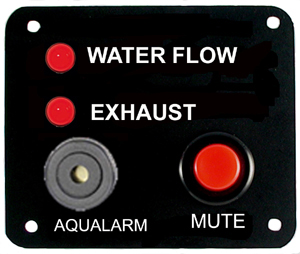
Here is a "belt AND suspenders" approach....BOTH exhaust temp alarm AND raw water FLOW alarm
20358rg.jpg


From the same website you referenced in your post above, they sell raw water flow detectors...this could also be useful for the genset.

Are any Tugnuts using either of these types of monitors?

Fair winds and cool exhausts,

dave
 
I have the Borel exhaust alarm system. A partially plugged raw water intake caused it to go off once, before the Yanmar showed any unusual sign of overheating. Sensor will reset after cooling down, but can take awhile. In my opinion, a good investment.
 
Update:
One hour and fifteen minutes to change the impeller. It did appear to have some creases on each vane. I am not sure if they were due to the regular curvature of the vanes or the overheat. In any event peace of mind is worth a lot. Thanks again for the opinions. And it seems like John Gray may have been okay with his opinion. It looks like at low RPM these impellers can take a little abuse.
And by the way, I recommend putting a little anti-seize on the bolts when reinstalling. It makes it nice for removal on the next go round.

Mike Rizzo
 
Back
Top