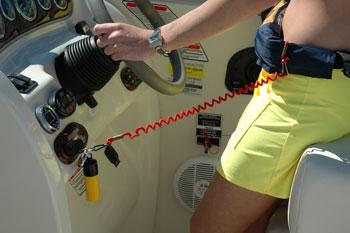
kill switch

ngleadow

Well-known member
Joined
Dec 8, 2010
Messages
82
Fluid Motion Model
C-24 C
Vessel Name
Blue Socks (sold)
I understand why a kill switch is needed on an open boat , for if the operator goes overboard then the engine shuts off... assuming the operator has the lanyard attached; but I am not sure why we have the same thing on the Ranger Tugs. I never have the lanyard attached to me when we are operating Blue Socks, and I can't imagine a situation where I would go overboard while at the same time having a lanyard long enough to allow me to get out the door and over the side! Is there a law requiring this thing? Can I disconnect the switch.. or, that is, have it always on. Yes I know it only takes a moment to put the plastic key thing over it so that the engine can start, but I have wondered what I would do it it broke. So I want to remove it.. any problems doing so?

Norm on Blue Socks (at Quayside Marina in Vancouver)
 
No such thing on my 2009 R25??
 
I keep mine in all the time and let the key hang from it when I am not motoring. I am not sure if it is required by law. However under extreme circumstances I could see it being useful when operating alone. You may not fall overboard, but you could pass out or be thrown from you seat in rough seas and get knocked out. Like I said, highly unlikely, but it could happen. In any event, if you keep it in all the time I doubt it will malfunction. If it does you can jump the two leads and make a permanent connection and bypass the switch. Being a pilot, I would put a label above it saying inoperative. You may forget to tell a subsequent owner that it no longer works and they will have a false sense of security.
 
I too have often wondered about the utility do a short kill switch cord on a larger boat. Turns out, many others have as well. Mothers are all kinds of electronic kill switches out there if you want to replace it. The industry adapted to a hodge podge of state and federal regulations that emerged in the 80's over PWC (where these are essential) and bass boat operators who tended to fall overboard and get chewed up by their props. They just put them in all small boats (that's us) as far as I can tell to avoid future litigation.

Even though this is UK based, it is a good summary of the history.

http://www.propellersafety.com/3913/reg ... h-history/

I'd just leave it as is (I do) and try to always put it in neutral when going forward while single handing.

Happy Memorial Day and safe boating.
 
Ditto Captain Steve. Kill switch?
 
Hey Captain Steve,
You do have a kill switch! On a 2009 R25 it's that red dongle on the helical (I love that word) key chain next to the ignition key. You can see it near the thruster controls in the photo below. You are supposed to attach the lanyard to your body (I advise anywhere except clipping it to your nipple) so that if you move a couple feet away from the helm it pulls the plastic doohickey out of its receptacle (I love those words, too) and kills the engine.
R25-7.jpg


This makes good sense when sitting in your dinghy with the lanyard attached to you and your 2 hp Honda. If you fall out of the dinghy it kills the engine. It also makes sense on an open cockpit boat when single handling to prevent death circling, like here:
kill-switch-lanyard.jpg


The puzzlement is why do this on a larger boat, as none of hardly would ever use the thing. I, like Mike, have used the lanyard in bad seas while alone for fear of being knocked out by flying stuff or whatever, but that was maybe once. I expected to find a government regulation requiring a kill switch, no matter how ridiculous it is in this application, but lo and behold there is none except, I think, in Alabama. There is a clear gradual move towards kill switches on smaller boats–I found a history of the subject through 07/14: http://www.propellersafety.com/3913/regulations/kill-switch-history/

Now, could it be that Ranger puts it there to prevent being sued by idiots? Like that lady who bought a Winnebago, put it on "auto pilot" at 60 mph and went to the kitchen to make a sandwich? She won her case (jury trial) and got a new motor home and Winnebago had to specify in its manual for future vehicles that cruise control is not an actual auto pilot. Maybe the presence of the kill switch is the first hint of a conspiracy by Ranger to take pre-emptive steps against us Tugnutters filing suits for things like failure to dock correctly, or whatever? I love conspiracy theories almost as much as funny sounding words.

I really do need to get a life. Maybe once Alto is back in the water...
 
My ignition switch is not like that. It is round and no other parts for the kill switch.
 
Interesting - our Cutwater with the Volvo just has the ekectronic "chip" that you have to have with you on board for the starter to work - certainly no help if you go overboard or pass out!
 
Hello,
Thought I would offer some advise on the lanyard kill switches. My experience has been that they wear (they're plastic) and can become the source for starting failures.... I've never liked them! Replace the lanyard regularly, and if you ever have a problem starting, consider the switch suspect first.
 
I was just on a 2010 R25 with a Yanmar engine. The ignition switch contained the kill switch parts. I wonder if when the Cummins engine was used the ignition switch did not have a kill switch?
 
We have a 2009 25 with a Cummins and do not have a kill switch.
 
Back
Top