
You are using an out of date browser. It may not display this or other websites correctly.
You should upgrade or use an alternative browser.
You should upgrade or use an alternative browser.
Question for any who tow a trailered classic R27:
- Thread starter Poppa Ron
- Start date
Trisailor
Well-known member
- Joined
- Jul 8, 2017
- Messages
- 153
- Fluid Motion Model
- R-27 Classic
- Hull Identification Number
- FMLT2720H011
- Vessel Name
- Fancy Nancy (2011 R27)
2011 R27 with Yanmar 4BY2-180. I lighten the load as much as possible. 1/2 or less fuel tank and 1/2 water tank. Empty black tank. The two solar panels on the boat roof maintain the house batteries so the fridge stays cold. Lower the mast/radar, I even add a small lashing to the mast between the handrails for side to side motion. Remove the bimini and secure the frame. Carry a 6 ft ladder on the swim step for access to the boat when stopped. If the truck stop or rest area is comfortable, I'll overnight on the boat. There are several favorites along the I-10 corridor. I put an insulation (bubble wrap) blanket over the windshield; under the canvas cover as protection from rocks. To secure the boat to the trailer, two 3 inch ratchet straps (Husky brand) are used; one across the stern over the cleats and one over the bow (over the anchor). So far, I have about 5k miles on the boat trailer (triple axle) towing with a 3/4 ton diesel truck from Ca to Mississippi, Virginia back to Miss, the home to Ca. I did a 1/4 of the loop. I have since upgraded the brake system on the trailer from surge brakes to electric over hydraulic so I can use the trailer brake controller in the truck, gives a bit more piece of mind when backing down a ramp. Next project is to wire the boat trailering lights into the trailer light wiring. Maybe add a camera system to the stern of the boat to see behind the trailer. It's also a good idea to clean the bilge and bottom of the boat so the watchdogs for invasive species don't get excited. Along I 10 there are no marine inspection stations, but I have seen several on different ( non boat) trips up in Northwest states.

scross
Well-known member
- Joined
- Jan 30, 2015
- Messages
- 2,170
- Fluid Motion Model
- C-28
- Hull Identification Number
- FMLC2831A717
- Vessel Name
- R-25 Classic - Sold
- MMSI Number
- 367719470
What Brian said with a few more tips.
1. Strap the stern of the boat to the trailer. We have used either strapped the aft side cleats to the trailer frame
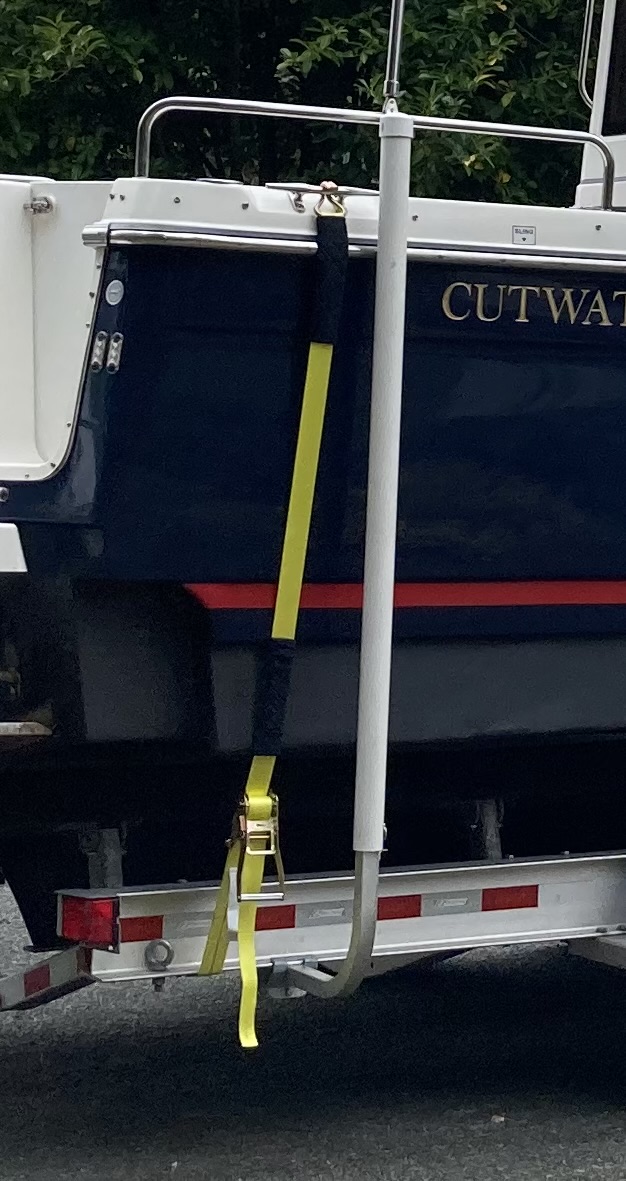 or we the use one long strap going side to side to the trailer frame. I use cut out wash mits to protect the boat gel coat from any strap rub.
2. Secure everything inside the cockpit and cabin. You won’t believe how much the contents can get thrown around on rough roads.
3. Obvious but make sure all vents and side windows are closed and locked.
4. Lock refrigerator closed.
5. At every stop measure tire and bearing temps on the trailer. Do a walk around the trailer to be sure everything is ok.
6. The boats are built with running lights on the stern. Plug your trailer’s flat-4 plug into the boats flat-4 connector. Usually the boats plug is in the anchor locker and the trailer plug is at the top of the hand winch tower. Recommend this even if not planning to tow at night.
Safe travels.
1. Strap the stern of the boat to the trailer. We have used either strapped the aft side cleats to the trailer frame
2. Secure everything inside the cockpit and cabin. You won’t believe how much the contents can get thrown around on rough roads.
3. Obvious but make sure all vents and side windows are closed and locked.
4. Lock refrigerator closed.
5. At every stop measure tire and bearing temps on the trailer. Do a walk around the trailer to be sure everything is ok.
6. The boats are built with running lights on the stern. Plug your trailer’s flat-4 plug into the boats flat-4 connector. Usually the boats plug is in the anchor locker and the trailer plug is at the top of the hand winch tower. Recommend this even if not planning to tow at night.
Safe travels.
Poppa Ron
New member
- Joined
- Sep 8, 2026
- Messages
- 3
- Fluid Motion Model
- R-27 Classic
- Hull Identification Number
- US-FMLT2712H
- Vessel Name
- OSPREY
2011 R27 with Yanmar 4BY2-180. I lighten the load as much as possible. 1/2 or less fuel tank and 1/2 water tank. Empty black tank. The two solar panels on the boat roof maintain the house batteries so the fridge stays cold. Lower the mast/radar, I even add a small lashing to the mast between the handrails for side to side motion. Remove the bimini and secure the frame. Carry a 6 ft ladder on the swim step for access to the boat when stopped. If the truck stop or rest area is comfortable, I'll overnight on the boat. There are several favorites along the I-10 corridor. I put an insulation (bubble wrap) blanket over the windshield; under the canvas cover as protection from rocks. To secure the boat to the trailer, two 3 inch ratchet straps (Husky brand) are used; one across the stern over the cleats and one over the bow (over the anchor). So far, I have about 5k miles on the boat trailer (triple axle) towing with a 3/4 ton diesel truck from Ca to Mississippi, Virginia back to Miss, the home to Ca. I did a 1/4 of the loop. I have since upgraded the brake system on the trailer from surge brakes to electric over hydraulic so I can use the trailer brake controller in the truck, gives a bit more piece of mind when backing down a ramp. Next project is to wire the boat trailering lights into the trailer light wiring. Maybe add a camera system to the stern of the boat to see behind the trailer. It's also a good idea to clean the bilge and bottom of the boat so the watchdogs for invasive species don't get excited. Along I 10 there are no marine inspection stations, but I have seen several on different ( non boat) trips up in Northwest states.
I am continually amazed at how many ex-sailors there are on this forum, thanks guys, good tips all.What Brian said with a few more tips.
1. Strap the stern of the boat to the trailer. We have used either strapped the aft side cleats to the trailer frame View attachment 28175or we the use one long strap going side to side to the trailer frame. I use cut out wash mits to protect the boat gel coat from any strap rub.
2. Secure everything inside the cockpit and cabin. You won’t believe how much the contents can get thrown around on rough roads.
3. Obvious but make sure all vents and side windows are closed and locked.
4. Lock refrigerator closed.
5. At every stop measure tire and bearing temps on the trailer. Do a walk around the trailer to be sure everything is ok.
6. The boats are built with running lights on the stern. Plug your trailer’s flat-4 plug into the boats flat-4 connector. Usually the boats plug is in the anchor locker and the trailer plug is at the top of the hand winch tower. Recommend this even if not planning to tow at night.
Safe travels.
-
Tugnuts.com is the community hub for Ranger Tug, Cutwater, and Solara owners. Since its inception in 2008, the Tugnuts forum has grown into an active and thriving community of more than 9,000 members. It serves as both a meeting place for the best boating community online, and an invaluable archive of information.
- User menu