super low battery voltage

briandunnington

Well-known member
Joined
Sep 14, 2020
Messages
139
Fluid Motion Model
C-242 C
Vessel Name
Salty Lass
we spent the night on the boat the other day and noticed something strange. at the end of the day, the solar panels had topped off the battery and the Victron battery monitor was showing 100% state of charge and a voltage of around 12.8. we had the fridge on, and ran some lights/etc throughout the evening.

in the morning when we woke up (well before the sun was up - no solar panel input), i could hear the fridge and bilge pumps still running, and the lights and radio/etc all worked as normal. however, when i checked the battery monitor, it now said we were at 92% SOC, but only 9.9 volts! I didnt think a 12v battery would even operate at 9.9 volts for an extended time. but other than the battery monitor telling us it was low, there was no other sign that the batteries were actually low - everything running off of them continued to work fine.

i double checked that the parallel switch was not engaged (and starter battery was still showing at 12.8v). i did turn on the Garmin and it warned of low voltage as well.

has anyone seen this before? is the battery monitor faulty? can 12v batteries still power a boat full of electronics at 9.9v? (these are the original batteries from 2018 so I planned to replace them this fall anyway, but want to make sure i dont have a different electrical problem as well).
 
Yes, 12V appliances can run on 10V. I had a very similar situation (in 2021) when I got my 2018 boat, everything looked fine when I went to bed for my first night on the hook, but I woke up, and the battery bank had collapsed

Some 12V appliances will be more picky, and won't function, but the ones that do will draw more amps to get the same wattage to do the work they need to do. When my battery bank collapsed, my fresh water pump kept popping the breaker because of the increased amp draw. This is hard on electronics, so while it may work, it isn't good.
 
I had a similar experience on my 2021 R29, though not that drastic. Fully charged and sunny day and by mid-next day with relatively light use voltage dropped below the inverter shut off at 11.1 volts. Battery monitor showed 72%. Other posts have pointed to batteries at end of life, but Mine are pretty new (and not abused) for that. I'll probably bite the bullet and replace them.
 
There are numerous posts on the forum about the quality of the stock batteries.

In addition, my R31 house bank was not wired correctly (e.g. 2 batteries connected in parallel incorrectly. The battery closest to the appliance will wear out faster. - https://batteryguy.com/kb/knowledge-bas ... batteries/). In the case of the R31, there are 4 house bank batteries, so the problem is amplified as more are chained in parallel incorrctly.

When you are replacing your batteries, make sure you wire them so they are charged/discharged in a balanced way
 
My first thought is the battery monitor is not wired properly. The shunt must be wired first off the battery negative. All negative 12v users - must be wired to shunt terminal opposite the shunt terminal that is connected to the battery terminal . Nothing else can be connected to this negative battery terminal for the battery monitor to read correctly. If any 12 volt users are connected to the battery ground the monitor will not calibrate that usage. So 92% SOC and a dead battery would either indicate a bad battery or improperly wired monitor shunt.
 
Curious because I have had some issues with my 2017 29CB, the previous owner did not use the boat much and it feels like the batteries are not anywhere near peak capacity. What are other owners replacing their stock batteries with? Also would like to get a better battery monitor that can track the historic usage and connect to my smartphone.
 
SOC and battery voltage not agreeing is a typical bad battery symptom. For most battery monitors the SOC(%) is determined by charge in/out of the battery via the shunt and does not use the battery voltage as a factor.) If the voltage does not agree with the SOC then either it is wired incorrectly at the shunt (as Brian states) or there is a bad batt+ (12 V) connection. If the battery monitor worked correctly previously and the voltage on the multimeter and battery monitor agree then incorrect wiring is unlikely and more likely a poor connection has developed or the battery needs to be replaced.

Check the following:

1) Poor battery+ (12v) sense connection: Check your battery monitor voltage connection. Your battery monitor may have a poor connection to the 12v battery sense. To test, use a multimeter with the probes directly on the battery terminals. If the reading is not close to the battery monitor reading (perhaps 12.6 or above for 92% State Of Charge (SOC)) then I would suspect a poor connection of the Battery 12V sense connection. Trace the Batt+ (12v) wire from your battery monitor to the battery positive (or the battery positive buss). It should run through a fuse which may also be the issue. Probe the voltage along the run to determIne where the poor connection is.

2) Bad Battery: If the battery reads low with a multimeter at the battery terminals as well as at the battery monitor display yet SOC on the battery monitor display reads good then the battery likely needs to be replaced. . A way to test is to run a high current item like the toilet or the microwave. If you see slow operation (just listen) of the toilet or a significant drop in voltage when running the microwave or cabin lights that dim or flicker, then the battery likely needs to be replaced. If everything works as usual then go back to suspect number one for further troubleshooting.

I hope this helps,

Curt
 
Thanks everyone. The battery monitor has always worked reliably in the past, but it was good to double check the wiring just in case.

But as suspected, the batteries really are toast. During the day (at least right now during summer), the solar panel provides enough power to keep the batteries topped off. Overnight, the voltage drops quickly down below 10v, but the fridge and bilge pumps seem to be able to keep running at that voltage (whether it is good for them or not is another story).

So, couple of new batteries are on the way and I have a fun new boat maintenance task for the next week.
 
I have a 30C 2021. Same issues of not keeping up with demand. I have been monitoring the solar output during our trip to Desolation Sound. The most it outputs is 5 amps at 20 volts. (100 wats) The panel is 150watt. I talked to the manufacturer tech support. The converter that is installed with the panel is only 70% efficient. Coupled with that, the amount of time the panel had full sun without any shade on it during the trip is minimal. (We have a command bridge, so the seat casts a shadow on part of the panel at least 80% of the time.) This coincides with the readings I usually got of 3-4amos on the sunny middle of the day and more like 2amps morning and afternoon. So I don't expect to get much help from the stock solar panel.

I brought a Honda generator with us as a backup so that I could start the motor if needed in a remote cove. Good thing I did since the first morning we had dead battery.

I found that if we turned everything off in the boat including the inverter and only ran the 2 refrigerators, and I paralleled the battery banks. Then in the morning the banks would be at 10v. And I would fire up the Honda to get us recharged enough to start the engine. Run for 2+ hours to the next destination and start over again.

I'm told by another C30 2021 that he changed the house batteries and his problems went away.
 
The solar install on command bridge cutwaters looks to me to be useless. Almost permanent shadow from the radar supports.

A few thoughts

Stock sunsaver duo solar controller is average at best and doesn’t charge the batteries properly (if that’s the model installed)
A 150w panel is already on the limit of keeping up with a 2 fridge boat with all the other power draws onboard
The standard panel is not a split cell and effected by shadow more than a split cell.
The stock batteries are agm and need a high voltage in absorption phase for a long time to be actually 100% Soc. Your battery monitor may be telling fibs.

In addition to the batteries possibly being toast. I’d also check there aren’t any high loads on the battery’s that could be pulling down the volts even if the battery monitor staying that soc is high.
Best path is to load test the battery off the boat.
 
briandunnington":ove35qdz said:
So, couple of new batteries are on the way and I have a fun new boat maintenance task for the next week.

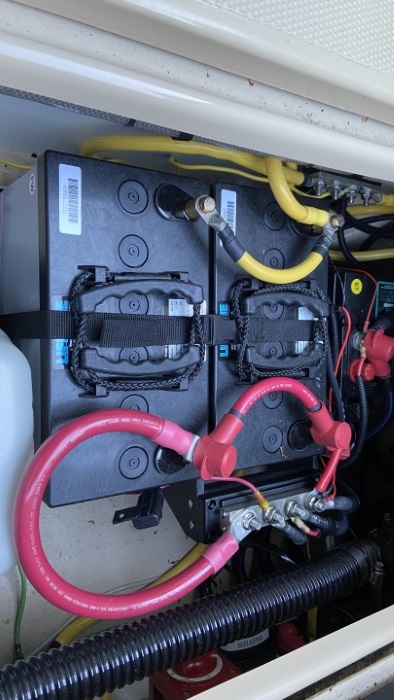
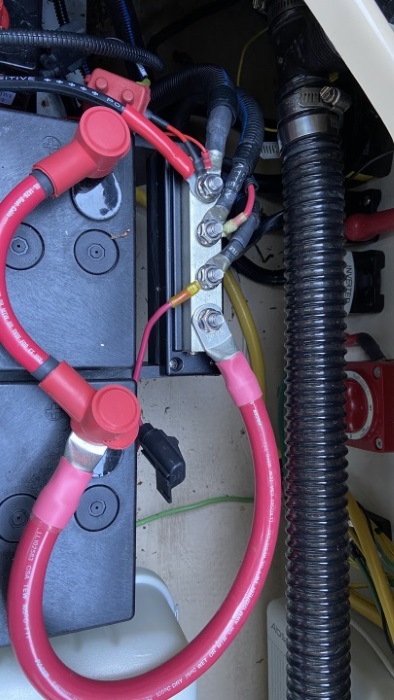
Installed two new Lifeline Group 27 batteries (100 amp hours each). Also took the opportunity to clean up my battery terminal wiring and move everything to a bus bar. I made a mount from some starboard and it turned out pretty nice. Also made sure the batteries were wired 'opposite' to hopefully keep the load evenly spread across them both.

newbatteries1.jpg


newbatteries2.jpg


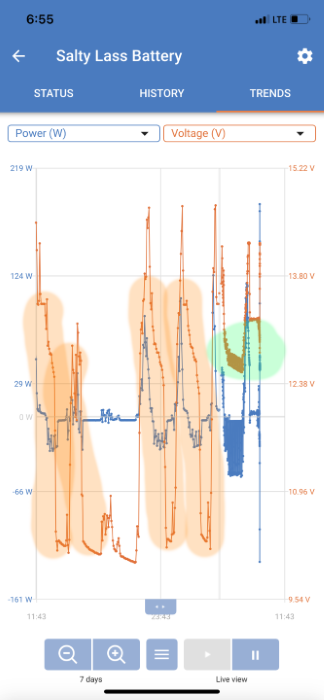
With the old batteries, the voltage would drop off a cliff each night down to below 10v, and then the solar panel would charge them back up the next day. With the new batteries, there is a nice flat line and voltage stays up above 12.4v all of the time.

lowvoltage.png
 
You need to install a fuse between the positive post on your battery and the bus bar. The easiest is a Blue Sea battery terminal fuse block for MRBF fuses (Blue Sea part # 5191) since you can install it without changing the wires. The ABYC guidelines require a battery bank fuse within 7" of the batteries for house banks. The fuse holder and a couple of fuses will cost you $70-$80. Size the fuse for your biggest load (likely the microwave). I would probably go with a 200 amp fuse which would protect your wiring and not be at risk of nuisance blows. The install will take less than 5 minutes.
 
Todd_D":18uottal said:
You need to install a fuse between the positive post on your battery and the bus bar. The easiest is a Blue Sea battery terminal fuse block for MRBF fuses (Blue Sea part # 5191) since you can install it without changing the wires. The ABYC guidelines require a battery bank fuse within 7" of the batteries for house banks. The fuse holder and a couple of fuses will cost you $70-$80. Size the fuse for your biggest load (likely the microwave). I would probably go with a 200 amp fuse which would protect your wiring and not be at risk of nuisance blows. The install will take less than 5 minutes.

Thanks Todd - I knew an eagled-eyed Tugnutter would call this out. I have an ANL fuse & fuse block and was waiting on the additional battery cable to install it (boat is just sitting in my driveway at the moment waiting to go back in the water). I didnt know about the terminal mount style fuses though and I kind of like that approach (one less thing to mount/wire to route). Thanks for the tip!
 
Todd_D":3htefynu said:
You need to install a fuse between the positive post on your battery and the bus bar. The easiest is a Blue Sea battery terminal fuse block for MRBF fuses (Blue Sea part # 5191) since you can install it without changing the wires.

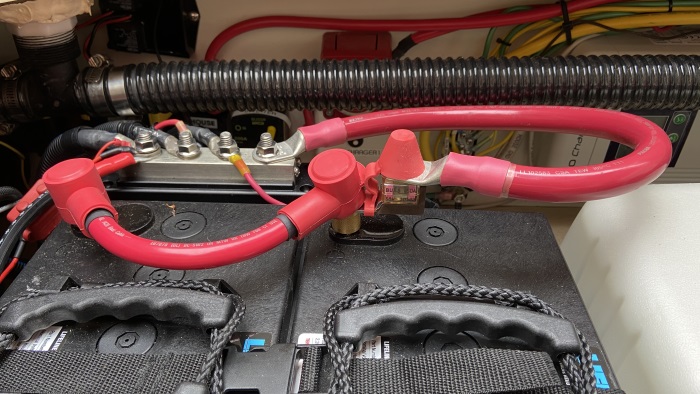
I forgot to reply here, but lest anyone think we are boating around freewheelin' and fuse-less, I followed @Todd_D's advice and used the MRBF battery terminal fuse block - no additional battery cable required.

newbatteries3.jpg


I didnt know this part existed, so thanks again Tugnuts for the info.
 
Good to see the Overcurrent protection on the battery cable -
But your bus bar also needs to have a cover of some sort to prevent accidental shorting (i.e. a dropped wrench or similar)

ABYC E-11 spec:
11.5.2.8 Continuously energized parts, such as positive battery terminals and both ends of all wires connected thereto, shall be physically protected to prevent accidental short circuits. Protection shall cover all energized surfaces (e.g., boots)
 
I don't trust voltage gauges cause there is stuff that is always running. I only trust the readings I get off the Batteries with my multimeter.

Bill
 
Back
Top