Heating water in the RT27OB

Tippetknot

Well-known member
Joined
Aug 6, 2020
Messages
99
Fluid Motion Model
C-24 C
Non-Fluid Motion Model
Trophy 2102
Vessel Name
Margaret Anna
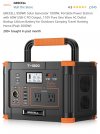
I picked up a Grecell power pack on Amazon for $450 on sale. Regularly about $700. I plug it into the shore power receptacle and run the water heater for about 40 minutes. Then, I charge the Grecell while I am cruising either with the motor alternator or with solar. Charges at about 150 watts. Takes several hours to recharge but that’s ok. No more strain on the house bank of AGMs + inverter to heat water. I like it.
IMG_5037.jpeg
IMG_5038.jpeg
 

Attachments

  • IMG_5037.jpeg
    IMG_5037.jpeg
    317.3 KB · Views: 34
Great upgrade, I love having hot water while on the hook.

Just a note to be careful using these without making adjustments to your inverter/charger, as the T-1000 can only supply 1000W (2000W peak). I'm not sure what charger/inverter your boat has but I suspect it has much higher capacity - which is why you're converting from a 15amp plug to a 30amp one with your pigtail. Hot water tank uses 850W (7.1 amps @ 120V as shown in my album below), you'll only have 150W for anything else being used before you start to put a strain on the T-1000.

The R31 is a bit different, the hot water tank is wired to only run off shore power, not the inverter. I added a transfer switch to allow the inverter to be used as an override. When I'm on the hook and solar has charged my house bank enough I dump any extra to the hot water tank.

Photos of the Victron transfer switch added to achieve this feature

https://www.icloud.com/sharedalbum/#B145FrPQ6moCdi
 
Hey Phil,

Looks great! When you do that, are you turning on the water heater with "shore power" on and not the inverter? Also, how long does it take for the water heater to go produce hot water? Any idea how many watts that takes? Thanks!

- tom
 
Hey Phil,

Looks great! When you do that, are you turning on the water heater with "shore power" on and not the inverter? Also, how long does it take for the water heater to go produce hot water? Any idea how many watts that takes? Thanks!

- tom
Tom,
Correct. I turn on the shore power breaker and the water heater breakers ONLY. The inverter is off. The battery charger is off. The 12 volt stuff is all still on, of course, as usual. It takes about 30-40 minutes to heat up the water, so 400-550 watt-hours or so. The capacty of the power pack is about 1,000 watt-hours.
 
Great upgrade, I love having hot water while on the hook.

Just a note to be careful using these without making adjustments to your inverter/charger, as the T-1000 can only supply 1000W (2000W peak). I'm not sure what charger/inverter your boat has but I suspect it has much higher capacity - which is why you're converting from a 15amp plug to a 30amp one with your pigtail. Hot water tank uses 850W (7.1 amps @ 120V as shown in my album below), you'll only have 150W for anything else being used before you start to put a strain on the T-1000.

The R31 is a bit different, the hot water tank is wired to only run off shore power, not the inverter. I added a transfer switch to allow the inverter to be used as an override. When I'm on the hook and solar has charged my house bank enough I dump any extra to the hot water tank.

Photos of the Victron transfer switch added to achieve this feature

https://www.icloud.com/sharedalbum/#B145FrPQ6moCdi
Watson, The inverter and charger are off when I’m heating water.
 
Watson, The inverter and charger are off when I’m heating water.
Sounds good. On the R31 you can't turn off the charger (without turning off all shore power) so that's where my concern was coming from.
 
Sounds good. On the R31 you can't turn off the charger (without turning off all shore power) so that's where my concern was coming from.
Ah, I see what you’re saying. That seems like an unwise wiring choice, but maybe there’s a good reason.
 
I picked up a Grecell power pack on Amazon for $450 on sale. Regularly about $700. I plug it into the shore power receptacle and run the water heater for about 40 minutes. Then, I charge the Grecell while I am cruising either with the motor alternator or with solar. Charges at about 150 watts. Takes several hours to recharge but that’s ok. No more strain on the house bank of AGMs + inverter to heat water. I like it.

For others reading this, this is an excellent solution posted by Tipperknot.

I put a temp probe on the water heater and have measured how long it takes to heat up and how long it takes to cool down. I run our water heater since I converted my boat to LFP. Hot water was a primary reason that I converted to LFP. I have 320 amp-hours of LFP for my house bank (about 3800 watt-hours).

It's a 6.5 gallon hot water tank. It will take exactly 120 minutes to go from 45 degree water to 167 degrees.
The thermostat is fixed (not adjustable). The Isotherm water heater has a mixer valve used to mix cold with hot water so it's not scalding at the tap. Most water heaters in houses are set 120-140 degrees. Why 167 degrees? It's a way to make it "feel" like there's 10 gallons of hot water in a 6.5 gallon tank.

To heat 6.5 gallons of water from 45 to 167 degrees is about 135 amp-hours (at 12 volt DC) (about 1600 watt-hours). The hot water will cool over the next 18 hours.
When we want hot water I turn on the hot water breaker and set a countdown timer on my phone for 45 minutes. Running the water heater for 45 minutes will consume about 50 amp-hours (about 600 watt-hours). This creates plenty of hot water for us to take 3 showers and have left-over hot water for dishes. (We often have 3 adults on board who need to shower).

Note: I was on a submarine for many years. We take sub showers on board. Get in, turn the water on, get wet. Turn the water off. Apply soap. Turn the water back on and rinse, done.
 
I was dreading a rewire and lithium install on my C288 with the same issue. This seams like a much simpler solution so I ordered one. Thanks - Tony
 
I hope that this doesn’t sound like to stupid of a question. I’m in the process of buying a Ranger Tug 31FT. Sedan. So I have very little understanding of how the systems on these Boats work. Is it possible to run the generator to have hot water when you’re laying on the anchor hook?
 
I was dreading a rewire and lithium install on my C288 with the same issue. This seams like a much simpler solution so I ordered one. Thanks - Tony
You’re welcome Tony. One of the main reasons I did not switch completely over to lithium is that there are insurance issues to consider. I’ve heard that you will not be able to insure your boat if you make a DIY change like this. Submariner did it, but he went through a expensive process so that his boat can be insured with the lithium conversion. You should check with him if you’re seriously considering making this change at some point in the future.
 
You’re welcome Tony. One of the main reasons I did not switch completely over to lithium is that there are insurance issues to consider. I’ve heard that you will not be able to insure your boat if you make a DIY change like this. Submariner did it, but he went through a expensive process so that his boat can be insured with the lithium conversion. You should check with him if you’re seriously considering making this change at some point in the future.

I converted to LFP primarily for hot water, plus we are power hogs on the boat.

Regarding insurance.. they want to see the following:
Professional install of the batteries (LiFePo4) and a battery management system (BMS)
Known proven manufacturer of the batteries based in the USA. (Battle Born, Dakota, Lithionics...).
All cabling must be to ABYC standards.

ABYC E-13 standard added more requirements. (American Boat & Yacht Council).
A BMS is required (internal or external).
A Battery monitor is required with a physical gauge (not just bluetooth). A physical gauge is required as it can sound an audible alarm.
The LFP battery must be UL approved. (Underwriters Laboratory).
The LFP battery bank must be sub-divided into units such that the ampere interrupting capacity (AIC) of the overcurrent protection device is not exceeded.
AIC is a big deal with LFP as a MRBF or ANL style fuses are generally insufficient protection from LFP. (This is what a T-Class fuse is for).

The entire ABYC LFP (E-13) standard is about 10 pages.

I had to provide a detailed electrical schematic that Lithionics reviewed and approved before they would sell their battery to me. To activate the 7 year warranty, upon completion of install, there was a warranty form I had to fill out and attach photographs of the installation to prove all the above.

I also had my electrical design and implementation reviewed by a marine electrical company (Ocean Planet Energy). I paid them for this.

But enough of that technical requirement stuff.
I've had LiFePo4 (LFP) in my NorthWest Edition RT27-OB now for 2.5 years. I'm almost through my third boating season with this setup. I have not had any battery issues. I have 320amp-hours which gives me 256 usable amp-hours. (A NW edition comes with 99 amp-hours usable with AGM).

My deepest discharge (which was last weekend), was 254amp-hours consumed (21% SOC (state of charge)). Our average discharge is 158 amp-hours (50% SOC).
I can wake up at anchor (or at a dock without shore power), be down to 30% SOC, turn on the inverter, and make coffee with a 120volt electric coffee maker and pull 100 amps at 12 volt DC without issue.

Battery Monitor Statistics (2.5 years worth).

Running the water heater. (pulling 76 amps at 12 volt DC with the House bank at 38% SOC and 12.45 volts).
 
For others reading this, this is an excellent solution posted by Tipperknot.

I put a temp probe on the water heater and have measured how long it takes to heat up and how long it takes to cool down. I run our water heater since I converted my boat to LFP. Hot water was a primary reason that I converted to LFP. I have 320 amp-hours of LFP for my house bank (about 3800 watt-hours).

It's a 6.5 gallon hot water tank. It will take exactly 120 minutes to go from 45 degree water to 167 degrees.
The thermostat is fixed (not adjustable). The Isotherm water heater has a mixer valve used to mix cold with hot water so it's not scalding at the tap. Most water heaters in houses are set 120-140 degrees. Why 167 degrees? It's a way to make it "feel" like there's 10 gallons of hot water in a 6.5 gallon tank.

To heat 6.5 gallons of water from 45 to 167 degrees is about 135 amp-hours (at 12 volt DC) (about 1600 watt-hours). The hot water will cool over the next 18 hours.
When we want hot water I turn on the hot water breaker and set a countdown timer on my phone for 45 minutes. Running the water heater for 45 minutes will consume about 50 amp-hours (about 600 watt-hours). This creates plenty of hot water for us to take 3 showers and have left-over hot water for dishes. (We often have 3 adults on board who need to shower).

Note: I was on a submarine for many years. We take sub showers on board. Get in, turn the water on, get wet. Turn the water off. Apply soap. Turn the water back on and rinse, done.
Hi Martin; our R27 LE 2024 has a total of 560 amp hours of lithium battery storage I believe. If we leave the dock with batteries @ 100%, the hot water tank is cold, and activate the 3000 watt inverter to heat water, do you have any sense for the realistic alternator output of the Yamaha F300 in mitigating battery drainage? We'll assume the inverter would run for about an hour, consuming something like 100 amp-hours or so, without considering alternator output. Have you noted an increase in fuel consumption while the F300 alternator charges the battery bank? Excuse my ignorance if any part of this doesn't make sense, and thanks for your thoughts. RTS14 (Toby Sutcliffe-'Baguette').
 
Hi Martin; our R27 LE 2024 has a total of 560 amp hours of lithium battery storage I believe. If we leave the dock with batteries @ 100%, the hot water tank is cold, and activate the 3000 watt inverter to heat water, do you have any sense for the realistic alternator output of the Yamaha F300 in mitigating battery drainage? We'll assume the inverter would run for about an hour, consuming something like 100 amp-hours or so, without considering alternator output. Have you noted an increase in fuel consumption while the F300 alternator charges the battery bank? Excuse my ignorance if any part of this doesn't make sense, and thanks for your thoughts. RTS14 (Toby Sutcliffe-'Baguette').

The Yamaha 300 has a 70 amp alternator. It'll output at most, 50 amps. The DC to DC charger will reduce that to 30 amps for house charging when underway. Then because you're under way, you have the chartplotter, radar, refrigerator, autopilot, all running... that's another 10-15 amps. That leaves about 15 amps of actual engine charging. I've measured this using the battery monitor on the boat.

Because the alternator on the Yamaha can't talk to anything to say "Hey, I'm working too hard and am overheating...", to prevent from burning up the alternator, the dc to dc charger should be 1/2 the size of the alternator, which is 30 amps.

Expect 15-20 amps of engine charging. The hot water heater will consume 65 amps at 12 volts. This will create a 50 amp deficit.
This is why I'm such an advocate for solar. I have 400 watts of solar which generally gives me 10-25 amps extra, for free.

I'm sure the alternator working hard would consume more fuel, but I don't notice it. But then again, most of the power we use in our house bank comes from solar, not engine charging when we're boating around Puget Sound and Canada. When we're out on our boat, my battery is usually between 30% and 80%, the engine is usually working to charge the house bank and rarely ever gets it to 100%. Sunshine is 10-14 hours a day, engine run time is often less than 3 hours a day. Solar can bring me back to 100%.

Regarding the hot water tank... It's best to leave the dock with it fully hot. But regardless, run the hot water heater for 45 minutes. I've found that makes enough hot water to take 3 adult showers and do dishes at a cost of only 50 amp-hours without wasting house battery power on water that's just going to cool off.
 
Last edited:
I know this is mildly off-topic, but my R-29 heats water as I cruise. (Any of the inboard models should.) I have HOT water for the first 24 hours or so on the hook. I have reasonably warm water for the next 24 hours. After 48 hours, depending on how much hot water I’ve used, the water cools down considerably. Since my current (factory) battery/solar set up only allows for two nights on the hook, this works out OK for me. I don’t usually stay anywhere more than two or three nights.

Navy showers are the way to go. Equivalent for washing dishes. It’s not only conserves hot water, but it conserves water. I seriously doubt I use more than 2 gallons of water for a shower.
 
I know this is mildly off-topic, but my R-29 heats water as I cruise. (Any of the inboard models should.) I have HOT water for the first 24 hours or so on the hook. I have reasonably warm water for the next 24 hours. After 48 hours, depending on how much hot water I’ve used, the water cools down considerably.

The RT29 comes with an 11 gallon hot water tank that's heated via engine coolant. The R27-OB comes with a 6.5 gallon water tank, installed in the cockpit, near the waterline and is only heated via 120volt AC (shorepower or the inverter). Being half the size, it cools off quicker. I've graphed it heating up and cooling down over time using a temperature probe and a Victron CerboGX. It's a trade-off of having a raw water cooled outboard vs. an inboard diesel with free hot water. If I remember correctly, the inboards are also not wired to allow the hot water heater to run off the inverter (engine heat or shorepower only).
 
The RT29 comes with an 11 gallon hot water tank that's heated via engine coolant. The R27-OB comes with a 6.5 gallon water tank, installed in the cockpit, near the waterline and is only heated via 120volt AC (shorepower or the inverter). Being half the size, it cools off quicker. I've graphed it heating up and cooling down over time using a temperature probe and a Victron CerboGX. It's a trade-off of having a raw water cooled outboard vs. an inboard diesel with free hot water. If I remember correctly, the inboards are also not wired to allow the hot water heater to run off the inverter (engine heat or shorepower only).
Why am I not surprised that you measured this? And 11 gallons would explain why that water lasts so long. I was under the impression I had a 6 or 8 gallon hot water tank; I still have not been able to get my hands on a 2019 manual.

Yes, it’s true. I can’t make hot water off the inverter. But I’m actually pretty happy about that because when I’m at anchor with my current set up I would not have enough battery power to run the water heater if I wanted more than two or three nights on the hook. And, as I’ve said elsewhere, I usually don’t spend more than two nights at any one place.

(A side note here: some friends of mine in an older R-31 did the entire Great Loop without any hot water on board. The system wasn’t functioning properly and, for some reason, they decided not to fix it. They did Marinas just about every night, but still!)
 
The Yamaha 300 has a 70 amp alternator. It'll output at most, 50 amps. The DC to DC charger will reduce that to 30 amps for house charging when underway. Then because you're under way, you have the chartplotter, radar, refrigerator, autopilot, all running... that's another 10-15 amps. That leaves about 15 amps of actual engine charging. I've measured this using the battery monitor on the boat.

Because the alternator on the Yamaha can't talk to anything to say "Hey, I'm working too hard and am overheating...", to prevent from burning up the alternator, the dc to dc charger should be 1/2 the size of the alternator, which is 30 amps.

Expect 15-20 amps of engine charging. The hot water heater will consume 65 amps at 12 volts. This will create a 50 amp deficit.
This is why I'm such an advocate for solar. I have 400 watts of solar which generally gives me 10-25 amps extra, for free.

I'm sure the alternator working hard would consume more fuel, but I don't notice it. But then again, most of the power we use in our house bank comes from solar, not engine charging when we're boating around Puget Sound and Canada. When we're out on our boat, my battery is usually between 30% and 80%, the engine is usually working to charge the house bank and rarely ever gets it to 100%. Sunshine is 10-14 hours a day, engine run time is often less than 3 hours a day. Solar can bring me back to 100%.

Regarding the hot water tank... It's best to leave the dock with it fully hot. But regardless, run the hot water heater for 45 minutes. I've found that makes enough hot water to take 3 adult showers and do dishes at a cost of only 50 amp-hours without wasting house battery power on water that's just going to cool off.
Thanks very much Martin-this confirmed my suspicion that the F300 charging output is pretty minor when underway, with all of the other usual DC loads. I came to the same conclusion about leaving the dock with water hot, and keep the hot water tank setting at the highest temp, making it feel as you said, more like a 10 gallon tank. We have only the standard 175 watt single solar panel, but since we carry a SUP and an inflatable kayak on the roof, another solar panel isn't really practical. Shore power every 2-3 nights seems like the easiest/simplest solution for we 'casual boaters'. Regarding our lithium house bank, I gather you feel that a relatively routine discharge down to 20% SOC doesn't significantly affect battery lifespan-is that correct, or are you reserving that level of discharge for relatively rare situations? I appreciate your thorough analysis!
 
Regarding our lithium house bank, I gather you feel that a relatively routine discharge down to 20% SOC doesn't significantly affect battery lifespan-is that correct, or are you reserving that level of discharge for relatively rare situations? I appreciate your thorough analysis!

The Lithionics manufacture of the 320ah battery I have states to keep it above 20%. It comes with a feature called "NeverDie BMS". At 10% SOC, the battery will shut off and isolate from the boat to protect itself. I can then push the on/off button on top of the battery to turn it back on and there's 32amp-hours (10%) left which I can use. Though they state I would need to charge the battery immediately to prevent damage resulting in reduced capacity. I've been down to 20-30% many times. I use 80% of the available capacity. (256 amp-hours usable).

What about keeping it fully charged all the time? Lithionics comes with a 7 year warranty. The internal BMS monitors its environment (how well I take care of it). Specifically, it measures how often it stays in a hot compartment (LFP doesn't like to operate in super hot environments, like a hot engine room). It also keeps track of how often the LFP battery spends at 100% on a battery charger (which also isn't good and will reduce capacity over time). Li3 uses these two metrics on a warranty claim to quantitatively reduce their responsibility.

They refer to these as Aging Factor Temp and Aging Factor SOC.

Li3 Stats on Channel Surfing

Internal BMS Stat's on Channel Surfing - Aging Temp and Aging SOC

Deep Discharges
 
Last edited:
Back
Top