12v DC over coax? (Peplink Antenna MAX install)

GunkHoling

Active member
Joined
Jan 6, 2024
Messages
25
Location
San Juan Islands
Fluid Motion Model
C-28
Non-Fluid Motion Model
J/70
Vessel Name
Gray Goose
Does anyone know an off-the-shelf solution to run 12v DC over an existing RG coax run? I plan to purchase the Peplink Antenna MAX to improve my onboard internet. It's an antenna and housing that I can mount my current Peplink BR1 Pro into. I'd remove the KHV dome and install the Antenna MAX in it place. Rather than run Ethernet or new DC supply through the boat and to the mast, I am thinking of just taping the 12v that is already fed to to the existing powered digital TV antenna.

The best solution I've found so far is some small PCB kits that should let me cleanly connect a 2-wire 12v lead to the coax that currently goes to the dome. Is there something I'm missing? Any reasons I should be concerned with such a solution? Given the current powered antenna already has a 12v supply I don't imagine I'm introducing any new sources of interference or other issues.
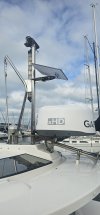
 
Does anyone know an off-the-shelf solution to run 12v DC over an existing RG coax run? I plan to purchase the Peplink Antenna MAX to improve my onboard internet. It's an antenna and housing that I can mount my current Peplink BR1 Pro into. I'd remove the KHV dome and install the Antenna MAX in it place. Rather than run Ethernet or new DC supply through the boat and to the mast, I am thinking of just taping the 12v that is already fed to to the existing powered digital TV antenna.

The best solution I've found so far is some small PCB kits that should let me cleanly connect a 2-wire 12v lead to the coax that currently goes to the dome. Is there something I'm missing? Any reasons I should be concerned with such a solution? Given the current powered antenna already has a 12v supply I don't imagine I'm introducing any new sources of interference or other issues.
I used the Coax wire for the TV antenna to run 24VDC out to our Starlink unit. It is working great. I ended up crimping waterproof butt connectors on as I was unable to solder to the shielding braid of the Coax. If you can find a connector that might work better, just remember it all needs to be waterproof.
 

Attachments

  • 1000010319.jpg
    1000010319.jpg
    837.2 KB · Views: 29
I bought the Antenna Max to upgrade my Mobility 42G antenna already installed.

To power my Peplink Max BR1 Pro 5g router, I picked up a 12 volt powered POE injector (802.3at, 35 watts) and a POE splitter with a Molex connector (for the router).
I'm going to run 2 ethernet cables to the mast. One for power to the router, the other for Starlink. Using ethernet cables into the Antenna Max dome will ensure it being waterproof. I've already converted my Starlink Gen2 dish to run off 12 volts as well.

I'm looking to eliminate the 2meters of antenna cables I have with the 42G antenna and thus, eliminate any attenuation from the excess cable length. I bought the Antenna Max months ago and have been collecting the rest of the parts required for the install. Now I'm just waiting for warmer weather and time to upgrade my boat.
 
I used the Coax wire for the TV antenna to run 24VDC out to our Starlink unit. It is working great. I ended up crimping waterproof butt connectors on as I was unable to solder to the shielding braid of the Coax. If you can find a connector that might work better, just remember it all needs to be waterproof.

Do you have an example of what type of connector you used? I'm assuming its still an F type connector to the antenna, but haven't opened up the KVH dome yet. The Peplink Antenna Max dome should be weather tight to help with any water intrusion inside the dome. I was going to solder up an F-type terminal to PCB that breaks out to normal wire leads and then just wrap it all up in conformal tape if necessary. The coax would enter the Antenna MAX dome via a weatherproof cable gland.

I mostly use 5G via my Google Fi SIM. I do have a Starlink Mini that I bring when necessary, but I just power that off 12v DC from the downrigger plugs and have the Peplink associate to its WiFi when active. I may run ethernet and do POE in the future, but don't have a need for it this season.
 
I would be worried about the amperage draw at 12V to run anything significant. It is a pretty small wire, and it's a long run.
 
I would be worried about the amperage draw at 12V to run anything significant. It is a pretty small wire, and it's a long run.

The POE injector takes 12volts and converts it to 56volts. The POE splitter at the other end, drops the voltage back down. The Ethernet cable ran should be 23 or 24awg, no smaller, to handle the wattage (which is also small, less than 20 watts needed by the router).
 
The POE injector takes 12volts and converts it to 56volts. The POE splitter at the other end, drops the voltage back down. The Ethernet cable ran should be 23 or 24awg, no smaller, to handle the wattage (which is also small, less than 20 watts needed by the router).
I was more referring to the 24V DC for StarLink, that seems like significantly more amperage, and a coax cable is a single pair. POE runs on 2 pairs, and as you called out is higher voltage.
 
I was more referring to the 24V DC for StarLink, that seems like significantly more amperage, and a coax cable is a single pair. POE runs on 2 pairs, and as you called out is higher voltage.

For converting Starlink to run off 12volts DC, I installed a 12 to 56 volt dc to dc converter. POE for Starlink runs across all 4 pairs of wires. It pulls upwards of 150 watts. Best to shut off the "heater" function, as then it'll operate with less than 50 watts. I usually see 35-50 watts of usage. I run the Gen2 dish, but this is also true for the Gen3 dish (the one with the kickstand). They are powered via POE. The Starlink mini has its own power cord, and doesn't run off POE.

The Gen2 and Gen3 Starlink dishs actually run off 56 volts. They'll operate off a 12 to 48 volt DC to DC converter as well. But Starlink really wants 50+ volts.

12 to 56 volt DC to DC converter with a Starlink POE Injector (that takes 56volts in, and puts the power across the wires).
 
Back
Top