Update: One Battery to Rule Them All

NorthernFocus

Well-known member
Joined
Jun 29, 2014
Messages
1,469
Location
Alaska
Website
www.northernfocusphotography.com
Fluid Motion Model
R-25 Classic
Hull Identification Number
FMLT25910808
Vessel Name
Divine Focus
Updated with performance report in post #7

I recently finished installing a LiFePO4 battery for my house bank. I elected to go with the IP67 rated Epoch DP12300H. The DP in the model number stands for dual purpose. The battery capable of 300A continuous draw and 1000A for 5s. This made it possible to eliminate the thruster bank and power the thrusters and windlass off of the house bank. It should also be capable of starting the engine so I installed a selector switch to allow using either the dedicated starter battery or the house bank. In spite of all I'd read about the complexities of converting to LiFePO4 the new system is actually simpler and removed a lot of weight back aft. Net cost was about $1700. Benefits are:
  • 2 battery banks simpler than 3
  • 2 ACRs and associated wiring eliminated(see attached pic)
  • 160lbs lighter and shifted weight forward(new 80lb battery located in the "cave")
  • 300Ah available for house load vs 100Ah previously(50percent of 2x100Ah flooded cells)
  • much faster recharging house bank when depleted(no solar)
  • phone app connects with the BMS(battery management system) to provide real time state of charge, net amp flow in/out, time remaining to full charge/discharge, etc.
  • aft lazarette now available for other use

The only added complexity of this configuration is the need to install a DC/DC charger between the lead acid start battery and the LiFePO4 house bank. Which is pretty straight forward.
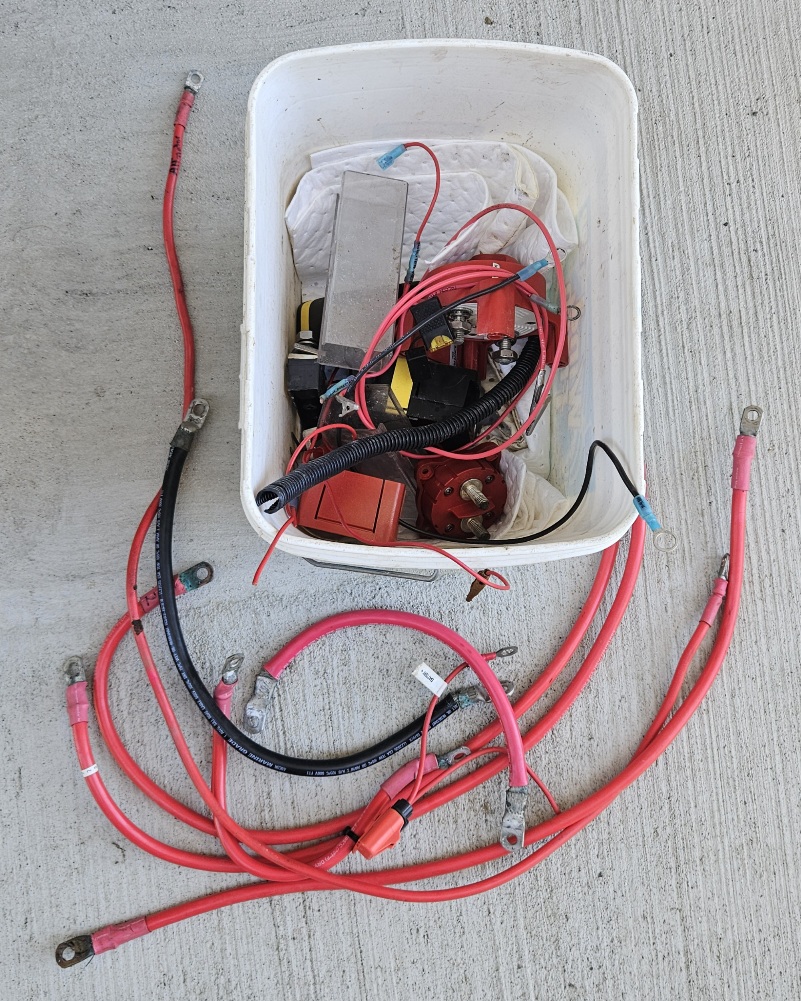
20260604_165707.jpg
 
Last edited:
did you install a alternator protector like the balmar to prevent damage to the alternator when the BMS shuts off? - or is this not needed anymore with these batteries?

if im understanding your setup

solar to house
alternator + shorepower charger to house
DC-DC to engine start?

what else?
are you using stock shorepower converter?
did you change the inverter?
 
did you install a alternator protector like the balmar to prevent damage to the alternator when the BMS shuts off? - or is this not needed anymore with these batteries?

if im understanding your setup

solar to house
alternator + shorepower charger to house
DC-DC to engine start?

what else?
are you using stock shorepower converter?
did you change the inverter?
No solar.

Alternator and shore power charger connect to starter bank lead acid battery.

DC/DC charger from starter battery to house bank.

No inverter.
 
ah. thanks for the details.
 
Very cool. Do you have a picture of how you installed the battery in the cave?
It's still just a temporary install. I'll fiddle around with it a bit. I set it as far inboard as possible. But it needs to move outboard. With all the weight gone out of the lazarrette we now have a starboard list. Plus it has a cooling plate on top and I wanted to monitor temps for a while to determine how much ventilation it needs. So far it looks like zero. With 50A max charge as I've got it set up heat appears to be a non issue.
 
Update: performance report

We just returned from our shakedown cruise with new battery system and new engine. Following observations:

  • house bank LiFePO4 used for both single thruster operation and main engine starting with no observable voltage drop(engine starts before voltage drop shows up on digital display)
  • 300ah battery comfortably provides enough capacity for 4+ days on the hook at our typical usage(no inverter/110v appliances)
  • net charge rate while under way with all electronics etc functioning is +- 40A; typical overnight usage(heater, fridge, laptop, anchor light) recharges in about an hour of run time
  • virtually zero temperature change noted in battery during charge/discharge
Essentially we're now running everything off of a single battery bank. The starter bank just sits there in backup mode. The one exception is that the ECM is wired directly to the starter bank. But that is somewhat moot as it only draws (measurable)power when the engine is running and the alternator is providing power.
 
Last edited:
Update: performance report

We just returned from our shakedown cruise with new battery system and new engine. Following observations:

  • house bank LiFePO4 used for both single thruster operation and main engine starting with no observable voltage drop(engine starts before voltage drop shows up on digital display)
  • 300ah battery comfortably provides enough capacity for 4+ days on the hook at our typical usage(no inverter/110v appliances)
  • net charge rate while under way with all electronics etc functioning is +- 40A; typical overnight usage(heater, fridge, laptop, anchor light) recharges in about an hour of run time
  • virtually zero temperature change noted in battery during charge/discharge
Essentially we're now running everything off of a single battery bank. The starter bank just sits there in backup mode. The one exception is that the ECM is wired directly to the starter bank. But that is somewhat moot as it only draws (measurable)power when the engine is running and the alternator is providing power.
I really like this idea. Eliminating the separate bow thruster battery seems like it simplifies the heck out of the system. I went on a trip this weekend and packed kind of heavy and saw a huge impact in fuel mileage, so I have weight reduction on my mind now. Also freeing up room in the lazarette is great too.
 
Updated with performance report in post #7

I recently finished installing a LiFePO4 battery for my house bank. I elected to go with the IP67 rated Epoch DP12300H. The DP in the model number stands for dual purpose. The battery capable of 300A continuous draw and 1000A for 5s. This made it possible to eliminate the thruster bank and power the thrusters and windlass off of the house bank. It should also be capable of starting the engine so I installed a selector switch to allow using either the dedicated starter battery or the house bank. In spite of all I'd read about the complexities of converting to LiFePO4 the new system is actually simpler and removed a lot of weight back aft. Net cost was about $1700. Benefits are:
  • 2 battery banks simpler than 3
  • 2 ACRs and associated wiring eliminated(see attached pic)
  • 160lbs lighter and shifted weight forward(new 80lb battery located in the "cave")
  • 300Ah available for house load vs 100Ah previously(50percent of 2x100Ah flooded cells)
  • much faster recharging house bank when depleted(no solar)
  • phone app connects with the BMS(battery management system) to provide real time state of charge, net amp flow in/out, time remaining to full charge/discharge, etc.
  • aft lazarette now available for other use

The only added complexity of this configuration is the need to install a DC/DC charger between the lead acid start battery and the LiFePO4 house bank. Which is pretty straight forward.

View attachment 27636
 
Hi Dan,

I’m intrigued by your LFP solution. One question I have is how did you deal with shore power charging of the LFP?

  • Did you change your shore power charger to a lithium profile and disconnect the starter battery? If so, are you only charging your start battery from the alternator?
  • Or is the DC-DC charger configured to charge based on house voltage? If so, how do you keep the charger from draining the start battery?

It seem like a very efficient solution if the issues above can be effectively managed.

Curt
 
Hi Dan,

I’m intrigued by your LFP solution. One question I have is how did you deal with shore power charging of the LFP?

  • Did you change your shore power charger to a lithium profile and disconnect the starter battery? If so, are you only charging your start battery from the alternator?
  • Or is the DC-DC charger configured to charge based on house voltage? If so, how do you keep the charger from draining the start battery?

It seem like a very efficient solution if the issues above can be effectively managed.

Curt
The DC/DC charger feeds from the lead acid starter battery to the LFP based on starter battery voltage so it doesn't get pulled down. In the Victron app you can set the turn on/off voltage. There is an instant threshold intended for when the engine/alternator starts and a lower threshold with a time delay.

My design for shore power may not fit your needs. We don't spend time tied up at a dock while on board. Shore power for me just keeps the batteries up while the boat is on the trailer. There is a small continuous house load due to the vent fan for composting toilet and a couple of parasitic electronics. Then occasionally when working on the boat or prepping for a trip we run the heater and fridge. So for my needs I just use a 6A charger that's connected to the start battery and let the DC/DC charger do its thing. Also when the LFP reaches full capacity it's own battery management system shuts it down from drawing additional charge current.

So the system is really quite simple. BTW with the battery that I've got when I operate the thruster I see zero voltage drop on house power.
 
The DC/DC charger feeds from the lead acid starter battery to the LFP based on starter battery voltage so it doesn't get pulled down. In the Victron app you can set the turn on/off voltage. There is an instant threshold intended for when the engine/alternator starts and a lower threshold with a time delay.

My design for shore power may not fit your needs. We don't spend time tied up at a dock while on board. Shore power for me just keeps the batteries up while the boat is on the trailer. There is a small continuous house load due to the vent fan for composting toilet and a couple of parasitic electronics. Then occasionally when working on the boat or prepping for a trip we run the heater and fridge. So for my needs I just use a 6A charger that's connected to the start battery and let the DC/DC charger do its thing. Also when the LFP reaches full capacity it's own battery management system shuts it down from drawing additional charge current.

So the system is really quite simple. BTW with the battery that I've got when I operate the thruster I see zero voltage drop on house power.
Sounds like a pretty good and simple system. I was aware the DC/DC chargers often have a voltage check on the supply battery to turn on but I was not aware they also have a turn off function based on input supply voltage that can be a operated in tandem with the alternator start/stop. Google AI failed me in that it said there was a danger in draining the start battery in shore mode unless the shore charger capability exceeded the DC/DC charger max charge.

We already have the ProMariner shore charger I can use for charging the start battery but it is difficult to find the space for an additional lithium shore charger. Just relying on the DC/DC charger to do all the lithium charging work makes things simpler and uses less space if it will meet our needs. I also like the idea of using Lithium for the thrusters and windlass. Since they are only run when the engine is running it also would be nice to add the thruster capacity to the house.

Does the Epoch DP12300H fit in the space of a group 31 lead acid battery?

Curt
 
Thanks Dan. I looked it up and the other smaller batteries do not have the same start capability. Supposedly good for outboard starting but not bigger marine diesel engines. It does appear I could replace the two group 31 house batteries with one DP12300H and then replace the thruster battery with the 12172A-DP. Likely would create a charging problem though because of two different capacities/specs.

Curt
 
Last edited:
Thanks Dan. I looked it up and the other smaller batteries do not have the same start capability. Supposedly good for outboard starting but not bigger marine diesel engines. It does appear I could replace the two group 31 house batteries with one DP12300H and then replace the thruster battery with the 12172A-DP. Likely would create a charging problem though because of two different capacities/specs.

Curt
I replaced all three with the single DP12300H. It has more actual useful amp hours at half the weight. No more thruster battery.
 
I replaced all three with the single DP12300H. It has more actual useful amp hours at half the weight. No more thruster battery.
Understood. I was just thinking of using the available space the Thruster battery occupies to get yet additional lithium capacity. Alas, since the batteries are different they would not be able to be wired in parallel and thus it would add additional complexity making it not worth the trouble. I have an additional freezer on the boat and would like to heat hot water as well so would like to maximize the capacity in the given space. Probably can get by with 300AH though.

I’m spoiled with 16kWhr lithium capacity in my camper and never even worry about it at all! I’d like the boat to the the same or somewhat closer.
 
Understood. I was just thinking of using the available space the Thruster battery occupies to get yet additional lithium capacity. Alas, since the batteries are different they would not be able to be wired in parallel and thus it would add additional complexity making it not worth the trouble. I have an additional freezer on the boat and would like to heat hot water as well so would like to maximize the capacity in the given space. Probably can get by with 300AH though.

I’m spoiled with 16kWhr lithium capacity in my camper and never even worry about it at all! I’d like the boat to the the same or somewhat closer.
Did you look at the 460ah model? As I recall it's not much bigger than the 300.
 
Back
Top