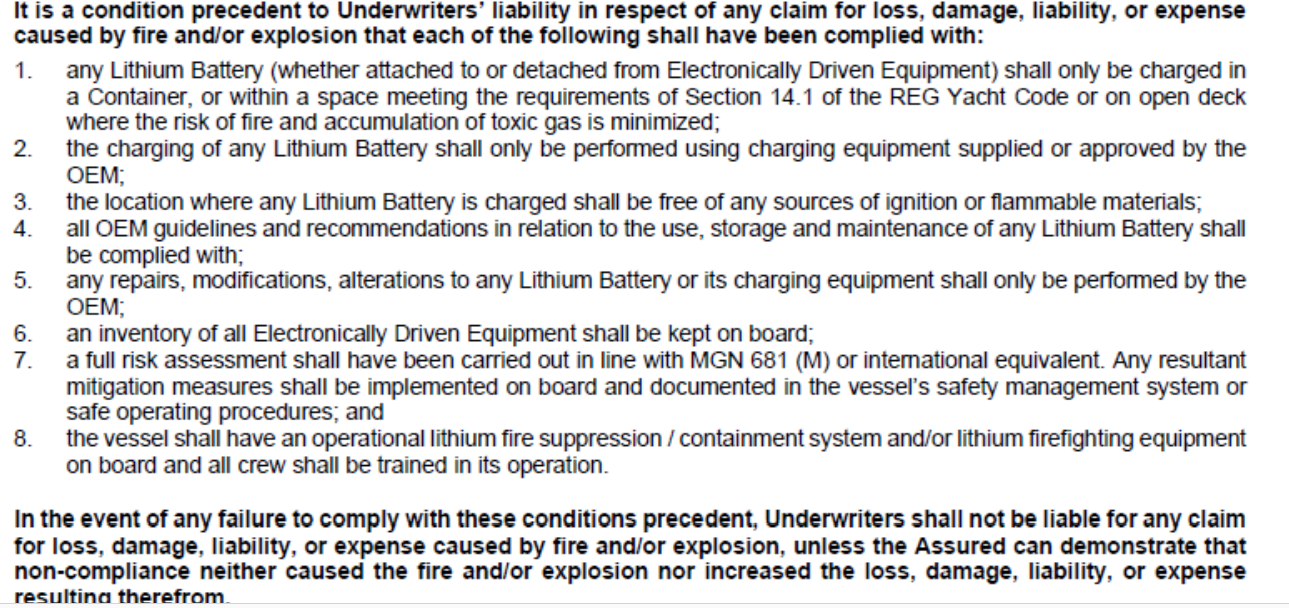
That was a strange paragraph from your underwriter and would carry no weight in the US. I'd never heard of "REG Yacht code" so looked it up and here is what AI says about it only pertaining to large ships and applicable in the UK.
The Red Ensign Group (REG) Yacht Code is a comprehensive set of safety, design, and operating standards for large commercial and private yachts registered with Red Ensign Group members. Implemented in 2019 and updated in 2024, it replaces the former Large Yacht Code 3 (LY3) and Passenger Yacht Code, simplifying regulations into two parts: Part A for vessels with up to 12 passengers and Part B for 13 to 36 passengers.Key Details About the REG Yacht CodePurpose: To standardize safety, pollution prevention, and technical standards for yachts over 24m, allowing for innovation while ensuring crew/passenger safety.Structure😛art A: Applies to commercial yachts (24m+ in length) carrying 12 or fewer passengers.Part B: Applies to yachts (private or commercial) carrying between 13 and 36 passengers.Update: A new version of the code was officially brought into force on July 1, 2024.Applicability: Applies to members of the Red Ensign Group, which include the UK, Crown Dependencies (Isle of Man, Guernsey, Jersey), and UK Overseas Territories (e.g., Cayman Islands, BVI, Bermuda).
I don't know about Canada, but here in the US we follow the USCG and ABYC standards and there's nothing wrong with a PROPER LiFEPo lithium battery installation. I survey lots of boats with lithium batteries and as long as they are installed properly I've never had a customer tell me they had a problem with insurance. 99% of lithium fire claims on boats & yachts come from other chemistries of lithium batteries, like the ones in phones, laptops, scooter, ebikes, etc.