Is your Yamaha’s VST filter on your service invoice? Ours wasn’t for 1,105 hours.

Submariner

Channel Surfing
Joined
Feb 2, 2020
Messages
1,902
Location
Everett, WA
Website
www.letsgochannelsurfing.com
Fluid Motion Model
R-27 (Outboard)
Hull Identification Number
FMLT2702C021
Non-Fluid Motion Model
https://tinyurl.com/yrv84xdm
Vessel Name
Channel Surfing
MMSI Number
368187810
1,105 hours. This was the first time the VST filter on our F300 had ever been serviced.

The VST filter is the last fuel filter on the engine. It sits inside the vapor separator tank and catches debris before fuel reaches the high-pressure pump and the injectors.

I couldn’t find a VST filter interval anywhere in the Yamaha service manual. The Yamaha tech who presented at the rendezvous in September said to replace it every 300–500 hours.

The boat ran fine and hit WOT with no problem, and that’s exactly why it gets missed. Some shops sea-trial the boat, and if it pulls to WOT clean, the VST filter gets skipped. Ours was skipped at 500 hours and again at 1,000 by the dealer. It wasn’t flagged because the engine had no run-ability issues.

A sea trial tells you the engine runs today. It doesn’t tell you what’s building up inside.

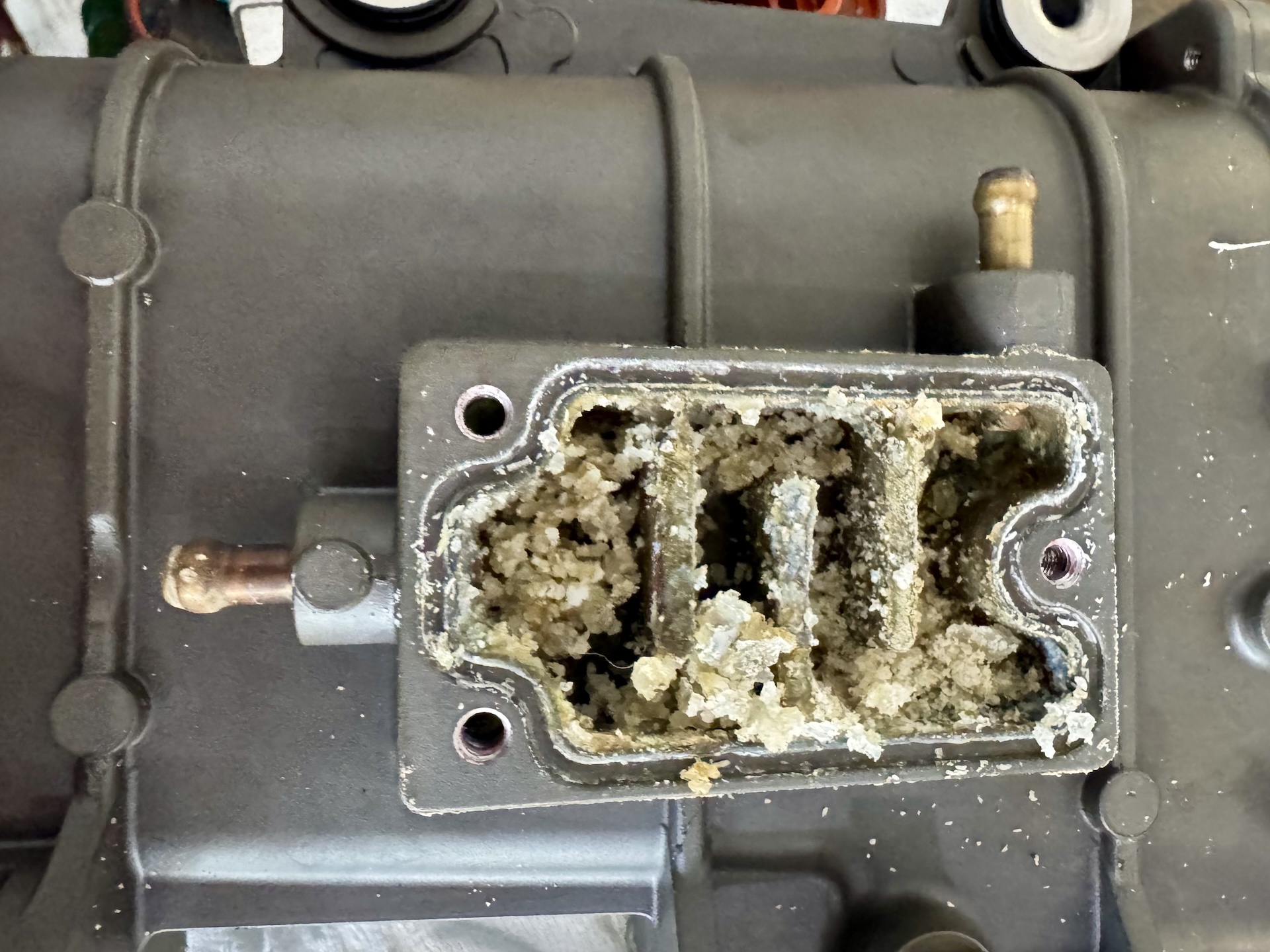
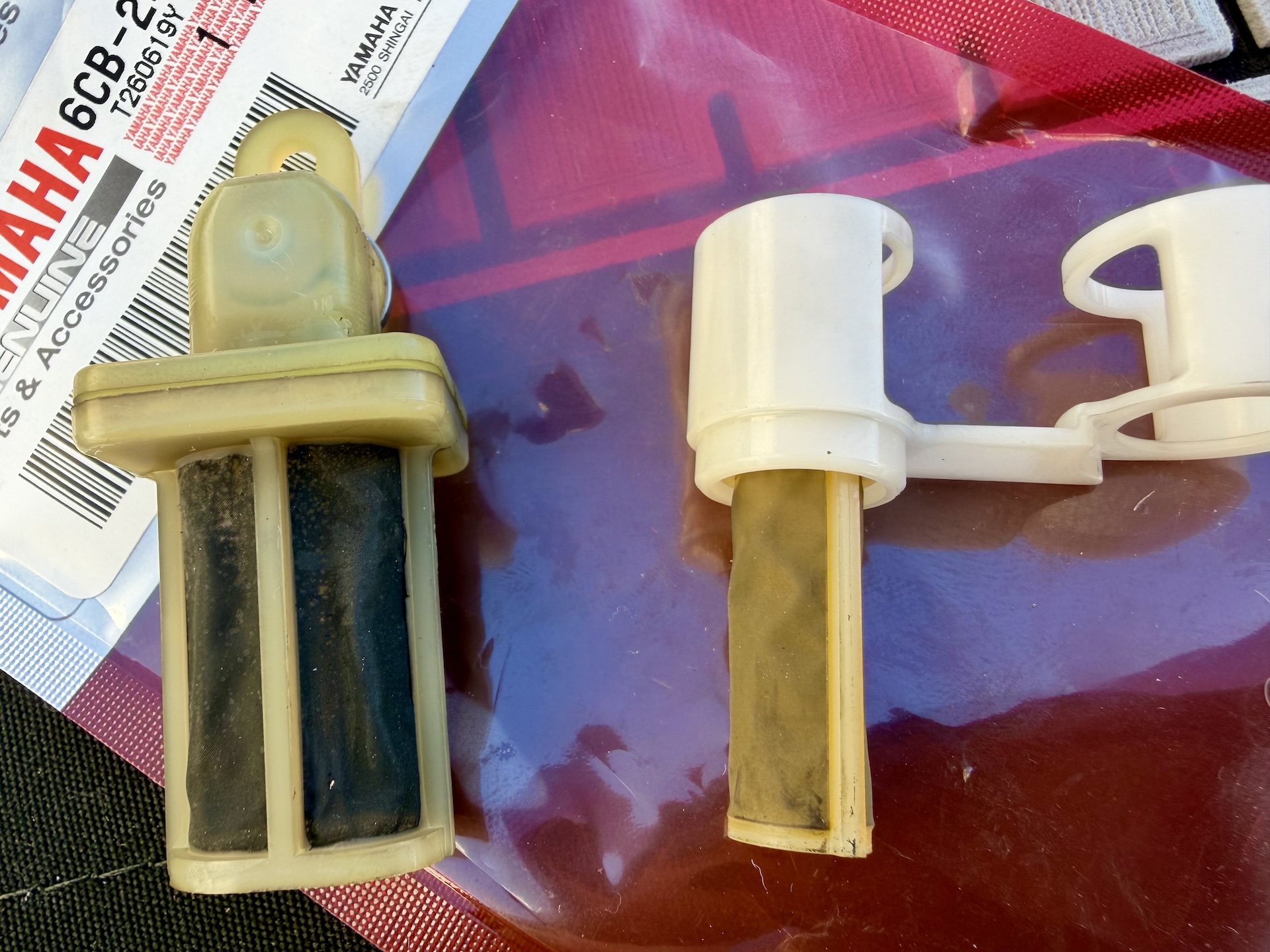
Bonus finding: one photo is the inside of the VST’s raw-water cooler, packed with salt crystals and mineral deposits. You only see it when the VST comes apart. The other photo shows the VST filters. I also flush my engine often.

What to do with yours:
  • If you are over 500 hours, pull your service invoices and look for “VST filter” listed by name. “Fuel filters replaced” can mean just the external ones.
  • It’s a dealer job, about 3-4 hours of shop time. If it’s installed wrong, it can damage the engine.
  • While the VST is apart, have them check and clean the raw-water cooler.
I had it serviced this week in preparation for SE Alaska in May 2027. It’s going north with a clean one.

I’ve also added the VST filter to my updated Yamaha maintenance spreadsheet, to be serviced every 500 hours going forward.
IMG_7518.jpeg


IMG_2296.jpeg
 
Last edited:
Did the whole unit get replaced or just cleaned up and new filters?
 
Did the whole unit get replaced or just cleaned up and new filters?

Cleaned the raw water cooler side of salt and mineral deposits.
Replaced both filters with new.

Here's a few pic's off a friends F300, with 700 hours on his VST filters showing them next to a new filter.

IMG_9874.jpeg

IMG_9875.jpeg
 
Last edited:
Seeing all that salt build up in the unit worries me. When you say you flushed your engine often, was that with a salt removing solution or just water? Is there any reason why salt would build up more in the VST than elsewhere in the engine?
Basically I am wondering if having a once in a while Saltaway (or equivalent) flush might be a good idea for me to start doing.
 
Hi Martin, I see you were at Tom-n-Jerrys getting service. I am taking Snug there next week for service so this is a great tip. Doubtful mine has ever been changed either.
Dennis
 
Seeing all that salt build up in the unit worries me. When you say you flushed your engine often, was that with a salt removing solution or just water? Is there any reason why salt would build up more in the VST than elsewhere in the engine?
Basically I am wondering if having a once in a while Saltaway (or equivalent) flush might be a good idea for me to start doing.

I run salt-away occasionally. I'm going to switch to running it every time. Though, a friend of mine uses salt-away a lot and still had salt build up. It's the price we pay to have fun in the big ocean. I'll be doing the VST every 500 hours going forward.

Also note, while the pics look bad, the boat ran fine.

Now that I've completed the 1000 hour maintenance cycle, there's some changes I've made going forward:
  • Yamalube Ring-free with every fill-up.
  • Yamalube Synthetic 10w30 oil going forward.
  • Salt-away with each engine flush.

On the to-do list, after SE Alaska:
  • engine exhaust guide anode(s), and my engine exhaust guide inspected.
  • engine oil cooler anode(s).
 
Last edited:
I am jealous of your Alaska trip, that is going to be so much fun.
Yeah, I think I'll start using SaltAway when ever I flush.
 
I am jealous of your Alaska trip, that is going to be so much fun.
Yeah, I think I'll start using SaltAway when ever I flush.

I do flush every time I bring the boat back from a trip also, every time, mainly with just freshwater and I let it run for about 20 minutes and I do it when the engine is hot also. I also tilt the engine down and up a few times during the flush.

I'm just going to start running salt away every time with the freshwater flush.
 
Given the fact that the four stroke Yamaha motors have a daisy chain of filters the VST filters are not usually a culprit for causing fuel starvation and are usually over looked because they are a bit more labor intensive to replace. 500 hours of five years seems like a good practical solution. The two filters before the separator will keep the fuel system in check and are considered the primary filters. The large spin on mounted inside the boat that filters the fuel coming out of the tank and the primary filter under the cowling usually but not all models in the front of the powerhead. These filters are the easy replacements and for the most part the important ones. Easy to change and easy to inspect. If they are dirty and have water in them and there has been an indication of fuel starvation it is not a bad idea to go further and at least drain the VST. Water or sediment seen when drained maybe its time to inspect and replace the high pressure pump filter and the H filter. If the VST draining shows clean fuel and no water your primary filters were doing their job.

I have found the biggest culprit of VST filters and the vapor tank needing attention sooner or basically ever is the use of poor quality fuel. There are many parts of the country that 10 % ethanol fuel at the pump is considered the good stuff. It is not unusual to find 15%. Either one in my opinion is not a good source of fuel for a marine engine especially a high output outboard. When a VST is pulled and serviced it is a dead give away of what type of fuel has been used when the filter and the tank are inspected. A yellow or white powdery crust will be seen in the bottom of the tank and a dark discoloration of the filter is the give away that ethanol gas was used. The filter is not plugged from dirty fuel that has passed thru the primary filters it is plugged from the degradation of the fuel and deposits that are formed in the tank. This doesn't happen over night so if your filling with 87, 89 or 91 octane 10% ethanol and burning it every week probably not as big of a problem as filling the tank once a month.

There is a difference 91 ethanol free will last longer, burn cleaner and leave the fuel system clean. Amazing clean !! Most of my gas powered boats were trailerable so I always filled up at good quality gas stations. For as long as I can remember 10% ethanol was the norm. I was one that said I will just use the 10% and put an additive in the gas, stabilizer, an OMC product, Mercury Marine , Yamaha or Sea Foam they all work at keeping a good grade 10% ethanol gas from degrading quickly. I have used this method for years and have had little issues with fuel systems. My boat engines started and ran fine, my lawn mower, power washer started and ran, my Honda generator sits for months and when I need it it starts. I added a fuel stabilizer every time I filled up anything that I was not going to use the gas up within a week or two. It works! But if I did not do that I believe I would have fuel system issues shortly. After some poor quality fuel issues that I have experienced over the last few years I have given up using 10% and will only use ethanol free in everything I own except my car and truck that are designed to operated. with up to 85% ethanol gas.

The fuel, cooler is the bigger question about service. It is a problem with Yamahas. All the flushing you do will still not prevent the cooler fouling. It is a known issue. The cooler gets plugged reducing water flow through it and the regulator rectifier. If the cooler gets plugged in warmer water and warmer climates like Florida it will give the same running conditions as if the fuel filter was plugged. It will cause a Vapor lock. Using the flushing adapter on the motor does not always flush all cooling system components especially the secondary or auxiliary cooling passages. There is not enough volume and pressure from a garden hose. Compare the telltale with the engine running at temperature and the telltale when you are using the hose. If it is weaker on the hose you may not have enough pressure to clean and flush the smaller cooling passages. If the telltale is weak with the engine running but does not over heat that is another sign that the coolers may be plugged up. To me cleaning the fuel cooler is has important or more important that replacing the fuel filters. The fuel filters at 500 hours probably do not need replacing. But the fuel cooler will need to be cleaned. As long as you are doing the cooler replace the filters. It is an easy job to do. I prefer doing it on a ladder on land !
 
It is an easy job to do. I prefer doing it on a ladder on land !

Pretty much the reason I bought the outboard over an inboard. Working on the submarine, and my last boat (Mercruiser 5.0l MPI, Alpha1 stern drive), I was tired of working upside down, feet sticking up.
 
This is very interesting - thank you.

Looking through the service manual for the F350, there is no mention of the Vapor Separator Tank filter replacement or inspection under the Maintenance Items, so I will definitely add this to the 500 hour list. From the diagrams on the F350, it looks very similar to the F300's.

Curiously, when following the cooling system diagrams, the cooling lines for the Fuel Cooler (and Oil Cooler) are smaller lines in parallel with lines from the Thermostat and Cylinder block, thus when running, a smaller portion of the water is diverted to (or shared with) the Fuel Cooler and Oil Cooler. When flushing the engine it would be the same, so a lesser amount of fresh water is flowing through the fuel and oil cooler. (Perhaps that's why Yamaha recommends flushing for 15 minutes - to ensure fresh water is getting to these components). The problem I see is if the fuel cooler or oil cooler become restricted, more flow is diverted through the larger parallel lines (path of least resistance), thus less cooling (or flushing) water is going through the coolers the which is just a build up of problems. My initial thought would be to perhaps tee into those lines separately and flush them separately periodically - but I'd need to think on that some more.

Either way, good to know!
The whole flushing thing has had me thinking ever since the flushing hose adapter idea started with the outboard manufactures. In the old 2 stroke days we used the "Flush muffs" and ran the engine. We used the same water source a spigot, so the volume was the same but we used the impeller to move the water in the same flow has the cooling system design. The water pressure at idle is no much and the water pressure coming out of the hose (spigot pressure) should be higher. I do think that running the engine and flushing does a better job than using the flushing adapter installed for static flushing. I believe static flushing is better than nothing. Outboard cooling systems are much different compared to closed block cooling systems that maintain the coolant in the water jackets all the time. An outboard motor has to completely fill all cavities with water each time it is started and empties every time it is shut off. When water pressure is gone water empties and the block is dry. All the "little nooks and crannies" is where most residual water settle. If this coolant water is salt water when the engine is hot and shuts down residual water quickly boils or evaporates leaving behind salt deposits. These salt deposit over time build up and the result is what is found in the small fuel cooler passages, in thermostat housings, exhaust cavities, areas in the block and heads. Periodic flushing helps but doesn't really work well from preventing this. If you are a day cruiser and every time you go out for the day come back to the dock or ramp the first thing you do is flush the motor while it is still hot from running the results will be the best. Flushing after a week of boating with several intervals of hot/cold block will help and adding salt way will remove or lift fresh salt crystals, sodium or what ever else is in salt water but it is not going to remove salt deposits. The only way to get rid of those is mechanically.

I have been out of the outboard boating for about 10 years. When I switched to inboard diesels I maintained my outboard flushing regiment. Both of the boats I owned the first thing I installed was flushing devises to my sea stainers. I planned on using the boats in salt water and wanted to make sure I always had clean maintained raw water cooling. The Cutwater had a compromised cooling system from day one so it was essential that it stayed clean. The Mainship had two engines and was a full time Great Lakes boat so I wanted to keep it that way even though it would be used in salt water about 40% of the time. I sold the inboards and now back to an old school two stroke Yamaha OX66 mounted on a well preserved 208 Grady White. This is/was a full time Green Bay Wisconsin boat that was used very little for 25 years. I use the boat in Southwest Florida saltwater and rack store it in the winter and tow it back to the midwest and use it during the summer in freshwater. It has the Yamaha flushing adapter and I use it each time the motor is used. I try to flush as soon as I can after shut down but this is not aways possible. When I got back to Illinois I did a small test. The motor was flushed in Florida when I put the boat back on the trailer. I flushed it for an extended time as I was cleaning the boat and preparing it for my trip back to Illinois. When I got home and the boat was in my shop I decided to do another flush using a large plastic bin with a Geyser submersible pump hose and flushing muff. I put the bin under the motor lower the gear case into the bin and to fill the bin I attached the hose to the fresh water adapter on the motor and started flushing it and all the water would circulate and then end up in the bin. I figured I'll flush it both ways. Once the bin had about 20 gallons of water I then used the Geyser pump and flushing muff. I checked the bottom of the bin to see if any crud had flushed out of the motor and it was free of debris and sediment. My thought was all the flushing worked. I fired up the engine and ran it in the bin circulating the water and kept checking engine temperature with my IR gun making sure it was getting up to temperature and thermostats were opening. I ran it for at least 10 minutes until the water in the bin was getting warm and I saw the engine temperature starting to climb well above thermostat opening temperature. I then shut the motor down.

Results! The bottom of the bin was full of sediment, sand, black particulate, white crusty particulate and because it was a two stoke there was an oily sheen on the surface of the water. I emptied the water from the bin using the pump. The bottom of the bin was covered with sediment. I was surprised at how much crap came out after doing two flushes before using the Yamaha flush adapter. I will still use the flush adapter but I will also periodically have the boat put on a work rack and run it using the flushing muffs and running the engine up to temp. ( I used no additive in the water) I may do this again and put a couple of gallons of vinegar in the water and see what I find then. I have used the boat during the summer all freshwater in the midwest. It should be cleaned up and ready for another winter in SWF.

I plan on repowering the Grady with a new 4 stroke Suzuki but having a hard time letting go of the old OX66 225 Yamaha. It runs awesome but like the gas! For now I'll keep running and flushing!!! There isn't a fuel cooler on this engine but I have worked on 4 strokes that do have them. Fresh water they just have some white scale on them and require little maintenance. Saltwater while I have not worked on many the ones I have seen look like one in this post. The 500 hour or five years seems like a good solution along with good flushing.
 
All good stuff. I'm coming up on 1000 hours on my 2019 Yamaha 300s. Here's what I'm finding for a service list, however, I don't see a single comprehensive 1000 hours list.

SimYamaha and PartsVU calls out VST replacement at 500 hours:
https://blog.simyamaha.com/yamaha-four-stroke-maintenance-schedule/ says add the Timing Belts to all the other interval services.

 
I'm going to start looking for a dealer for changing VST and Timing belt and tensioner replacements and will call for quotes. Even my mechanical buddies recommended doing this in a shop since it requires special tools for re-assembly.

Has anyone done these two services at a dealer: 1. VST replacement; 2. Timing Belt and Tensioner Replacement and, if so, what were the costs? I know they usually try to sell the full service, but, all the other services are DIY.

If I use Martin's VST service estimate: 3-4 hours and H & M Marine Services (located in Sausalito, California) has a standard shop rate of $180 per hour. That would be about $800 per engine.

Timing belt cost me about $500, parts and labor. VST filter is about $800. My boat's still at the shop so I don't have the final bill yet.

I have them replacing the VST, replacing all 3 shaft seals on the lower unit (prop, shift and drive shaft), and replacing my tilt cylinder (which was leaking).

I emailed you my updated spreadsheet for working on the Yamaha.
 
@Rocky Lou

Boat's all finished,
I'm at 1,100 hours on my 2019 F300. in January, at 1,023 hours I had the timing belt and tensioners replaced.

This time, at the shop for the following: (I got the bill).
- VST filter, parts+labor: $800 (3 hours)
I'm going have this done every 500 hours going forward.

- I also had my lower unit seals redone. (propeller shaft, drive shaft and shifter shaft).
They had 1,100 hours on them. I did this as preventative maintenance. $1350. (5.25 hours)
- I had the drive shaft bushing also replaced (preventative), $300. (1 hour)

If I was operating in my normal backyard, Puget Sound/San Juan Islands, BC Canada, then waiting for milky oil, or a failed pressure test every 100 hours and only fix once failed would work for me. However, we leave for SE Alaska in May 2027. Having this many hours on those shaft seals, and looking to add another 300 hours in the next 8 months I took the preventative maintenance approach. (We'll add 200 hours for SE Alaska, and another 100 for our normal boating season in 2027).

Shop rate was $185/hr.

Also found my trim tilt ram leaking oil. That was $800 (parts+labor) to replace the sub-assembly.

I'll be doing the normal 100 hour service and replacing the thermostats and OCV filters this coming weekend.

Note: I rounded up/down the prices above. The detailed invoice says "oil seals", many times, with different costs, depending on where it goes. They didn't list individual part numbers. There's also a single "shop fee" line $ amount. The hours estimate is accurate. These prices and hours, I suspect will be close enough for budgeting at a service center near you.
 
Last edited:
Thanks, that's helpful Martin. My engines are also 2019, as is my boat, so not far apart from yours. As I approached 1000 hours, I asked on the Cutwater Facebook Group what folks thought of repoweriing and selling the old engines while they still had some value. I got a unanimous reply of 'ridiculous'. While I don't have a wife like yours who will go on long cruises, I fish up to 50 miles offshore and want to get home safely all the time. Hence, I see the value in doing 'extra' maintenance or investment. As you can see from my hours, I spend a lot of time on my 'Beach House' and it's worth it. I'll be using your spreadsheet later today to make a specific parts list for the upcoming service.
 
Back
Top