Is your Yamaha’s VST filter on your service invoice? Ours wasn’t for 1,105 hours.

Submariner

Channel Surfing
Joined
Feb 2, 2020
Messages
1,879
Location
Everett, WA
Website
www.letsgochannelsurfing.com
Fluid Motion Model
R-27 (Outboard)
Hull Identification Number
FMLT2702C021
Non-Fluid Motion Model
https://tinyurl.com/yrv84xdm
Vessel Name
Channel Surfing
MMSI Number
368187810
1,105 hours. This was the first time the VST filter on our F300 had ever been serviced.

The VST filter is the last fuel filter on the engine. It sits inside the vapor separator tank and catches debris before fuel reaches the high-pressure pump and the injectors.

I couldn’t find a VST filter interval anywhere in the Yamaha service manual. The Yamaha tech who presented at the rendezvous in September said to replace it every 300–500 hours.

The boat ran fine and hit WOT with no problem, and that’s exactly why it gets missed. Some shops sea-trial the boat, and if it pulls to WOT clean, the VST filter gets skipped. Ours was skipped at 500 hours and again at 1,000 by the dealer. It wasn’t flagged because the engine had no run-ability issues.

A sea trial tells you the engine runs today. It doesn’t tell you what’s building up inside.

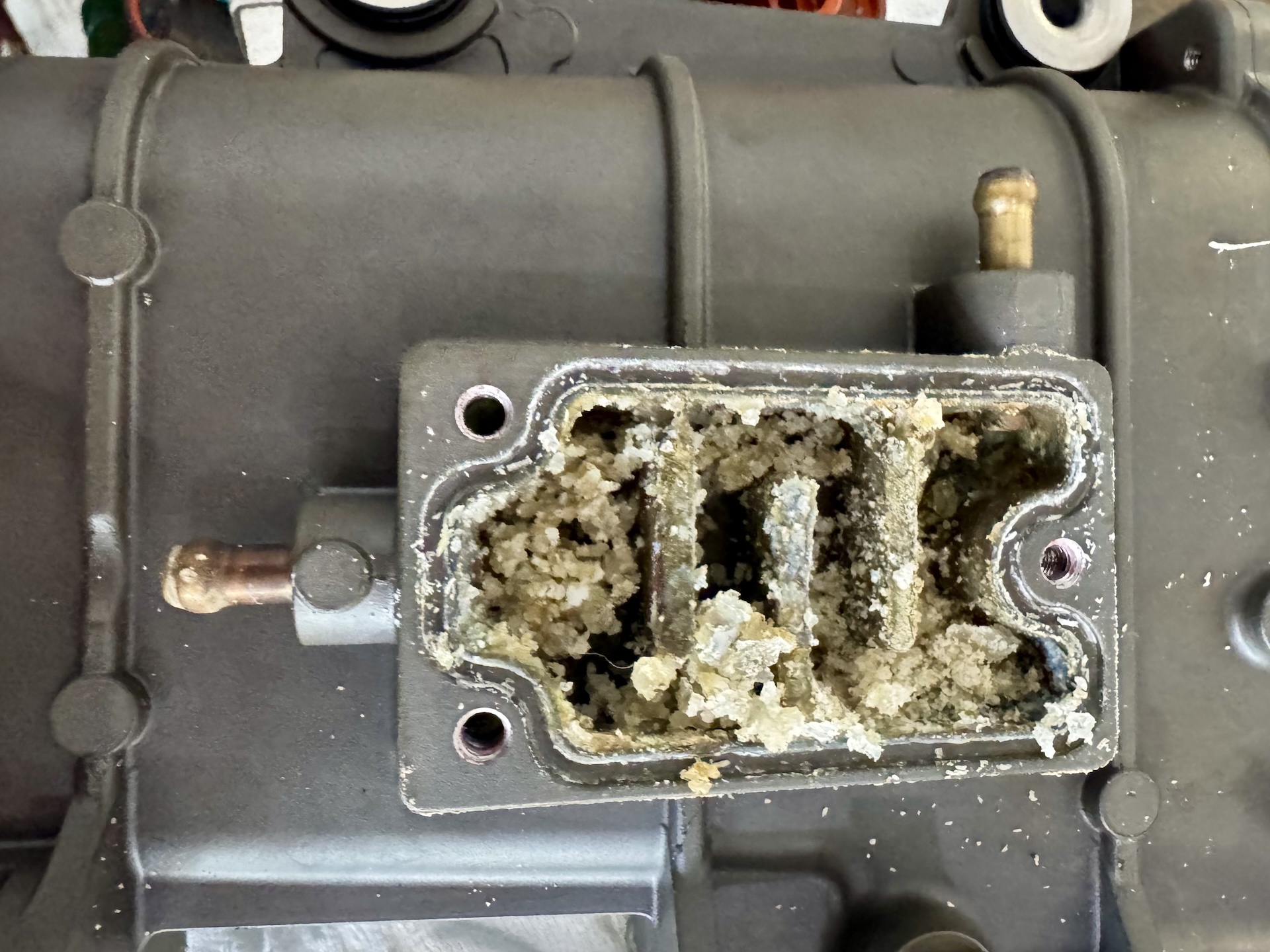
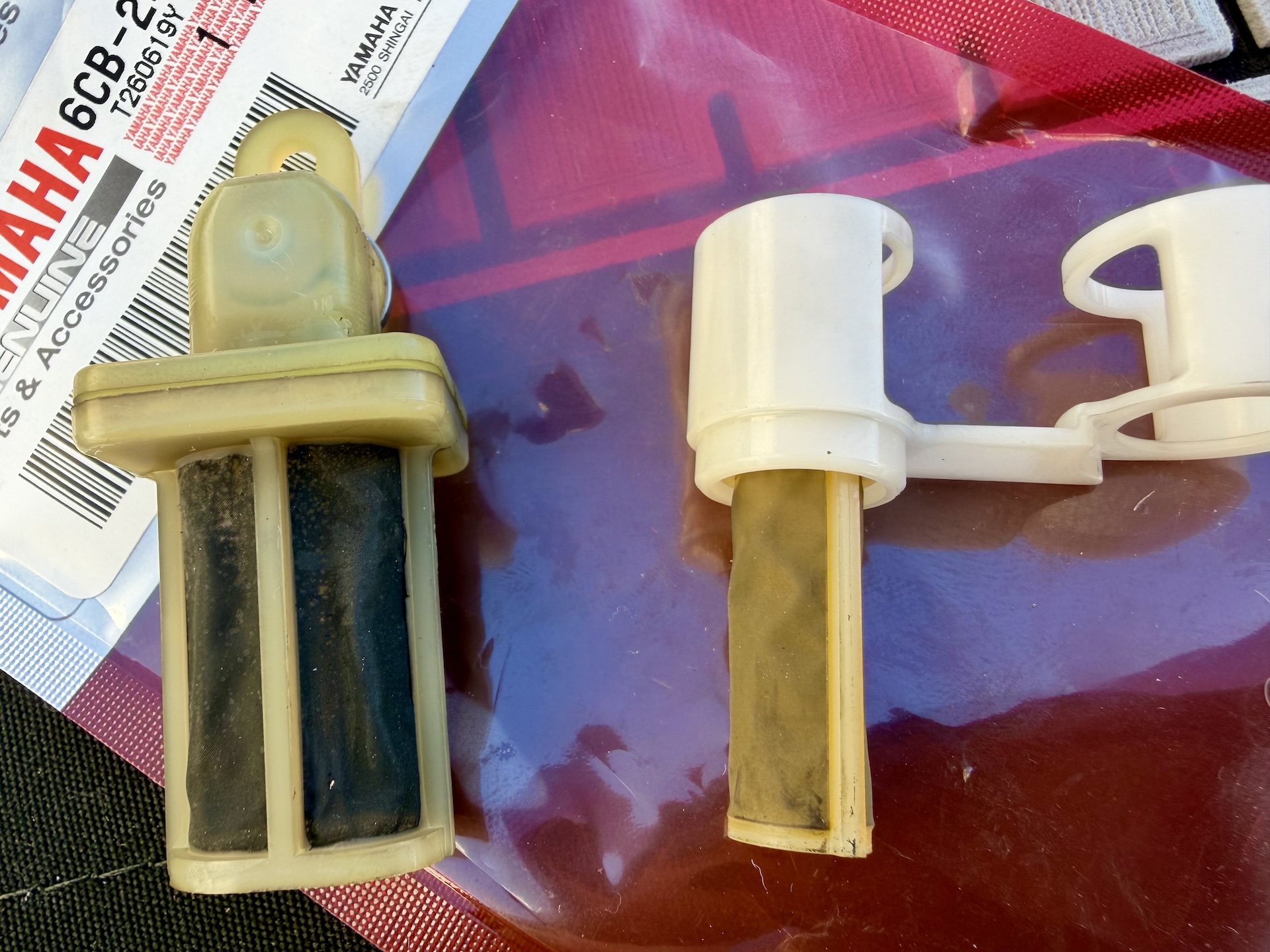
Bonus finding: one photo is the inside of the VST’s raw-water cooler, packed with salt crystals. You only see it when the VST comes apart. The other photo shows the VST filters. I also flush my engine often.

What to do with yours:
  • If you are over 500 hours, pull your service invoices and look for “VST filter” listed by name. “Fuel filters replaced” can mean just the external ones.
  • It’s a dealer job, about 3-4 hours of shop time. If it’s installed wrong, it can damage the engine.
  • While the VST is apart, have them check and clean the raw-water cooler.
I had it serviced this week in preparation for SE Alaska in May 2027. It’s going north with a clean one.

I’ve also added the VST filter to my updated Yamaha maintenance spreadsheet, to be serviced every 500 hours going forward.
IMG_7518.jpeg


IMG_2296.jpeg
 
Did the whole unit get replaced or just cleaned up and new filters?
 
Did the whole unit get replaced or just cleaned up and new filters?

Cleaned the raw water cooler side of salt.
Replaced both filters with new.

Here's a few pic's off a friends F300, with 700 hours on his VST filters showing them next to a new filter.

IMG_9874.jpeg

IMG_9875.jpeg
 
Seeing all that salt build up in the unit worries me. When you say you flushed your engine often, was that with a salt removing solution or just water? Is there any reason why salt would build up more in the VST than elsewhere in the engine?
Basically I am wondering if having a once in a while Saltaway (or equivalent) flush might be a good idea for me to start doing.
 
Hi Martin, I see you were at Tom-n-Jerrys getting service. I am taking Snug there next week for service so this is a great tip. Doubtful mine has ever been changed either.
Dennis
 
Seeing all that salt build up in the unit worries me. When you say you flushed your engine often, was that with a salt removing solution or just water? Is there any reason why salt would build up more in the VST than elsewhere in the engine?
Basically I am wondering if having a once in a while Saltaway (or equivalent) flush might be a good idea for me to start doing.

I run salt-away occasionally. I'm going to switch to running it every time. Though, a friend of mine uses salt-away a lot and still had salt build up. It's the price we pay to have fun in the big ocean. I'll be doing the VST every 500 hours going forward.

Also note, while the pics look bad, the boat ran fine.

Now that I've completed the 1000 hour maintenance cycle, there's some changes I've made going forward:
  • Yamalube Ring-free with every fill-up.
  • Yamalube Synthetic 10w30 oil going forward.
  • Salt-away with each engine flush.

On the to-do list, after SE Alaska:
  • engine exhaust guide anode(s), and my engine exhaust guide inspected.
  • engine oil cooler anode(s).
 
Last edited:
I am jealous of your Alaska trip, that is going to be so much fun.
Yeah, I think I'll start using SaltAway when ever I flush.
 
I am jealous of your Alaska trip, that is going to be so much fun.
Yeah, I think I'll start using SaltAway when ever I flush.

I do flush every time I bring the boat back from a trip also, every time, mainly with just freshwater and I let it run for about 20 minutes and I do it when the engine is hot also. I also tilt the engine down and up a few times during the flush.

I'm just going to start running salt away every time with the freshwater flush.
 
Given the fact that the four stroke Yamaha motors have a daisy chain of filters the VST filters are not usually a culprit for causing fuel starvation and are usually over looked because they are a bit more labor intensive to replace. 500 hours of five years seems like a good practical solution. The two filters before the separator will keep the fuel system in check and are considered the primary filters. The large spin on mounted inside the boat that filters the fuel coming out of the tank and the primary filter under the cowling usually but not all models in the front of the powerhead. These filters are the easy replacements and for the most part the important ones. Easy to change and easy to inspect. If they are dirty and have water in them and there has been an indication of fuel starvation it is not a bad idea to go further and at least drain the VST. Water or sediment seen when drained maybe its time to inspect and replace the high pressure pump filter and the H filter. If the VST draining shows clean fuel and no water your primary filters were doing their job.

I have found the biggest culprit of VST filters and the vapor tank needing attention sooner or basically ever is the use of poor quality fuel. There are many parts of the country that 10 % ethanol fuel at the pump is considered the good stuff. It is not unusual to find 15%. Either one in my opinion is not a good source of fuel for a marine engine especially a high output outboard. When a VST is pulled and serviced it is a dead give away of what type of fuel has been used when the filter and the tank are inspected. A yellow or white powdery crust will be seen in the bottom of the tank and a dark discoloration of the filter is the give away that ethanol gas was used. The filter is not plugged from dirty fuel that has passed thru the primary filters it is plugged from the degradation of the fuel and deposits that are formed in the tank. This doesn't happen over night so if your filling with 87, 89 or 91 octane 10% ethanol and burning it every week probably not as big of a problem as filling the tank once a month.

There is a difference 91 ethanol free will last longer, burn cleaner and leave the fuel system clean. Amazing clean !! Most of my gas powered boats were trailerable so I always filled up at good quality gas stations. For as long as I can remember 10% ethanol was the norm. I was one that said I will just use the 10% and put an additive in the gas, stabilizer, an OMC product, Mercury Marine , Yamaha or Sea Foam they all work at keeping a good grade 10% ethanol gas from degrading quickly. I have used this method for years and have had little issues with fuel systems. My boat engines started and ran fine, my lawn mower, power washer started and ran, my Honda generator sits for months and when I need it it starts. I added a fuel stabilizer every time I filled up anything that I was not going to use the gas up within a week or two. It works! But if I did not do that I believe I would have fuel system issues shortly. After some poor quality fuel issues that I have experienced over the last few years I have given up using 10% and will only use ethanol free in everything I own except my car and truck that are designed to operated. with up to 85% ethanol gas.

The fuel, cooler is the bigger question about service. It is a problem with Yamahas. All the flushing you do will still not prevent the cooler fouling. It is a known issue. The cooler gets plugged reducing water flow through it and the regulator rectifier. If the cooler gets plugged in warmer water and warmer climates like Florida it will give the same running conditions as if the fuel filter was plugged. It will cause a Vapor lock. Using the flushing adapter on the motor does not always flush all cooling system components especially the secondary or auxiliary cooling passages. There is not enough volume and pressure from a garden hose. Compare the telltale with the engine running at temperature and the telltale when you are using the hose. If it is weaker on the hose you may not have enough pressure to clean and flush the smaller cooling passages. If the telltale is weak with the engine running but does not over heat that is another sign that the coolers may be plugged up. To me cleaning the fuel cooler is has important or more important that replacing the fuel filters. The fuel filters at 500 hours probably do not need replacing. But the fuel cooler will need to be cleaned. As long as you are doing the cooler replace the filters. It is an easy job to do. I prefer doing it on a ladder on land !
 
Back
Top