Anchoring & Movement

guidothesquid

Well-known member
Joined
Feb 5, 2013
Messages
71
Fluid Motion Model
C-24 C
Yesterday we took 25SC Tug Toy out to anchor for our first time, off Port Madison in the long inlet. Water was about 25ft deep, we got a good hold and had about at 20 foot variance from the waypoint I marked as soon as the anchor set. We stayed pretty stationary and were happy with the results of our first time. Except, the regulator for my grill fell off somewhere, so we had to boil the sausages instead of grilling them!

The only thing that stood out was how much we swayed around. We basically were a pendulum for a few hours. We'd swing one way, then slow, stop, then swing back the other way. It wasn't too windy most of the time, tide was slowing going out... The question is: Is that normal for a Ranger? Seemed like the sails that were out there didn't move nearly as much as we did. Did their keels keep them stationary, but our little tugs just flap in the breeze?

Would love to hear your experiences and any tips.

Paul
 
We do move around a lot as we do not have a lot in the water, and a lot out of the water. You can always add a stern anchor to stay pointed in the same direction.
If your regulator was attached to your BBQ and fell off , check your burner on the BBQ. I had mine out to clean ( Magma ) and if you put it back upside down, the regulator still goes in and works but it doesn't lock and will fall out...I check it after every cleaning now .
 
In addition to Mark's comments about movement at anchor there are a couple of things you can do to help reduce some of the swinging. Make sure that your rudder is straight. This will not help a great deal but it does not hurt. You can also add an anchoring bridle to your anchor rode while you anchor. What this does is put your scope down further into the water so the scopes trajectory is at less of an angle to the sea bed. Mind you this will help but not eliminate the swing you mentioned, especially in high tidal current but it should reduce wipelash.

Jim
 
If wind and tides are a bit off in direction and your rudder is in the right position you may get an oscillation between forces of wind and tides where the the wind takes over at some time swinging the boat in one direction until tidal forces ovecome the wind and the momentum of the boat will swing you over into the opposite direction. Adjustment of rudder may help as may a small sail on the mast

Setting a we not anchor at the bow would reduce the swinging somewhat. Setting an anchor at stern would even further reduce it

That was the theoretical part. I am sure there are more experienced operators out there who can chime in
 
Every power boat I have had does this in just the wind (we do not have tides in the great lakes although there are times and places with current). I hesitate to use a stern anchor because of the danger of prop fouling. If you use two anchors off the bow set in a V it will eliminate the majority of the swing, but that is a lot of work for a lunch stop. For an overnight, it is worth it.
 
One thing we do that is quite easy is go out a bit later and find a friend who is anchored good with two bow anchors and a stern anchor and then just raft to them 🙂
 
My last sailboat was a ketch, so it was just a matter of reefing the mizzen, then sheeting it in tight and bob's yer uncle. The boat stayed head to wind and no yawning. For a power boat it's called a studding sail or riding sail - there are many names for it. It would do about the same thing on the tug. Trawlers with masts generally have one. I've wondered about how one might add a riding sale, but there's a fare bit of hardware required and not to mention a mast. $$ too !

In the meantime you might put the side curtains in at the cockpit - this will move the lateral CE aft a bit. I've had a bit of luck dropping a plastic bucket off the bow, directly below the roller - it acts as a bit of sea anchor against the sideward motion.
 
Thanks everyone for the tips and information. We really enjoyed being on anchor, we will try somehow your tips. I know I didn't bother with the rudder, will pay more attention next time, fiddle about. And maybe a bucket too...
 
I like the changing view!
 
guidothesquid":2no2pxhd said:
Y
The only thing that stood out was how much we swayed around. We basically were a pendulum for a few hours. We'd swing one way, then slow, stop, then swing back the other way. It wasn't too windy most of the time, tide was slowing going out... The question is: Is that normal for a Ranger? Seemed like the sails that were out there didn't move nearly as much as we did. Did their keels keep them stationary, but our little tugs just flap in the breeze?

Would love to hear your experiences and any tips.

Paul
HEllo Paul,

You are describing a normal phenomenon ("sailing") of boat movement whilst at anchor. Boats with larger above-water profiles tend to do it more so than lower profile models.

Several others have chimed in with suggestions which might help reduce the movement.

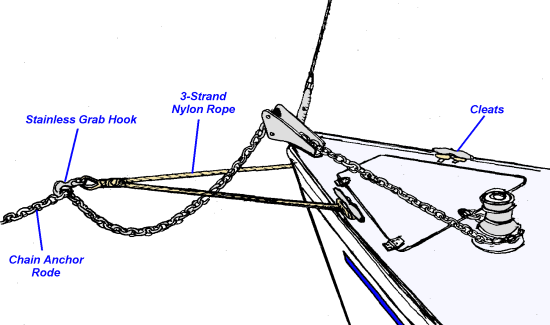
I would add that when using a bridle arrangement on your anchor to secure one leg of the 'Y' on the bow cleat as normal then secure the other leg of the 'Y' on the midship ('spring line') cleat.

For the record, this is an example of a anchor bridle. A hook is not necessary; the bitter end of the bridle can be tied to the anchor chain or rode.
Snubber.gif


/dave
 
We have had some success minimizing "sailing about the anchor" by using a one-legged bridle leading from one of the bow chocks to the rode. This places the boat at a small angle to the wind instead of dead-on. In lighter winds (and not certainly overnight), we have lead the bridle to the mid-ship cleat. This results in an approximate 45 degree angle to the wind and it pretty stable - except for the rolling that comes from not being dead on to the inevitable wind waves. Being on lakes, we have not tides to deal with, and that makes it a bit less complex.
 
tlkenyon":3n1zt933 said:
We have had some success minimizing "sailing about the anchor" by using a one-legged bridle leading from one of the bow chocks to the rode. This places the boat at a small angle to the wind instead of dead-on. In lighter winds (and not certainly overnight), we have lead the bridle to the mid-ship cleat. This results in an approximate 45 degree angle to the wind and it pretty stable - except for the rolling that comes from not being dead on to the inevitable wind waves. Being on lakes, we have not tides to deal with, and that makes it a bit less complex.


Technically, you have very tiny tides but no significant currents due to tidal movement. More pronounced if the lake is connected to another body of water and also dependent on the size of the body of water. Tides are caused by the moon, tidal currents are caused by the attempt of the water to fill in the void and vice versa.
 
Yes, technically, all bodies of water (even in your coffee cup and even groundwater) exprience tides as a result of the pull of gravity from the sun, moon and other celestial bodies. I probably should have said "discernable tides." Lakes also experience a phenomenon knows as a "seiche" which is essentially a storm surge that then oscllates back and forth as in a bath tub. There are also currents, driven by wind, hydrography and thermal anisotropy. All of these are almost always grossly overshadowed by the wind.
 
Has anyone rigged a “riding sail” to a RT and if so how was it attached? Obviously the tack and the head somehow on the mast, what about the clew?
 
Back
Top