Aqualarm low flow and muffler sensors for R21-EC

sheral

Well-known member
Joined
Mar 23, 2015
Messages
351
Fluid Motion Model
C-24 C SE
Hull Identification Number
FMLT2114H415
Vessel Name
Sheral Ann (2015 R-21EC)
MMSI Number
316029832
With the help of 'SGIDave' I have an Aqualarm water flow sensor and exhaust overheat detector coming directly from Aqualarm. Both sensors will be hooked to one dual function panel that will be mounted in the cabin.

They have a 10% sale right now and free shipping within the USA.

Anyway, if this helps anyone, here are the parts (confirmed with Rodney at Aqualarm - for the Volvo Penta D1-30).

#20250 Exhaust Overheat Detector
#20358 Water Flow and Exhaust Panel, 12v (warning lights and buzzer)
#13209 Cooling Water Flow Detector-Low Flow -1in FP (for 3/4" intake hose)
#29007 Hose to Barb Adapter 1 x .75 inch (x2)

Interestingly, Rodney said that the new water flow sensors also detect low flow, not just no flow. Looking forward to getting the toys and then figuring out where to mount the panel.

Thanks Dave!

🙂
 
You are welcome Al. I appreciate your kind words. If I've learned something boat-wise it's good to share details which might ease another's pain with their project. I'm glad it's all working out!

Don't forget to post pics

dave
 
Copy. It may be a while though as a trip to Sumas, WA to pick up the parts will have to happen first. I'm glad that I didn't do the analog gauges that I had originally thought about, as these two sensors (exhaust and raw water) from Aqualarm make so much sense. 😀
 
Thanks.... just ordered this stuff for my R-21EC based on your OP. 🙂 Your OP made it easy for me to order the correct stuff. 😉

To get the 10% discount I found out, after calling them, you have to enter WS10 as the Redemption code. 😱 ...and of course this code is also highlighted on their home web site page... but silly me as I didn't see it. 😉

If this works, then it's cheap insurance for sure. I only wanted the raw water flow alarm. Will now need to explore my wire fishing exploits getting the wire(s) from engine box/bay under the cockpit flooring over to the helm location. 😱

Screen%20Shot%202015-11-18%20at%2011.41.59%20AM.png
 
baz":nmtfbmcb said:
Thanks.... just ordered this stuff for my R-21EC based on your OP. 🙂 Your OP made it easy for me to order the correct stuff. 😉

Screen%20Shot%202015-11-18%20at%2011.41.59%20AM.png

Hello Barry,

QUICK! Call Aqualarm back and add another BARB to your order...you need TWO! 😱

dave
 
Aqualarm called me just now and told me as much, so 2 were ordered.... thanks all the same for the heads up.

During our tel call I asked how much wire is provided for the alarm unit and alert panel. Was told 5' for the alarm and maybe 1' for the alarm panel. That's not enough wire.... so 20 or 22 gauge will need to be purchased, right ? Maybe 2x 12' should be enough if 2 wires need to be snaked over from engine bay to helm position. Correct me if I'm wrong about this please.
 
baz":1zhojw5p said:
Aqualarm called me just now and told me as much, so 2 were ordered.... thanks all the same for the heads up.

During our tel call I asked how much wire is provided for the alarm unit and alert panel. Was told 5' for the alarm and maybe 1' for the alarm panel. That's not enough wire.... so 20 or 22 gauge will need to be purchased, right ? Maybe 2x 12' should be enough if 2 wires need to be snaked over from engine bay to helm position. Correct me if I'm wrong about this please.

Hello Barry,

Wiring projects...sounds like fun. They are like potato chips...can's stop after just one...

I buy my marine grade tinned wire from tinnedmarinewire.com. They sell something comparable to Ancor branded wire for a fraction of the cost. USA made to boot. You might as well buy a 25' or 50' spool of 16 AWG in RED (+) and YELLOW (DC neg). ABYC regs discourage used of anything smaller than 16AWG although certainly 18 AWG would work. PLEASE don't use non-tinned wire from the auto store; also AVOID non-marine grade terminations sold everywhere now including Home Despot, Lowes, etc. Get decent marine grade terminators (butt connectors, ring terminals, spade connectors, etc) - also at tinnedmarinewire.com. By 'decent' I mean Ancor, FTZ, or AMP brands or better.

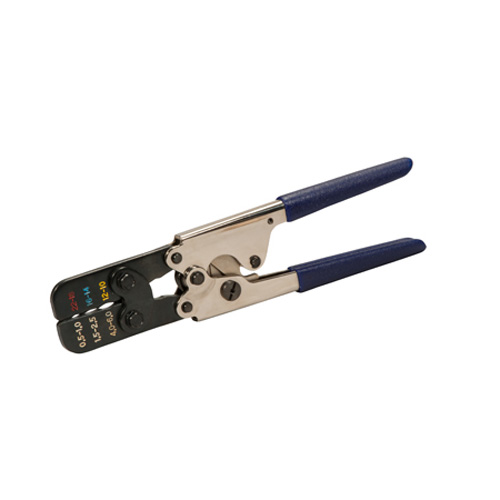
Oh, and you need a ratcheting crimper. One like this will cover everyting you need
990160_primary.jpg


You can use your standard crimper as a wire striper but DO NOT USE one of these for crimping
4337751.jpg


Marine wire connections are crimped - not soldered - and thus require specific forces which are NOT reliably generated with a non-ratcheting crimper.

Here is a great tutorial on marine wire terminations. Even if you decide to hire the work, it will give you the essentials of what to look for in a good wiring job.

dave
 
SGIDAVE":29admynf said:
baz":29admynf said:
Aqualarm called me just now and told me as much, so 2 were ordered.... thanks all the same for the heads up.

During our tel call I asked how much wire is provided for the alarm unit and alert panel. Was told 5' for the alarm and maybe 1' for the alarm panel. That's not enough wire.... so 20 or 22 gauge will need to be purchased, right ? Maybe 2x 12' should be enough if 2 wires need to be snaked over from engine bay to helm position. Correct me if I'm wrong about this please.

Hello Barry,

Wiring projects...sounds like fun. They are like potato chips...can's stop after just one...

I buy my marine grade tinned wire from tinnedmarinewire.com. They sell something comparable to Ancor branded wire for a fraction of the cost. USA made to boot. You might as well buy a 25' or 50' spool of 16 AWG in RED (+) and YELLOW (DC neg). ABYC regs discourage used of anything smaller than 16AWG although certainly 18 AWG would work. PLEASE don't use non-tinned wire from the auto store; also AVOID non-marine grade terminations sold everywhere now including Home Despot, Lowes, etc. Get decent marine grade terminators (butt connectors, ring terminals, spade connectors, etc) - also at tinnedmarinewire.com. By 'decent' I mean Ancor, FTZ, or AMP brands or better.

Oh, and you need a ratcheting crimper. One like this will cover everyting you need
990160_primary.jpg


You can use your standard crimper as a wire striper but DO NOT USE one of these for crimping
4337751.jpg


Marine wire connections are crimped - not soldered - and thus require specific forces which are NOT reliably generated with a non-ratcheting crimper.

Here is a great tutorial on marine wire terminations. Even if you decide to hire the work, it will give you the essentials of what to look for in a good wiring job.

dave

wow dave, thanks so much for the help. i have done quite a bit of auto wiring, soldering, crimping, etc but hadn't even considered the information you posted here... gotta get one of those ratcheting crimpers and will get the proper wire etc on it's way too! 🙂
 
baz":3tq1ganp said:
Thanks.... just ordered this stuff for my R-21EC based on your OP. 🙂 Your OP made it easy for me to order the correct stuff. 😉

To get the 10% discount I found out, after calling them, you have to enter WS10 as the Redemption code. 😱 ...and of course this code is also highlighted on their home web site page... but silly me as I didn't see it. 😉

If this works, then it's cheap insurance for sure. I only wanted the raw water flow alarm. Will now need to explore my wire fishing exploits getting the wire(s) from engine box/bay under the cockpit flooring over to the helm location. 😱

Screen%20Shot%202015-11-18%20at%2011.41.59%20AM.png

Nice! I really think the flow alarm will make life much more enjoyable! I was getting so paranoid i was thinking about installing a rear view mirror off the starboard side to watch the exhaust flow! Ha! :geek:
 
dave:
1. would the duplex marine wire (16 ga) from tinnedmarinewire.com be as good or better than buying separate spools of wire?
2. who makes the ratcheting crimper you suggested? some say they are for insulated terminals, etc...

thanks... 🙂
 
sheral":19omnd5t said:
dave:
1. would the duplex marine wire (16 ga) from tinnedmarinewire.com be as good or better than buying separate spools of wire?
2. who makes the ratcheting crimper you suggested? some say they are for insulated terminals, etc...

thanks... 🙂


Hello Al,

Yes the flow alarm is a great addition. It's nice to start the engine, hear the flow alarm beeping for a few seconds, then stop to let you know the raw water pump is doing its thing...ahh, life is good...

The Duplex wires are good for some things. Many applications will NOT require both DC lines (pos and neg) to run together. For instance, the flow sensor will have a wire running to GROUND which is very nearby whilst the long run to the helm console will be just the POS wire..WAIT, I'm not certain of that. But there are situations where that occurs. Overall, I don't use much Duplex even though I've got it.

The crimper is sold many places. Ancor branded tools cost more...mine is generic looking just like the pic above. This one from Defender is fine and price is fair. They will be used on insulated terminals as ALL your marine grade terminations are covered with heat shrink or some other plastic. For terminations in the bilge and engine box area, I like to use add some heat shrink, so, if your terminals aren't already the heat shrink variety, get some.

Sailboatowners.com has some good FTZ adhesive-lined heat shrink here for fair prices. It's a 48" length and is sold according to wire size so it's easy to buy the right size. You will need a heat gun. Yes, a little flame will work but not very well and IT'S DANGEROUS to do in the engine area, etc where fuel fumes might be. Get a proper heat gun for $20-25; one from Harbor Freight is fine. After 8 years mine is going strong.

dave
 
I think I'll run two +ive wires from flow meter to helm. One will be used and the other will be a backup in case the primary one goes bad. I like to have backup and/or redundancy when I can. Plus it could be used to easily snake another wire from engine bay to helm later if another requirement arises. 🙂
 
baz":1fr224ps said:
I think I'll run two +ive wires from flow meter to helm. One will be used and the other will be a backup in case the primary one goes bad. I like to have backup and/or redundancy when I can. Plus it could be used to easily snake another wire from engine bay to helm later if another requirement arises. 🙂


You will need those two wires one for power from the switch and one for the signal to the buzzer/display. It looks like a ground connection is made near the buzzer/display.

 
The sensor for exhaust flow...20250 EXHAUST OVERHEAT DETECTOR...didnt get ordered? I thought that original poster, Sheral,wanted to monitor both and posted the part number along with a panel that alerted to both conditions
 
Sue/Steve: That's correct. I was not interested in the exhaust temp sensor unit.
 
shear":3hqej3gx said:
...snip...
Interestingly, Rodney said that the new water flow sensors also detect low flow, not just no flow....snip...
🙂

I can see how the paddle switch works... when there's zero water velocity the paddle is in the up-flow position and would indicate zero flow with red LED lit up and buzzer sounding. When the water flow starts and reaches its proper/full velocity the paddle is moved all the way to the down-flow position and red LED dims and buzzer stops.

So presumably, low flow is assumed if the paddle is somewhere between the two extreme positions, right ?

I guess one can check this by hooking up everything before final installation and manually move the paddle sensor lever to understand at what point 'low flow' would be assumed.

Boo hiss... I forgot to order the buzzer (20106 Alarm Buzzer 85 dB)... and its a whopping $29. 😱
 
baz":xrk4846a said:
shear":xrk4846a said:
...snip...
Interestingly, Rodney said that the new water flow sensors also detect low flow, not just no flow....snip...
🙂

I can see how the paddle switch works... when there's zero water velocity the paddle is in the up-flow position and would indicate zero flow with red LED lit up and buzzer sounding. When the water flow starts and reaches its proper/full velocity the paddle is moved all the way to the down-flow position and red LED dims and buzzer stops.

So presumably, low flow is assumed if the paddle is somewhere between the two extreme positions, right ?

I guess one can check this by hooking up everything before final installation and manually move the paddle sensor lever to understand at what point 'low flow' would be assumed.

Boo hiss... I forgot to order the buzzer (20106 Alarm Buzzer 85 dB)... and its a whopping $29. 😱

Hello Barry,

Is a rotary mechanism whereby the faster the paddle rotates the greater the flow. No rotation, no flow. There is no paddle to move manually - the guts are all internal. You can test it by slowly closing your raw water cock as the engine idles.

dave
 
Dave:

The Aqualarm model I have is 306-13209. There's no rotary paddle inside. The paddle arm hangs down into the water's flow path and is moved from its standing position at one side to the other side. This movement is some 1" as best I can see.

The paddle arm has a spade-like shaped plastic glued to the arms end that hangs in the middle of the pipe through which the water flows through. This spade-like plastic piece occupies about 50% of the pipe's cross section.

Just to be sure I tried to rotate the paddle's spade-like piece thinking this was maybe what you're referring to as 'rotation'. However, the spade-like piece did not rotate. All I could do was to move it back and forth through a distance of about 1".

I'm assuming either my 306-13209 model is different from yours or that I'm not understanding your explanation.
 
baz":2prnsrcw said:
Dave:

The Aqualarm model I have is 306-13209.

I'm assuming either my 306-13209 model is different from yours or that I'm not understanding your explanation.

I'll have to check which model I have...

dave
 
Dave: Rodney told me they moved to the pendulum paddle design from the rotary paddle design because the rotary paddle has a tendency of having 'crud' buildup and subsequently can get stuck or its rotation gets sticky and can give false alarms. The pendulum design is superior in this respect.

It's probably a good idea regardless of the paddle type design to ocassionally check the paddle for deposited crud.

I wonder if a bit of bleach added into the raw water strainer might be a good maintenance procedure to do to help keep the paddle mechanism clean of 'crud' ? This would be simpler than having to remove the Aqualarm unit to inspect the paddle.

As an aside, Rodney (Aqualarm chap) will be sending me the buzzer for $9. He computed what the cost would have been had I ordered the "Safety Kit" that includes all the pieces. Rodney was easy and friendly to deal with.... very professional and excellent customer service IMO.
 
Back
Top