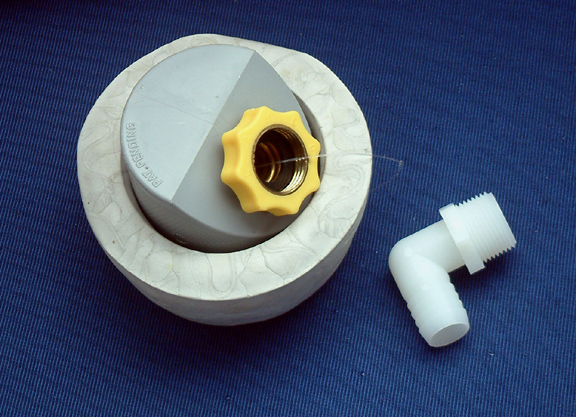
If you are determined to use the RV park sewer connection, you will need this type of fitting...
For explanation: that is a hard rubber "donut" around the outside (what most RVers use when they connect their sewer hose), with the interior piece purchased that allows connection of a standard hose. The L-fitting was used to attach the hose to the water outlet on the boat.
What turned out to be easier for us when using the boat on land: put a wash basin in the sink and catch your gray water. When you need to dump that, pour it into the RV site's sewer connection. Use the campground's showers. Our boat used a fresh water flush, so no problem with using the head. This way, there is no hose connection to mess with and no skanky hose to carry along and store.
If we were going to be traveling on land long enough to fill the black water tank, we'd find a lake along our route with a marina and spend a night or two enjoying the "local water" and use the marina's pumpout.
A 30 amp adapter is necessary to plug your marine 30 amp into the RV 30 amp pedestals. This is another area that concerns RV park owners: that you are going to use something that will mess up their power pedestal. I just made it a point to tell them, "We have a 30 amp power system, just like an RV."
You can also carry an inexpensive window air conditioner to keep the boat cool when on land. You don't have to knock out a window
😉 , but can put it in the doorway and use a canvas cover to fill the gaps.
While you can make the boat work as a camper-of-sorts while on land, it isn't the same (or as easy) as an actual RV (where you can use all the facilities onboard). But, you can make it work while you move the boat from one great water area to another.