Check Shift Actuator fault

Status
Not open for further replies.

Lukesdad

Member
Joined
Mar 17, 2017
Messages
16
Fluid Motion Model
C-302 SC
Hull Identification Number
FMLT3112K61
Vessel Name
Little Tug Nutz
I am getting a fault code on my 31CB Ranger Tug "Check Shift Actuator" this code completely disables the throttle
it seems to be intermittent I shut down boat all power etc and it cleared the fault
but it quickly came back
I disconnected the 2 connectors that go to soliniods and lubricated with CRC QD ... this did not fix issue
I shut down battery power for 2 mins and the fault went away for 10 mins and then returned
this is a very serious issue ....
when the fault appears it disables the throttle, than goodness this has not happened while underway or pulling into a marina to dock
Obviously I am not taking out the boat again until i get this solved
Paul
 
Update on issue as of 9/22/19
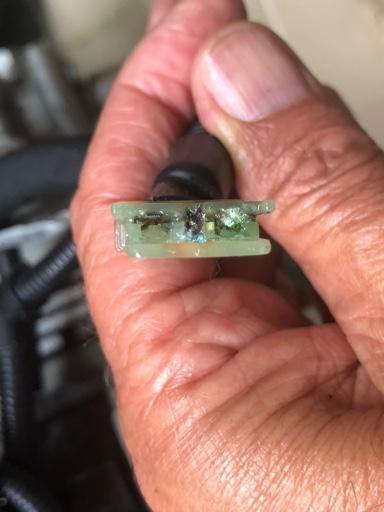
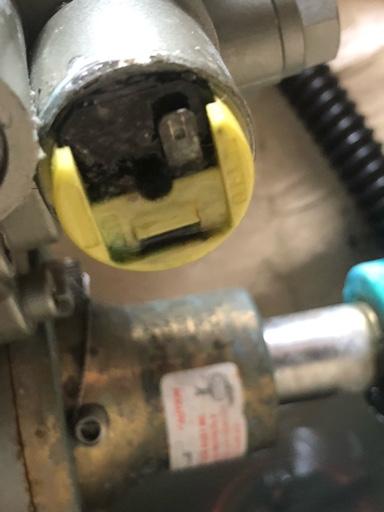
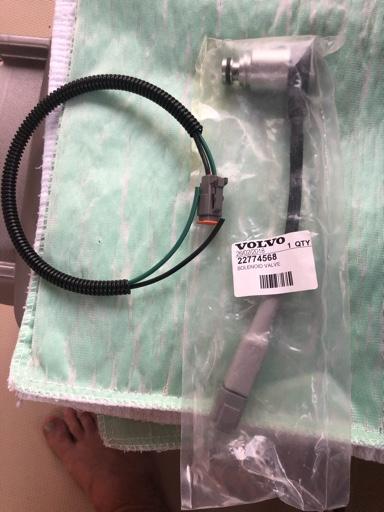
My great Volvo mechanic finally diagnosed and fixed issue that was a faulty solinoid
I tested the boat and ran 3 hours of sea trials to ensure problem was fixed
However I remain seriously concerned about the implications of this failure that is a total disarmament of the throttle, if this were to happen going through and inlet or pulling into a marina the consequences could be dia and extremely dangerous
I would like to here from Ranger or Volvo to understand if this is a know condition of this fault, also any other members of the Ranger family ever seen this issue ?
Thanks
 
Lukesdad":2qg68r76 said:
Update on issue as of 9/22/19
My great Volvo mechanic finally diagnosed and fixed issue that was a faulty solinoid
I tested the boat and ran 3 hours of sea trials to ensure problem was fixed
However I remain seriously concerned about the implications of this failure that is a total disarmament of the throttle, if this were to happen going through and inlet or pulling into a marina the consequences could be dia and extremely dangerous
I would like to here from Ranger or Volvo to understand if this is a know condition of this fault, also any other members of the Ranger family ever seen this issue ?
Thanks

Hey Paul,

Glad to hear that your tech was able to find and fix the problem. I did notice in your original post that you sprayed some stuff into the connectors, Volvo never wants any type of spray or dielectric grease in their connectors as it can cause more issues then fix. Thought I would let you know for future reference. As far as the issue at hand I haven't seen this be an issue unless the connector is corroded which typically is on the older solenoids where the connector connects directly to the solenoid. One thing to think about with a shift issue, when there is a problem while underway if it doesn't cut throttle it could potentially stick in gear and have no way of slowing the boat down. Let me know if you have any questions, email is best for me and quicker responses.

Thank you,
Kevin Lamont
 
I have a 2016 R31 CB that has the same SHIFT ACTUATOR FAULT.
What repairs were required to fix this issue? I am currently stranded at a marina in Brunswick, GA.
When the fault happen to us and the transmission shut down we were in the middle of St Simons sound in a major shipping lane. We had to be towed in and needed support from the Coast Guard.
Please advise
 
RRuff":37jyfjja said:
I have a 2016 R31 CB that has the same SHIFT ACTUATOR FAULT.
What repairs were required to fix this issue? I am currently stranded at a marina in Brunswick, GA.
When the fault happen to us and the transmission shut down we were in the middle of St Simons sound in a major shipping lane. We had to be towed in and needed support from the Coast Guard.
Please advise

Hello,

The service shop you are at will need to diagnose if one or both shift actuators are bad and need to be replaced. Do you know if you have the sealed actuators or not? The easiest way to tell is if the connector is directly on the actuator or if there is a pigtail harness coming off the actuator. With the non-sealed actuators you can apply some die-electric grease to the connector, DO NOT use grease on the sealed actuators that have a connector harness. In the past I have had this happen to me on new boats but did a software update and it cleared the problem. You can email me direct for a quicker response.

Thank you,
Kevin Lamont
 
Kevin,
We had a similar occurrence on our 2015 Ranger with D3 Volvo 200 hp.
The boat went out of forward gear and we had to get towed. The shifting solenoids had dielectric grease in the connectors.
Boat went to a shop in Anacortes and Volvo Tech cleaned connectors and downloaded software.
What software did you download and to what electronic module?
Thank you,
Patrick
 
Salmon Fisher":20krplde said:
Kevin,
We had a similar occurrence on our 2015 Ranger with D3 Volvo 200 hp.
The boat went out of forward gear and we had to get towed. The shifting solenoids had dielectric grease in the connectors.
Boat went to a shop in Anacortes and Volvo Tech cleaned connectors and downloaded software.
What software did you download and to what electronic module?
Thank you,
Patrick

Hey Patrick,

I downloaded software to the entire Volvo system, so the ECM, PCU and HCU's get an update if and only if there is an update needed. You may just have a bad solenoid, also I believe Volvo offers an update kit to retro fit the new solenoids to an older trans which is nice cause now they are sealed connectors. Hope this helps and feel free to email me if you have any additional questions.

Thank you,
Kevin Lamont
 
Hi Folks and Kevin,

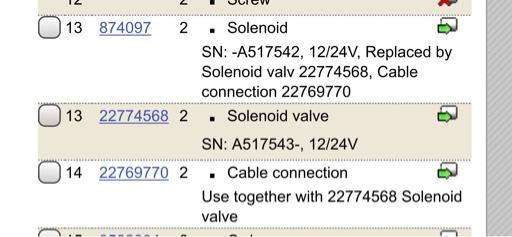
Had this shift actuator failure happen to our 2012 D-3 last weekend and indeed towed back. A little corrosion in the connector and the copper blade pin on the solenoid has failed and come off and the solenoid (and connector) needs replacing. Took it to a few trans shops without luck and they were shocked when I told them its a $603.00 (plus tax/shipping) and not a $9.99 part that looks similar to what they see everyday. Has anyone had any luck sourcing this outside of Volvo? I believe the trans in the C-26 is a ZF and the very small part number on the plastic housing reads " 3312308065" and "0.8-8.3 bars". Interestingly that comes up on a few sites as a ZF 24 Volt Solenoid....I thought our D-3's were all 12 Volt? Kevin mentioned a retrofit kit from Volvo that is sealed- anyone have any luck finding that? The stock solenoid is ferrous and not marinized- particularly vulnerable to shaft spray and salty bilge water due to close proximity. Thanks in advance!
 
Pretty sure Ranger can get you the sealed solenoid kit from Volvo as they put them on my R31 as part of their pre-delivery fixes to the boat. Though from what I understand talking to them they are just as expensive as you expect... around $600/solenoid.

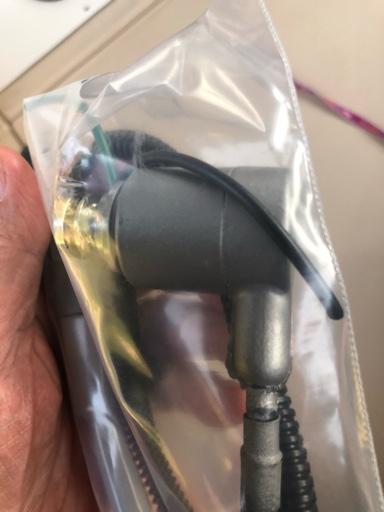
From looking at them it appears you get basically the solenoid with a sealed connector and then there is a sealed connector pigtail which gets attached to the existing harness with heat-shrink crimps. So not a hard retrofit to do yourself, just expensive.
 
OuttaTheBlue":3rt29st1 said:
Hi Folks and Kevin,

Had this shift actuator failure happen to our 2012 D-3 last weekend and indeed towed back. A little corrosion in the connector and the copper blade pin on the solenoid has failed and come off and the solenoid (and connector) needs replacing. Took it to a few trans shops without luck and they were shocked when I told them its a $603.00 (plus tax/shipping) and not a $9.99 part that looks similar to what they see everyday. Has anyone had any luck sourcing this outside of Volvo? I believe the trans in the C-26 is a ZF and the very small part number on the plastic housing reads " 3312308065" and "0.8-8.3 bars". Interestingly that comes up on a few sites as a ZF 24 Volt Solenoid....I thought our D-3's were all 12 Volt? Kevin mentioned a retrofit kit from Volvo that is sealed- anyone have any luck finding that? The stock solenoid is ferrous and not marinized- particularly vulnerable to shaft spray and salty bilge water due to close proximity. Thanks in advance!

Hello,

I would not buy nor would I trust any part that is not a certified Volvo part being installed on my Volvo engine to save some money. There could be a chance that the part fails or worse causes a bigger issue but that's just my two cents. You could order from us via parts@rangertugs.com or order through your local Volvo Penta shop, I always encourage customers to build good strong relations with their local shop, even if you don't like the price, never know when they will be there to save the day!!

Thank you,
Kevin Lamont
 
I am a bit late on this thread but there is an emergency work around for the transmission solenoid failure, its on page 74 of the Volvo penta operators manual ( D4,D6) . It involves loosening a screw and removing a washer which locks the transmission in forward for emergency use . You must then stop the boat by shutting off the engine , but at least it can get you back to the marina for repairs.
We had the issue on our 2014 R29 leaving the dock at Bowen , we got back on dock using the thrusters fortunately and repaired the corroded connectors using crimp connectors .. .not elegant but it works. They require regular protection with dielectric grease. Its also not a bad idea to build a little shelf above the stuffing box to limit the salt water spray..
 
This is true for most electric shift ZF transmissions. The emergency by-pass forward lock can also be used with D3's.
 
f881ecc4b798150755270014f885e61a.jpg

024205be59f59ebc6f929865d940bdda.jpg

ad5ea779eb7c0a461974325952a66548.jpg

fc91fbcecda68ce8ce052000c84c0aa6.jpg

20f09d0eb44a84683c3f9141e6761124.jpg

I experienced a loss of forward motion with our 2016 R-27 while underway near and Princess Louisa Park in British Columbia and required an extensive tow (6 hours) to a Volvo Penta workshop. Then it was a long wait for the parts that were flown in by sea plane after a 5 day wait. They are being installed first thing in the morning. I would strongly suggest that anyone with a Volvo Penta D3 / D4 with the old style trans solenoids that are open to shaft spray and corrosion upgrade to the new sealed solenoids before you get stranded in the middle of nowhere or something even worse happens. Yes they are expensive 600 US / 880 Can, but how much is your peace of mind worth? (Save your old solenoids for spares.)


Sent from my iPhone using Tapatalk
 
nomasrata2e":3nmglymd said:
I am a bit late on this thread but there is an emergency work around for the transmission solenoid failure, its on page 74 of the Volvo penta operators manual ( D4,D6) . It involves loosening a screw and removing a washer which locks the transmission in forward for emergency use . You must then stop the boat by shutting off the engine , but at least it can get you back to the marina for repairs.
We had the issue on our 2014 R29 leaving the dock at Bowen , we got back on dock using the thrusters fortunately and repaired the corroded connectors using crimp connectors .. .not elegant but it works. They require regular protection with dielectric grease. Its also not a bad idea to build a little shelf above the stuffing box to limit the salt water spray..

I'm a bit late too "nomasrata2e" and I don't see the emergency work around you site on page 74 of the owner's manual.

I think it is very important to share my experience. We e got the dreaded fault on our return from Olympia, "Check Shift Actuator" and needed to be towed back. We had no forward or reverse. We have a 2015 Cutwater 30 CB Volvo/Penta D6. What's even more concerning than this one failure to me was that the previous owner had the transmission replaced under warranty and the new transmission had the new sealed style that failed. So my replacement sealed solenoids are identical to the sealed ones that failed.

Only one of the solenoids went bad, but for some reason the other is linked causing both to stop functioning. Hence no forward or reverse even though only one was bad. I went ahead and had the technician replace both out of an abundance of caution. As you can see in the pics, although they are sealed, there still seems to be corrosion where the plastic seal joins the metal and a breakdown of the rubber collars where the leads go into the "sealed solenoid".

A rep at Pacific Power Group said because of the collars, "they might be suspicious for water intrusion".

OK, so like some have expressed concern in this thread, what if this failure happens in a tight situation, say rapid water at Deception Pass, or like the strong currents we get here in the Narrows. Or to Kevin Lamont's point, "One thing to think about with a shift issue, when there is a problem while underway if it doesn't cut throttle it could potentially stick in gear and have no way of slowing the boat down." That would cause a huge issue if it happens docking your boat and for other boats at the same marina.

Don't get lulled into a false sense of security that the new sealed solenoids are failure proof. I have a $2,000 repair bill to prove it can happen and an uneasy feeling about future faults!

I am interested in hearing from others.

 
Thank you for the info Sea Eagle.
 
The location of the reverse gear is close to the packing gland. This has been talked about in several threads. With a properly adjusted packing there is still a small amount of water that is slung off the shaft. This water or fine spray is hardly seen when the engine is running at say 3000 rpm and the shaft is turning around 1500 rpm but it is there. I noticed several times after a long hard run there would be water evidence of water laying on the engine stringer. not much just a few puddles. I could not see were this was coming from. ( I keep my packing gland adjusted no drips at the dock engine not running and 2 to three drips in gear running at an idle. I have made 2 adjustments in 430 hrs of run time approx. 1/8 of a turn. total) I finally found where the water was coming from I set the engine rpm at 3200. My wife at the helm I opened the engine deck hatch and put my hand about 4" above shaft/packing location. There was a fine mist of water visual on the palm of my hand and periodically a large droplet would be felt hitting my hand. I made a simple shield out of marine plastic sheeting that snaps to the bilge liner. This has proven to deflect all the mist and water down into the bilge keeping the spray from hitting the solenoids, engine mounts or any other equipment in the compartment. I believe keeping a good packing adjustment and a protective shield over the gland will help preserve the longevity of the solenoids.

gallery2.php?g2_itemId=67896
 
BB marine":189txh2t said:
The location of the reverse gear is close to the packing gland. This has been talked about in several threads. With a properly adjusted packing there is still a small amount of water that is slung off the shaft. This water or fine spray is hardly seen when the engine is running at say 3000 rpm and the shaft is turning around 1500 rpm but it is there. I noticed several times after a long hard run there would be water evidence of water laying on the engine stringer. not much just a few puddles. I could not see were this was coming from. ( I keep my packing gland adjusted no drips at the dock engine not running and 2 to three drips in gear running at an idle. I have made 2 adjustments in 430 hrs of run time approx. 1/8 of a turn. total) I finally found where the water was coming from I set the engine rpm at 3200. My wife at the helm I opened the engine deck hatch and put my hand about 4" above shaft/packing location. There was a fine mist of water visual on the palm of my hand and periodically a large droplet would be felt hitting my hand. I made a simple shield out of marine plastic sheeting that snaps to the bilge liner. This has proven to deflect all the mist and water down into the bilge keeping the spray from hitting the solenoids, engine mounts or any other equipment in the compartment. I believe keeping a good packing adjustment and a protective shield over the gland will help preserve the longevity of the solenoids.

gallery2.php?g2_itemId=67896

Thanks a lot BB! That was very helpful information. I was trying to think of a way to shield the shaft and stuffing box. I was thinking about using clear polycarbonate (Lexan) so I can still see through without having to remove it for inspection. I was also thinking about further sealing the rubber collars around the solenoid wires with high temp silicone sealer. And finally, I am considering a dripless stuffing box later this year. What are your thoughts?
 
Status
Not open for further replies.
Back
Top