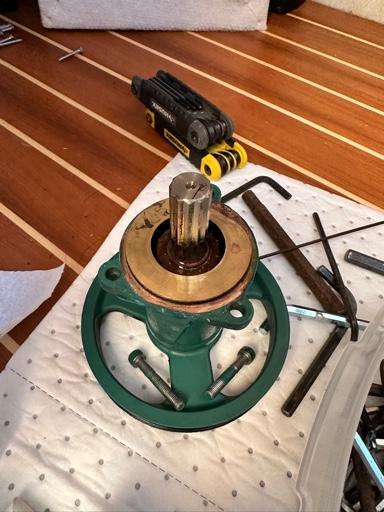
Impeller replacement…

dougxn

Well-known member
Joined
Feb 22, 2022
Messages
78
Fluid Motion Model
R-27 Classic
Vessel Name
Celtic Sun
MMSI Number
368274950
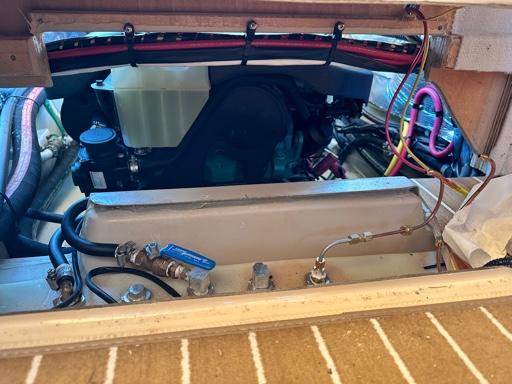
Seems like the right time to do this, but doesn’t look easy[emoji2369]
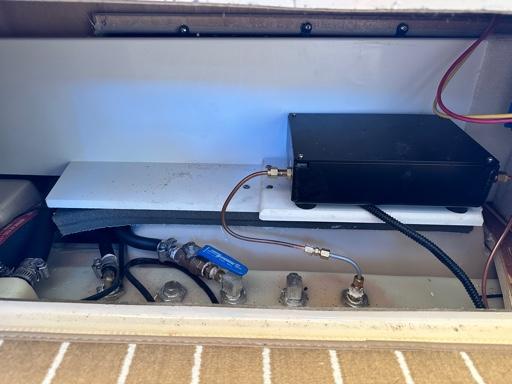
4f017ce5ca1b94b65fe0ae0bd6113681.jpg


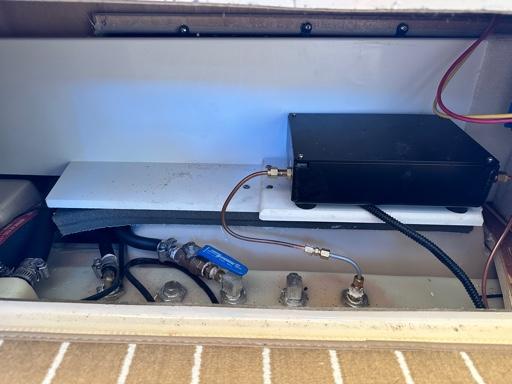
I presume this little black box has something to do with my webasco heater, so that has to get moved out of the way, but this access looks really small[emoji53] Anyone, have any tips before I start trying to loose weight to climb in here[emoji37][emoji2962][emoji2959]


Sent from my iPhone using Tapatalk
 
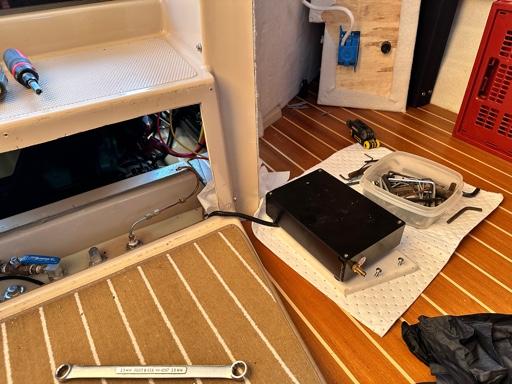
The black box is the pump for the heater. Do no disconnect it. Take out the screws holding it down and move it to port out of the way. There are several panels to take off to port of the stair. One slides out of the way completely (the athwartship panel) after all the screws are out. The fore/aft panel to the immediate port of the stair also comes completely out. After sliding the black box to port, several screws will be revealed, allowing for the removal of the shelf the black box is (was) affixed to. This allows better access to the impeller housing. It also allows for better inspection of the belts and tensioners.

Some of the screws are kinda hard to find in the mouse fur...be patient. When all the screws are removed, the panels are easily moved/removed.

Good Luck.

TK
 
I took a step further for access and did what a few other owners did and cut the top of the step out like this.

Here's the link:

gallery2.php?g2_itemId=39436

Then I simply put a nicely finished piece of 3/4" plywood on top with some non skid strips on it. I screwed it down to the margin of fiberglass with 4 ss wood screws.

This is what the factory should have done for access as it is very much impossible to wriggle under the step to do the work.
I still need to do what Red Raven did to make the interior panels easier to remove.

This link shows what the owner did to cover the cut step.

gallery2.php?g2_itemId=39393&g2_page=4
 
Here's a link to a YouTube video that goes through the whole process. https://youtu.be/5mMUDJ9c3zE

The first time I did it, it took about an hour and a half...and dozens of cuss words. After 3 or 4 times, it took 30 minutes and maybe 20 cuss words. Long sleeves and gloves are your friend, the fiberglass slivers from around the opening can be ugly.

Chris Boyd
EX Ranger Tug 25SC
Destined Nomad
 
Thanks so very much everyone!! I will get going soonish on this project, but I am sure I just saved a ton of work and [emoji2959] with your help. More later.


Sent from my iPhone using Tapatalk
 
Salmon Fisher,

Thanks so much for including a picture of how you cut out the step to get much improved access to the front of your engine. I agree 100% with you that it would have been fantastic if Fluid Motion had built the boats with such a capability. It certainly makes access to the front of the inboards so much better for annual maintenance on the water pump, belts and belt tensioners as well as any other work on equipment on the front of the engine.

The link you attached:
gallery2.php?g2_itemId=39393&g2_page=4 from I think Dave Cook shows a very well done fiberglass replacement step for the cut out. If this was available, I would in a heart beat make the cut out and install the new replacement step. Building such a fiberglass step is above my pay grade, but I could make the cutout and drill screw holes!

I have a question for the FORUM - How many people would be interested in doing this modification if the replacement fiberglass step were available and didn't cost an arm and a leg?

Question for FLUID MOTION - Would you consider fabricating such a replacement step for those owners who signed up and pre-paid for the step? If you are not interested in this idea, would you work with a third party after market company who could build such a piece?

I look forward to hearing back on the questions posed.
Regards,
Bob Allan 2016 R-27C
 
Question for FLUID MOTION - Would you consider fabricating such a replacement step for those owners who signed up and pre-paid for the step? If you are not interested in this idea, would you work with a third party after market company who could build such a piece?

I am sorry but we would not be able to manufacture or fabricate these steps. For someone that has a table saw, these are two rectangle pieces that should be pretty easy to do.

Thank you,
 
What I did was use a multi tool to cut the top of the step away leaving a 3/4" margin like in the photo.
I then used a piece of cardboard to make a template for the top step. Then I used the template on a nice piece of finish grade 3/4" plywood. To make the plywood fit the best along the two side and back, I gently rounded over those edges. I finished the plywood with a stain that looks like teak and used polyurethane to finish. As I mentioned above, I put 3 strips of non skid material on top of the plywood. Attach top step using stainless wood screws and countersink to make screws flush.
For the front of the step, I just left the existing teak removable panel there.

Good luck, it makes a world of difference.
 
Salmon Fisher,

I am going to make this modification, but unfortunately my boat is stored for the winter in Alaska some 3000 miles away. Does the new 3/4" plywood step meet the existing removable front riser for the step? Or is there a small gap that needs to be filled? Does the new plywood step contact the riser to provide support for the new step? I don't remember and I don't have pictures to show how high the step riser comes up on the front of the step.

Thanks,
Bob
 
Bob,

The new plywood step meets the existing front riser very closely, but does not touch it. I too was concerned about the riser supporting the new step, but didn't need to be. You will have plenty of support on 3 sides of the step, on both sides and the rear where you leave at least a 3/4" to 7/8" margin of the original fiberglass step. If you want more support on the front edge of the new plywood step, you could easily glue and screw a piece of 1"x1" hardwood underneath it.

Patrick
 
Patrick,
Thanks for clarifying about the forward support for your new step. Do you have access to your boat? Could I ask a favor?

I'd like to fabricate a replacement step at my home over the winter in Texas so it will be ready to install next summer in Alaska when I get the boat ready. Is your step rectangular or trapezoidal in shape?

Could you provide the length x wide of the step you fabricated?

Many thanks.
Bob
 
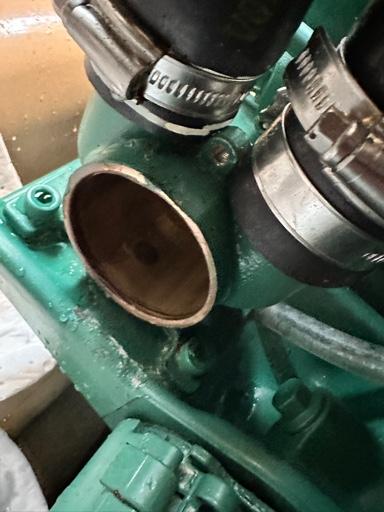
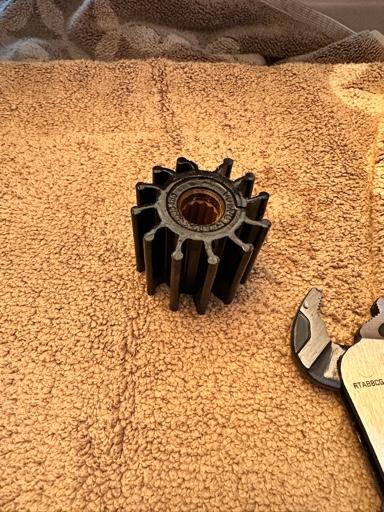
So, thank you everyone for the pictures, videos and help!!! I replaced the impeller today - 2 hours. It went relatively smooth. I will say, I really admire you guys for crawling in that space- wow, that was tight[emoji37]

But it would have been way harder with out your help! So thanks again!

287f065bbeef24de79b770adcc864e48.jpg

b4758d1c5cec90f9cb880f611bdf7b48.jpg


26e3fb19df6f7f97365c7eb8b182ec7f.jpg

9adcff5599473b8a9900e6d0cf0bd356.jpg

3f92350eec6bcfa7d06697c62595de91.jpg

03d8ba7bc722ba56cc66f2d346e1de97.jpg


Somewhere on the water [emoji97]
 
tlkenyon":3t35bc51 said:
The black box is the pump for the heater. Do no disconnect it. Take out the screws holding it down and move it to port out of the way. There are several panels to take off to port of the stair. One slides out of the way completely (the athwartship panel) after all the screws are out. The fore/aft panel to the immediate port of the stair also comes completely out. After sliding the black box to port, several screws will be revealed, allowing for the removal of the shelf the black box is (was) affixed to. This allows better access to the impeller housing. It also allows for better inspection of the belts and tensioners.

Some of the screws are kinda hard to find in the mouse fur...be patient. When all the screws are removed, the panels are easily moved/removed.

Good Luck.

TK
Hey, tlkenyon, you said not to disconnect the webasto heater pump[emoji51] I could not see a way to accomplish this task with disconnecting it[emoji2962]it is hard plumbed so to speak - can you tell me how sorry I am going to be about this situation? Thanks - dn


Somewhere on the water [emoji97]
 
You will have air in the lines and, I have been told, the heater will (might) have some problems getting going. I do not have first-person experience as I have always kept the heater box connected. Let us know what happens. I have considered changing out the solid lines with hoses, but and kinda chicken....
 
This looks like it was more difficult than in my C30, which I thought was already pretty difficult. Bravo for these mods to make it easier...
 
To the Webasto question, you do have to disconnect the fuel lines to move it in my experience. I would not want to bend them far at all.

The next time you use the heater, it will probably take about 3 tries to get it to start. The air in the lines will give an ignition error after it tires to start. When that occurs (blinking red light, 5 blink if I recall), turn it off, wait a minute or two, then try again. After 3-4 tries it should start.
 
I have a couple of suggestions to add to the D3 water pump impeller change out. (1) when removing the impeller from the pump housing it is easier to remove the impeller with the pump cover bearing and pulley assembly as one. Once the three socket head screws are removed grab the pulley and start to turn it clockwise (facing the front of the engine) at the same time start to pull the cover/pulley assembly out. This will walk the impeller out of the housing but also keeping it engaged to the shaft splines and cover assembly.The removal will be a complete with one move. When working in the tight compartment area it makes impeller removal much easier. A similar procedure for reinstalling the impeller. Install the o-ring seal then slide the impeller on to the splined shaft. Lubricate the interior of the pump housing and impeller blades with the lubricant supplied in the kit. Start the impeller into the housing applying a slight pressure then turn the pulley clockwise and it will walk the impeller into the housing with ease. Push the pulley as you turn it and seat the complete assembly with impeller. This positions the impeller blades properly with little effort. Again working in this tight area the least amount of moves the better.
(2) The weak link of the power belt assembly is the belt tensioners. The belt tensioners used on the D3 engines are notorious for seizing. The number one reason is they get contaminated with water when technicians change water pump impellers. When the pump housing cover assembly is removed the water that is in the water hose and pump housing spills out. When it spills out it drains all over the belt tensioner. The bearing used in the tensioner and the spring assembly are not sealed. When exposed to salt water the life expectancy is not long and the tensioner locks up and in a short period of time no longer works properly. Most technicians don't think about protecting the tensioner from the water. It is easy to just place a rag that has some penetrating oil saturated in it over the tensioner before pulling the pump cover pulley assembly off. This will protect the tensioner from water. and moisture damage.

As a yearly maintenance item when replacing the impeller I did this plus one more step. I sprayed the tensioner with penetrating oil and the exercised it by releasing and then tensioning the spring a few times. I would make sure there are no catches and the spring arm works freely. This insures that the tensioner is working properly. I did the same to the alternator tensioner. If both exterior tensioner are working good this gives a good indication that the timing belt tensioner is going to be ok. If you find that the tensioners are not in good condition it may be a good idea to inspect the timing belt tensioner under the cover. The D3 are marinated automotive engines. Salt water and air exposed to some of theses components can shorten the life expectancy if not maintained. I know of more than a few D3 owners that had early engine failures because these simple checks were not done and the components were compromised from the elements.
 
Hello All,

Has anyone done this step cut-out on an R25SC (Volvo)? It looks to me that the step top has a different shape on the R25 compared to the 27., at least looking at these pictures. If any one has done this on a 25, it would be great to see some photos!

Thanks
 
I changed the impeller a few times on our R25SC ( 2015 model year) (sold that boat when we ordered our R29S) and the pictures looked just like those posted above. I found it was not necessary to make any alterations to the step section for access.
 
Back
Top