Max Extended Cruise RPM

I agree with that about statistics. In my work we call it bean counting and the beans never add up ! I'm looking for real numbers . The factory numbers are off a bit , one could argue salt water to fresh water , test runs done in perfect conditions, and maybe a little human factor added in . I agree each boat is going to run different , load distribution , how much gear , weather conditions , and bottom condition . I have a couple years to figure it out . Each trip we take I clear the trip on the Garmin write down beginning hours , remaining fuel , ( a must because of inaccurate fuel gauge ) date and time and weather conditions and go . I will switch back and forth from Navigation on plotter to fuel on the garmin and find the best rpm/Gph/mph then switch the Volvo gauge to engine and monitor temp / boost/ and run . When I fill up the tank I reset the fuel tank on Garmin and then do calculations on fuel economy . I base on miles per gal and hours per gal . I did a 100mile trip last week average running speed 3220 rpm, average 12kt , average 14 mph , average 2 mpg , 7 Gph , burned 49.4 gal fuel , my garmin was off by 1/2 gal on fuel left in the tank . Weather conditions 75 degrees , waves half the trip 1 to 2' then increased 3'to 4' . At 2200 rpm I'm at 7kt , 3mpg , 2.6 Gph . Anything slower then that the numbers come in with great economy . Anything above the 2200 rpm I might as well throw the throttle down it doesn't change much just get there faster and put less hours on the engine . As far as the Cutwaters being faster , I think the 28 is much faster then the tugs , but the 26 runs about the same. The extra 2 feet with that hull design helps the boat to level out a little more . It has just 40 hp more and is a good 5kt faster . I really like my 26 Cutwater just a little disappointed in the performance . Hopefully with some more running time , and more information from experienced Cutwater/Ranger owners ( Tugnuts ) I'll get it dialed in .
 
BB Marine,

You mention switching back and forth from Navigation to Fuel on the Garmin. It sounds like you are not displaying your fuel usage and economy on your navigation display. On our boat (Garmin 7212) in the chart setup you can turn on what is called data bars. One of them (I can't remember the name, maybe fuel economy or something like that) displays your fuel usage numbers including GPH, MPG, fuel remaining, and range in a data bar at either the top or side of the screen. I have that data bar turned on for each of the chart options I regularly use and find it indispensable.

Hopefully you have the same option on your boat. Switching back and forth would be a real pain.
 
BB Marine,

As noted by Red Raven, you can set up your chart plotter to include Data Bars and have your screen split into multiple windows. This makes it possible to get all the info you normally need on a single screen. See a sample of my Garmin 7215 that is split up to allow displaying a lot of info. Click on the thumbnail image to get a larger view of the pic:


Once you have your Chartplotter set up similar to this image, then you can take snapshots with your cell phone as you cruise along under varying conditions. Afterwards, enter the data points into Excel and plot it to get an overall "picture" of your fuel usage versus various speeds/RPM and conditions.
 
Nice ! I monitor all that by switching display . I didn't know That I could put boost , temp , engine functions on there I do have speed and mpg on it . Thanks for the tip .
 
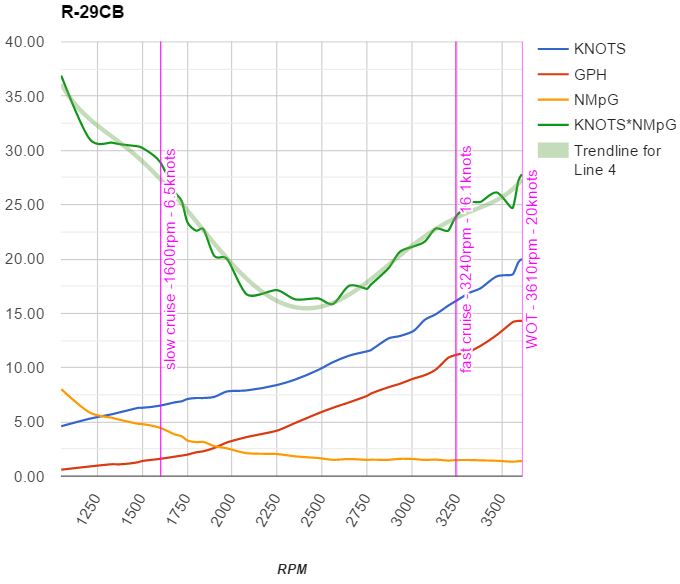
I spent some time today gather metrics on our R-29CB performance in a similar format to Red Raven's. This was with a half tank of fuel, half tank of potable water, 3 crew members, bottom paint, 1 foot waves in fresh water. I particularly like his patented NMpG*KNOTS metric. Based on this I like to avoid anywhere between 2000rpm and 3000rpm.

click the image for more detail:

 
Cessna172 said:
Quote from page 61 of the D4 Operating Manual "For best fuel economy operations at full speed should be avoided. We recommend a cruising speed that is at least 10% below the maximum engine revolutions at top speed (full throttle)".
.
.
So according to these sources, if your maximum engine rpm is 3600, maximum recommended cruising rpm would be 3240.


From our experience with a somewhat similar 26-foot boat and similar engine, sounds right to me. For New Moon's 260 hp Volvo KAD44P (WOT RPM 3800-3950 if propped correctly), I was told by one of VP's traveling expert engine techs to cruise at no greater RPM than 10% off WOT. This guy supported their dealers and service organizations in the western US.

He also said that RPM lower than 90% of WOT would be even better for longevity. For higher-speed cruising, RPM of 3200-3400 or sometimes 3500 would be his recommendation. He said operation at WOT for brief periods was fine, but not for extended cruising.

Cruising at lower power levels (not idle - maybe 1300 or 1400 RPM, enough power to keep the engine temp up to 175 degrees or so) is OK too, once the engine is broken in. Occasionally after a long stretch of low power operation, running up to planing cruise speed to bring the engine up to full heat for a few minutes is a good idea.

Following these recommendations has worked for us. Our 44 has 6,500 hours on it in 18 years, and still uses no more oil than when it was just broken in. Two thirds of those hours have been at 1300-1400 RPM, 6-6.5 knots. The other third at 3200-3400, 16-18 knots.
 
spierp, nice chart!

It's good to know I'm not crazy to think about it this way. 😎
 
I seem to remember the Volvo guy giving the seminar last fall at Roche Harbor mentioning no more than 10% of engines max recommended rpm for extended periods. Then he said in the case of a D-3's he would even suggest even 15% off ( of max rpm(4000) = 3400 rpm if we went to the same schools together.
 
One thought that came to me. The D3 engines differ by their turbos, injectors chips etc. but essentially the 150 and the 200 or 220 are the same engine. The higher power is much a function of the higher operating speed. So if you can run a D3-200 at up to 90% of 4000 for cruising (3600 rpm) why is a D3-150 limited to 90% of 3000 (2700). I asked the question of a Volvo Penta sales guy at the Vancouver Boat Show. He didn't have an answer.

Interesting question
 
that's a very interesting question Chimo.

Out of curiosity, what do people suppose is the life expectancy of one of these D3/D4 powerplants? And then if you're running 95% WOT for isolated extended periods of time, but otherwise keeping the engine properly maintained, are you shortening its usable life by 250, 500,1000, 2000 hours?
 
The local Volvo construction equipment shop guy told me that there is no difference between the D3 used in their commercial gensets and the marinized version...outside the marinized cooling and exhaust. The engines are the same, and he has been certifiably doing my warranty-required maintenance. He sez the gensets run at WOT forever and that as long as the temps stay in bounds, there is not problem with prolonged WOT runs. The owner of the shop agreed with him.

Interestingly, I asked the owner how to turn my D3-150 into a higher HP version, and why the 150/170 and 200/220 versions have different red-lines even though they are essentially the same engines. He said that was confidential and proprietary and could not divulge that info. Interesting...
 
I wonder why a generator would be set to run at maximum rpm's in the first place. That aside I have been told by more than one dealer prolonged max rpm should avoided. Also do not over fill with oil. At $30,000 dollars for a replacement Volvo D3 engine I'll error to the conservative side. I mean it for us is the difference between running 15 or 20 mph. Plus the fuel mileage does not improve with rpms. Happy Sailing!
 
They axed it because the guy who put the law in lost reelection in 1980.
 
I do not get the 1980 election reference.....

The service guy also said that "max RPM" is a governed speed, not the actual max that the engine will turn. I think the generator has to turn at a specific speed....anyway, maybe he was blowing smoke. Who knows?
 
tlkenyon":290lcry7 said:
I do not get the 1980 election reference.....

The service guy also said that "max RPM" is a governed speed, not the actual max that the engine will turn. I think the generator has to turn at a specific speed....anyway, maybe he was blowing smoke. Who knows?

This would seem to make sense though I do not pretend to be an electrical engineer. The generator should produce 60 HZ power to be of any use. Without gearing it would follow the 7200 logic, same as for a motor, and a 2 pole generator would need to turn at 3600 rpm. This would be an asynchronous generator but some simple electronic conditioning would make the output fine for most use. Obviously it makes sense to govern at that speed, which is coincidentally 90% of the 4000 rpm limit for the D3 - 200.

BTW, this engine is widely used in cars in Europe. In gasoline version I believe (stand to be corrected) it is the Volvo T5 used in many cars here in N.America. Just fun facts.
 
This would seem to make sense though I do not pretend to be an electrical engineer. The generator should produce 60 HZ power to be of any use. Without gearing it would follow the 7200 logic, same as for a motor, and a 2 pole generator would need to turn at 3600 rpm. This would be an asynchronous generator but some simple electronic conditioning would make the output fine for most use. Obviously it makes sense to govern at that speed, which is coincidentally 90% of the 4000 rpm limit for the D3 - 200.

I love this! Makes sense to me.

I'm sticking with 3600 max rpm!
 
Earlier on in this post someone mentioned you get more miles between service intervals running faster. That is because modern hour meters are just clocks. Older equipment had mechanical tachometers and hour meters. The meters referenced "Hours at 2550 RPM". Some might have been different but 2550 was the standard for farm equipment. Thus the meter compensated for slower running which makes perfect sense. The only thing that contaminants the engine oil and filters is burning fuel. Run at lower power and you can extend service intervals.
 
Back
Top