Navigation: Creating a Deviation Matrix

BaseCampAnne

Well-known member
Joined
May 24, 2009
Messages
258
Fluid Motion Model
C-288 C
Hull Identification Number
FMLT2916B313
Non-Fluid Motion Model
Eddyline Skylark, Mariner Coaster (kayaks)
Vessel Name
Cascadia
MMSI Number
367604650
At tonight's Coast Guard Auxiliary navigation class we heard that each individual boat is unique and has a different deviation, so we should create our own deviation matrix based on 30 degree increments. Several instructors and students with Navy and Coast Guard backgrounds (I am in San Diego currently) had experience with that and spoke up. They also mentioned how their own boats vary and may be +3 degrees W at 30 degrees and can be -1 degree E at 60 degrees, etc.

This is new (and confounding) information to me, and along with checking set and drift every 30 minutes while in transit, seems to be a lot of work in our world of modern electronics, although possibly satisfying if becoming proficient.

Later we were practicing plotting a route to Catalina, and then a reciprocal route back. I had no idea there could be a difference in the return based on our own boat's deviation, which could have us going towards Ensenada and possibly missing San Diego.

I feel like this is a parallel universe to using our Garmin or Raymarine chartplotters, but certainly not parallel in terms of effort :!: On the other hand, that might be premature, since I still have lots to learn about the Garmin system.

I carry paper charts and review them before a trip, but have not done this level of work. Now I wonder if other Tugnuts have created a deviation matrix, use it, and go through both ways of plotting a course each day when going to someplace new :roll:

Perhaps this is an introduction to one of the many areas of knowledge needed to head north to Alaska or south to Baja 😀
 
Hi Anne,

There was some discussion of this a while back on the C-Brats, evolving from the poll of "Who still uses a compass on their boat?" Many feel if you aren't going out of sight of land, there isn't much use for a compass on a boat. (Not my opinion, btw) With all the great nav devices at our disposal, it is so easy to press a few buttons and follow the path on the screen.

I was a pilot in the days of E6Bs to calculate wind correction, fuel burn, time en route. When the first panel-size lorans (after closing the "mid-continent gap") and hand held size flight computers came into use, flight planning became WAY less tedious. The first GPS we used on our sailboat was amazing! No charting - it gave us numbers that showed our actual lat/lon, track, and speed over the ground!! We never envisioned chartplotters that showed "You Are Here" like the directory in the mall. 😉

Seems that our nav gear has divided folks into two camps: the compass and paper chart folks, and the electronic gear folks. I had to do chart plotting (not to be confused with using a chartplotter) to pass the test for a captain's license. The only use for that these days is if you are ded reckoning (that is not a typo - "ded" is short for deduced). The compass and chart folks side of the argument is: electronics can fail. The electronic gear folks will come back with: the best back-up for a GPS is another GPS (or two), with separate power sources.

Personally, I think having the skills to use paper charts (and a compass, parallel ruler, and caliper) allows you to better interpret using an electronic chartplotter. Is it absolutely necessary to cruise by boat? Probably not, since there are plenty of people out there traveling by boat who have never plotted a ded reckoning course. Frankly, if you are "doing the Loop" or going up the Inside Passage, you will come across many people doing the same who do not have chart plotting training. (Rarely out of sight of land) While we're at it, when's the last time any boater you know used a sextant? 😉

For full disclosure, I still do trip (route) planning. Instead of spreading out a chart and tools the night before, I use an iPad and an app. That same iPad is one of my "back-ups."

One of the other effects of all that nav gear on our boats is what it does to a compass. In aviation, the deviation on a compass card was required to be checked regularly (and noted in the logbook), with all the other electronics on. The deviation will change according to various electronic gear in proximity. If the chartplotter isn't functioning, have you checked the deviation of the compass with that electronic gear on AND off?

If push came to shove, all your electronic gear died, and you didn't have a compass on the boat, could you get back from Catalina Island? Sure: see where the sun is in the morning (east), head that direction, and when you reach land, do what "Captain Ron" taught us: "Pull in somewhere and ask where we are." 😎

Happy plotting.

Best wishes,
Jim (USCG licensed Master)
 
Thanks for your comments Jim,

I have been wondering more and more if many boaters keep a foot in both "parallel universes." One of the things I have missed that you pointed out was having different sources of power for the electronics.

The iPad sounds so convenient and useful for navigation planning and backup, but in my C-Dory years I found that once my iPad was drained I was not able to recharge it when underway again. Now I no longer have an iPad, have Garmin on Cascadia and am following the iPad charging discussion on this site. Adding to that since moving aboard I no longer have my desktop computer so recently purchased a laptop.

I feel a bit awash with factoids and changing situations and am deciding it is time to clarify and make some choices.

Perhaps rather than trying to choose one system over another, this is an opportunity to take the time to continue to learn and practice the compass and paper chart form of navigation. Maybe I will purchase a new iPad, which together with compass and charts might be a good use of time and money and deepen my slowly-developing knowledge of navigation.

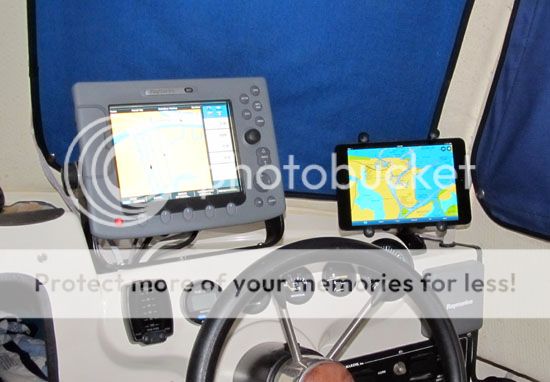
Herb of Willie's Tug suggested that as a solo boater it would be good to have the chartplotter and iPad visible. (Thanks, Herb.) And after you mentioned it, I recall seeing several photos of C-Brat boats showing two screens, including Sam Landsman's. Have any Tugnuts posted photos of where to mount an iPad on a 25?

Coming full circle, that leads to wondering if/when finding a place to mount an iPad, there will be another issue of compass accuracy due to introducing another electronic feature? I was hoping a solar panel would power the iPad, but that sounds extremely slow. Does this ever get sorted out?

How do I use both electronic systems, use different power sources and not impact the compass functions :?:

Suggestions, comments?

Thanks,
 
Remember when navigating there is variation and deviation you need to compensate for variation depending on where you are located on earth. As an example in my area of the Northeast I have to allow for 14 degrees of variation regardless of my compass. Once I know variation I then have to add or subtract for compass deviation. If you want to calculate a course accurately you also need the component of wind and current. The GPS does make life easy, basically point and shoot. You can also correct for compass deviation by "swinging" the compass and there are adjustment screws to make corrections. Even with this the compass will have deviation and you should carry a card indicating the corrections that need to be made minimally on N,S,E and W headings. I have not been as meticulous as I should be with this and did come upon a situation the other day when I had to make a turn heading 212 degrees at a particular channel marker for 1 mile and my course was a bit off, so you never know when you may need the accuracy. I used to swing my compass in my plane at the airport where they had a compass rose painted on the ground. It is much more difficult to do it on the water, but since we can trailer our boats doing it on the trailer in a parking lot with a simple boy scout compass should work just as well.
 
An easy way to swing your compass (boy, that sure sounds like euphemism for something nasty) if you have a GPS is to set a magnetic course by your GPS and record the resultant compass heading. Do this for several headings and you will end up with a rough deviation card. It will also take into account the magnetic deviation for your area, but is is only really good for your area, as the magnetic deviation varies with your position relative to the North Magnetic Pole. It is not a lot, but over the distance of a hundred or so miles, can be significant (again, depending on where you are). It also accounts for some of the electrical disturbances from the stuff you usually have operating. Of course, if you need the compass because all your power is out, you would need to iteratively turn things on and off and see the impact on the compass, but that gets a little crazy....
 
If you have the autopilot option you should also swing it so any deviation it has can be electonically corrected. Once you do this you can check your compass against the autopilot heading. The autopilot manual explains how to put the unit into dealer mode so you can swing it and adjust North. On a calm day you cruise in a slow circle so it can automatically compensate deviation, and head in one direction for a while so it can determine North based on your GPS. (at least for the Garmin system, not sure about others)

I need to swing the compass in my R27, as shipped it has a LOT of error in some directions. I also plan to swing the autopilot and set North this spring.

I use an iPad as a backup chartplotter, but even with this you are still dependant on one GPS system which can be shut down, have satellite failures, or be jammed. A good compass, paper charts, and the knowledge on how to use them can be important. I also carry paper charts and some plotting tools. A habit from years of flying both VFR and IFR.

I learned the importance of an accurate compass deviation card during instrument flight proficiency checks. My flight instructor was an old school navigator having spent 20 years in the Navy as a navigator on Lockheed Constellations and C-130s. He used to love giving me a NDB approach that used an off airport beacon. A little compass error (or ADF misinterpretation) could put you very, very far from the airport.

Howard
 
Anne:

Having the iPad and say Garmin's Bluechart Mobile Application is an excellent 'backup'. However, be aware that if you use the iPad for GPS navigation purposes the battery drain is significant and should not be ignored. For this reason I would suggest you also have a means to power up and charge up the iPad when afloat. Four iPad companion devices come to mind.

1) Monoprice External Battery Pack/Charger for iPad, iPhone, iPod, etc-5000mAh ($32)

2) Mophie Juice Pack Powerstation External Battery ($80)

3) HyperJuice External Battery 222Wh for iPad/iPad 2 & MacBooks (MBP-222) ($450)

4) High Power 2Amp Car Charger For Apple iPad 3 iPad 2, iPad (UK £4.95) http://www.amazon.co.uk/2Amp-Car-Charge ... 168&sr=8-6

Take your pick.... 🙂 :roll:

Further advice...

1) Always have your iPad fully charged prior to departure.
2) Don't have the iPad turned on unless you need it. The battery drain as mentioned above is significant.
3) Invoke the iPad's GPS navigation software ONLY when needed -- to conserve its battery charge.
 
How's this for timing: I made a blog post today regarding RAM Mount stuff to use the iPad Mini in the boat...

http://captnjim.blogspot.com/2013/01/th ... stand.html

And a look...

FrontMountBoatE.jpg


If you have an available 12v plug, you can power the iPad while underway, even if it doesn't say it is charging; or, use a small inverter and plug in the small wallwart. Since you are in a marina, there's no issue with charging an iPad when you're plugged in.

And just for discussion sake, we have all US charts on DVDs. If the satellites all go out, it is likely that we have a bigger problem than getting back from Catalina Island. We have accumulated a lot of paper charts over the years, but I don't intend to buy anymore. The electronic charts are just as functional as the paper version and it is a LOT easier to store them. And, the price is right. 😀

Best wishes,
Jim
 
Keep in mind that the GPS is tracking the heading of the boat's track/path, not the heading of your bow. So if you are trying to swing your compass using that method you need to do it in a place that has no wind or current so that boat track heading is the same as the bow heading. And as Howard noted, you need to swing the autopilot compass before you use it to swing your compass. This is why, in my opinion, doing the compass swing on the trailer would be the most accurate way of doing it. Granted, it may not be the easiest if your boat is currently on the water.
 
Knotflying is absolutely correct.....the conditions must be appropriate, i.e, no significant wind and no current...and this is, at best, a rough approximation of what a professional would do. It might just be a place to start and get an idea of agreement between your instruments but should not take the place of professional assistance. For us inland lakes guys, not a big deal (Capt. Ron method). For you true seafarers...another deal altogether.
 
My iPad charges from the 12 volt power outlets in our boat with an inexpensive adapter purchased a local electronics store. During the summer, that is the only way we charge our iPad. It is very effective. I leave it plugged in as we cruise with Navionics and GPS on and tracking.
 
Thanks, fellows!

I am happy to say I am more comfortable now than I was Wednesday evening after class 🙂

The paper charts, compass and navigation tools are a part of my resources, and since I am in the Auxiiiary i will be regularly practicing using them. My experience seems to be that a little bit of knowledge is confusing, and so it goes, so i keep asking questions 😀

Having two electronic systems working for navigation in first and second place sounds ideal, and I will probably purchase an iPad and adaptor and hope the 12v system will work fine as it does for some of you for two separate sources of energy. Baz, I will also look into a separate charging pack. And as you say, Jim, there are other electronic resources such as the phone and laptop.

Getting the compass and autopilot precise, or at least more accurate, is also a good suggestion, and although I am not sure that I will work on that in the immediate future, I know I can experiment more now with this additional understanding.

Seeing the matrix you posted for electrical charge, Herb, was a good reminder to me that there are practical ways to keep reminded of important information (not that I am ready to work on electrical charge issues currently :roll: )

Thank you all,
 
I know we are getting a little off point here and mixing two threads, but as far as charging goes I also use one of those cigarette lighter inverters and that seems to work fine for everything. I carry a few and very rarely use the boat inverter.
 
Back
Top