R-21 Yanmar vs. Volvo

REO6205

Well-known member
Joined
Feb 21, 2015
Messages
166
Location
Fortuna, Ca.
Fluid Motion Model
R-21 EC
Hull Identification Number
FML2138C414
Vessel Name
Chenier
MMSI Number
338228251
Those of you who have actual experience with both the small Yanmar and the Volvo in R-21's...which do you like better?

Which runs smoother, which is easier to work on, which has better parts availability?

Has anyone swapped the Yanmar for the Volvo when it came time to re-power?

Which engine do you actually prefer and why? Thanks
 
Hi,

RT11002003, might be able to answer this question for you, I think that he had both the Yanmar and Volvo engines on the last few tugs that he owned.
 
I haven't heard from him. Maybe somebody else will have an answer. Thanks.
 
Two of my R21EC's had the Yanmar; the present one has the Volvo. I did the maintenance work on the first Yanmar: adjust valves, align the shaft, change oil, change filters,etc.. Never had call to do any work on the second Yanmar. My Volvo has 42 hours, I drained the oil on Monday, couldn't get the oil filter loose by hand. Will take my trusty oil filter wrench and change the filter today. Can see no difference in those tasks for the different engines. The one thing I didn't/don't like on the Volvo is the setup on the fresh water supply line. The Yanmar setup had an easily accessible fitting installed just past the fresh water filter and below the pump where one could attach a hose and flush the system; or pump antifreeze thru it (a one person operation). The Volvo system is more complicated. One has to tap in (after finding an appropriate fitting) past the fresh water filter; and there's only a short hose with not enough space to install a fitting (and it would be ackward to attach a water hose.). So, the best solution is to mount the filter higher and use a longer hose. I believe SGIDAVE did that when he replaced the engine/battery bulkhead. I'm not sure I can do the remounting on my standard engine/battery bulkhead (lack of space?). Meanwhile, my wife has helped me run antifreeze thru the system via the fresh water filter. I pour antifreeze into the filter housing; and she manages the engine controls and monitors the output thru the exhaust.

I believe the primary fuel filter will be more difficult to change. It's mounted lower on the bulkhead and closer to the hull. I know that has nothing to do with the different engines.

I didn't compare individual component prices, however I paid approx. the same for my usual order of spares. I bought my order for my 2009 boat from Marc at Wefings. Purchased the order for the Volvo at Ranger. I think one can compare those prices on the Ranger site.

I will say; I found it easier to get engine info via the internet from Yanmar. I have had no luck at all with Volvo.

I've owned both Yanmar and Volvo in other boats, a sailboat and a trawler. Both did the job. I preferred the Yanmar in the trawler, but it's an apples vs oranges comparsion.

In the R21EC, my present Volvo is quieter and runs smoother. Both engines are likely to run more hours, without major maintenance, than one of us will put on them.

Sorry, I'm late responding. Had a visit to my pain mgt. Dr. yesterday and sometimes those drugs he injects into my spinal area take a few hours of my conscious wareness away. Then, I crash.
 
rt11002003":24hkdan0 said:
Two of my R21EC's had the Yanmar; the present one has the Volvo. I did the maintenance work on the first Yanmar: adjust valves, align the shaft, change oil, change filters,etc.. Never had call to do any work on the second Yanmar. My Volvo has 42 hours, I drained the oil on Monday, couldn't get the oil filter loose by hand. Will take my trusty oil filter wrench and change the filter today. Can see no difference in those tasks for the different engines. The one thing I didn't/don't like on the Volvo is the setup on the fresh water supply line. The Yanmar setup had an easily accessible fitting installed just past the fresh water filter and below the pump where one could attach a hose and flush the system; or pump antifreeze thru it (a one person operation). The Volvo system is more complicated. One has to tap in (after finding an appropriate fitting) past the fresh water filter; and there's only a short hose with not enough space to install a fitting (and it would be ackward to attach a water hose.). So, the best solution is to mount the filter higher and use a longer hose. I believe SGIDAVE did that when he replaced the engine/battery bulkhead. I'm not sure I can do the remounting on my standard engine/battery bulkhead (lack of space?). Meanwhile, my wife has helped me run antifreeze thru the system via the fresh water filter. I pour antifreeze into the filter housing; and she manages the engine controls and monitors the output thru the exhaust.

I believe the primary fuel filter will be more difficult to change. It's mounted lower on the bulkhead and closer to the hull. I know that has nothing to do with the different engines.

I didn't compare individual component prices, however I paid approx. the same for my usual order of spares. I bought my order for my 2009 boat from Marc at Wefings. Purchased the order for the Volvo at Ranger. I think one can compare those prices on the Ranger site.

I will say; I found it easier to get engine info via the internet from Yanmar. I have had no luck at all with Volvo.

I've owned both Yanmar and Volvo in other boats, a sailboat and a trawler. Both did the job. I preferred the Yanmar in the trawler, but it's an apples vs oranges comparsion.

In the R21EC, my present Volvo is quieter and runs smoother. Both engines are likely to run more hours, without major maintenance, than one of us will put on them.

Sorry, I'm late responding. Had a visit to my pain mgt. Dr. yesterday and sometimes those drugs he injects into my spinal area take a few hours of my conscious wareness away. Then, I crash.

I saw this fitting and I was wondering if I was to shut the seacock valve and connect the garden hose to this fitting, would it be ok to fire up the engine on dry land with the water flowing thru the fitting?
 
rt11002003":pmbwm8oa said:
The Yanmar setup had an easily accessible fitting installed just past the fresh water filter and below the pump where one could attach a hose and flush the system; or pump antifreeze thru it (a one person operation). The Volvo system is more complicated. One has to tap in (after finding an appropriate fitting) past the fresh water filter; and there's only a short hose with not enough space to install a fitting (and it would be ackward to attach a water hose.). So, the best solution is to mount the filter higher and use a longer hose.

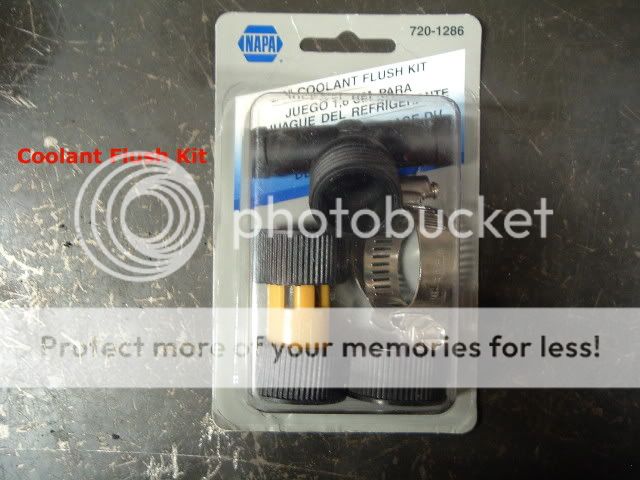
The 21ECs with the Yanmar 3YM30, or at least my 2013 model year, have a fitting plumbed into the raw water intake hose which comes as part of a "radiator flush kit" like this:
CoolantFlushKit.jpg

It's simple to install; just cut the 3/4" ID raw water hose and insert the T-fitting with hose clamps.

Note the Yellow hose adaptor piece in the pic above. It has a sort of flow "restrictor" built in and has an arrow on the side indicating direction of flow. I have a 3-4' piece of garden hose which I can screw onto the fitting and put the other end into a 5 gallon bucket of water which is being filled by the garden hose. This way, the Yanmar sucks up cooling water at whatever rate it wants; simulating normal engine operation; no "pressure" being applied to the raw water circuit. It's also easy peasy to "winterize" the engine by sticking the same hose into a gallon of antifreeze which gets sucked into the engine and expelled out the exhaust after filling the muffler; one gallon is the perfect amount.


I saw this fitting and I was wondering if I was to shut the seacock valve and connect the garden hose to this fitting, would it be ok to fire up the engine on dry land with the water flowing thru the fitting?
This is a handy way to run the engine whilst the boat is on the trailer. The answer is YES but with serious consideration of RISKS of connecting a pressurized water source to the raw water circuit. The main risk here is water flowing retrograde (i.e., backward) into the cylinders. So, you need to get something like this
GHSHUTOFF-2.gif


My solution is to FIRST start the engine, THEN turn on the hose. Yes, the engine runs for 3-5 sec "dry" but I believe this to be trivial risk compared with potential for hydrolock. I install a simple hose shut off (as in the pic above), then the coolant flush adapter. I start the engine at the helm like usual, then step back to the engine and open the water flow at the hose end. After I've flushed the engine, I simultaneously stop the engine using the emergency stop button next to the fuel pump and turn off the hose water. NO risk of hydrolock catastrophe. The raw water seacock is CLOSED during this operation.

dave
 
I got the coolant flush kit too just like in the picture that you showed, to run the engine on the trailer, I'll use a bucket like you said, this way, I will avoid a hydrolock problem like you explained in your previous post

thank you so much Dave 😀
 
Both Dave and Pat offer good advice. I should have mentioned the issue arising with using a city pressure water hose. I never used city water; I found it simplier to stick the my hose overboard and let it use lake water to flush; or just use a large container w/fresh water.

Dave, did you replace the original raw water filter with the larger one in the photo, or have I gotten my photos confused?
 
rt11002003":1qktirwl said:
Both Dave and Pat offer good advice. I should have mentioned the issue arising with using a city pressure water hose. I never used city water; I found it simplier to stick the my hose overboard and let it use lake water to flush; or just use a large container w/fresh water.

Dave, did you replace the original raw water filter with the larger one in the photo, or have I gotten my photos confused?

Hello Gene,

Good to hear from you! Yes, I replaced my stock raw water strainer with the Vetus FTR140 series model. Shown here...you can also see the "flushing" hose connected into the system just below the strainer.
main.php


/dave
 
Back
Top