R23 fuel capacity

Status
Not open for further replies.

simonp

Active member
Joined
Oct 4, 2017
Messages
26
Fluid Motion Model
C-242 C
Vessel Name
Bonnie Boat
MMSI Number
338303097
The fuel tank on my R23 is an 80 gallon tank, I see that written on the tank itself. But the R23 literature says that the fuel capacity is 75 gallons.

Is there a reason that the usable fuel is less than the tank capacity, or is the literature incorrect?
 
I have had the same question about my R23. The very first time I filled the tank to 80 gallons, fuel came out of the vent fitting at the rear of the tank into the bilge. My dealer repaired the problem by removing the fittings and properly sealing it. The fuel should have escaped overboard through the vent, but did not. This past summer, I was fueling and the attendant did not stop when he was told to and again when the tank filled, the forward vent fitting dumped fuel into the bilge. Unlike the aft fitting, the forward fitting is almost impossible to get to without completely removing the tank. Having experienced this twice, I now leave a 5 gallon void and never put more than 75 gallons in the tank. It appears that the vent fittings on the tank were not properly sealed at the factory and fuel escapes if the tank is filled to 80 gallons before the fuel causes the pump to turn off due to pressure in the filling tube. This is a troubling and dangerous situation, but having logged over 300 hours, I can say it has only happened twice and I now know to watch the fuel level very carefully. I always open the center cockpit hatch and check for gas fumes when filling up.
 
CobyF":2e6qnu2c said:
I have had the same question about my R23. The very first time I filled the tank to 80 gallons, fuel came out of the vent fitting at the rear of the tank into the bilge. My dealer repaired the problem by removing the fittings and properly sealing it. The fuel should have escaped overboard through the vent, but did not. This past summer, I was fueling and the attendant did not stop when he was told to and again when the tank filled, the forward vent fitting dumped fuel into the bilge. Unlike the aft fitting, the forward fitting is almost impossible to get to without completely removing the tank. Having experienced this twice, I now leave a 5 gallon void and never put more than 75 gallons in the tank. It appears that the vent fittings on the tank were not properly sealed at the factory and fuel escapes if the tank is filled to 80 gallons before the fuel causes the pump to turn off due to pressure in the filling tube. This is a troubling and dangerous situation, but having logged over 300 hours, I can say it has only happened twice and I now know to watch the fuel level very carefully. I always open the center cockpit hatch and check for gas fumes when filling up.

That's good advice, I think I'll set my tank capacity to 80 gals on the garmin, but never fill past 75 gals just in case.
 
That is what I have done and while it reduces your range, it improves safety which is the most important thing when you are on the water.
 
Greetings,
I have the R23 Diesel , 80 gallon tank. I have had only one issue, are you all the outboards ?
 
I was told that the tanks in the diesel 23 and gas 23 are the same external sized tank. BUT the tank for the gas version has more internal baffles and that reduces the fuel capacity by about 5 gallons.
 
We recently acquired a 2018 R-23 and have not experienced the overflow problem. I would like to know how to access and set fuel capacities on the Garmin if anyone can help.

Regards,

Fred
 
Oh boy, not at the boat and going from memory but I think it's
Home - AV Guages and Fuel - Menu and then look at the options.

A lot of good stuff in there if you poke around. The Garmin is flexible and you can put pretty much what you want, where you want, so play with it.

On the nav screen, if you touch and hold you can customize what data shows where.

Jim
 
CobyF - I might be misreading the thread, but if you have fuel (especially gasoline) vapors venting and/or fuel possibly overflowing into the bilge, I'd strongly recommend getting it resolved before using the boat or any of its accessories.
 
has this issue been addressed? This appears to be a safety issue issue\
 
The label attached to the fuel tank is the correct capacity. That is a certification label that is required to be on the tank. The tank capacity is how much fluid it holds. If the label has 80 gallons entered in the tank capacity that is the capacity. The fact that it can not be filled to 80 gallons only means that the installation does not allow for a full capacity. This can be do to the way the boat sits in the water, the way the tank is vented or the hose installation. The other component to consider is If there is 80 gallons of fuel in the tank how much of that fuel is usable? The fuel pickup in the tank is normally 1" above the bottom of the tank.
gallery2.php?g2_itemId=52942
Depending on the tanks design this can be as much as 10% of the fuel in the tank not usable. I did drain my 80 gallon tank in my C26 and found that the first inch of fuel is 4.5 gallons of fuel. 80 gallons - 4.5 gallons = 75.5 gallons is the most that I will be able to put in the tank if I run out of fuel. I still use the 10% rule when figuring Max range. 72 gallons of usable fuel.

I have set the Garmin to show full capacity of 80 gallons. I have also done a full calibration of the sending unit in the tank which makes the engine fuel gauge to be accurate when the boat is operated at a level attitude. This is for a Volvo EVC but the calibration and is similar to the Yamaha gauge. In the past the factory calibration has just been the full tank calibration. This is not the most accurate way to calibrate the gauge.

viewtopic.php?f=18&t=10780&hilit=+calibrate#p74140


CobyF":2zt0xl33 said:
I have had the same question about my R23. The very first time I filled the tank to 80 gallons, fuel came out of the vent fitting at the rear of the tank into the bilge. My dealer repaired the problem by removing the fittings and properly sealing it. The fuel should have escaped overboard through the vent, but did not. This past summer, I was fueling and the attendant did not stop when he was told to and again when the tank filled, the forward vent fitting dumped fuel into the bilge. Unlike the aft fitting, the forward fitting is almost impossible to get to without completely removing the tank. Having experienced this twice, I now leave a 5 gallon void and never put more than 75 gallons in the tank. It appears that the vent fittings on the tank were not properly sealed at the factory and fuel escapes if the tank is filled to 80 gallons before the fuel causes the pump to turn off due to pressure in the filling tube. This is a troubling and dangerous situation, but having logged over 300 hours, I can say it has only happened twice and I now know to watch the fuel level very carefully. I always open the center cockpit hatch and check for gas fumes when filling up.

I would believe this to be just an issue with this boat. It seems like a build issue caused by a build technician not following through with the installation properly. The technician did not apply sealant, tighten the fittings and the hoses properly. The dealer in my estimation did not do a good job either. If the dealer technician found the installation to be an issue at one fitting he/she should have assumed this to be the case at all fitting locations. Not filling the tank to full capacity is not the answer. This is a serious condition that should have been addressed by the dealer. I hope it was!
 
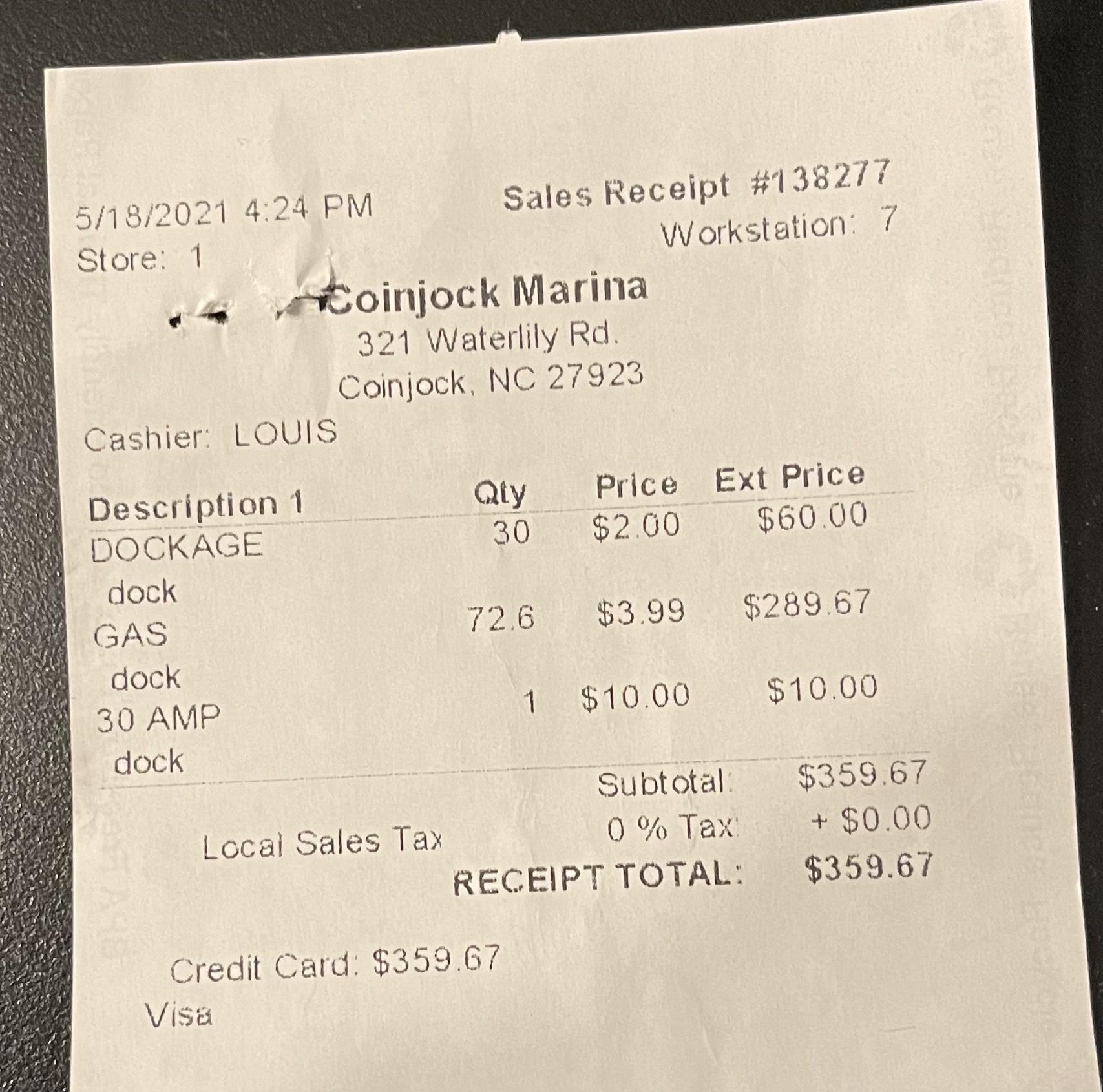
We did a long cruise from Morehead City NC to Coinjock, NC. 158 miles. Burned more fuel than expected because the Albemarle sound was a lot rougher than predicted.

Long story short: filled up in Coinjock. 72.6 gallons. Whew! Engine never sputtered.

984d2e7b234be4204941ed6ad6beebcf.jpg


Sent from my iPhone using Tapatalk
 
CruisingElvinRay":2x2uatxr said:
We did a long cruise from Morehead City NC to Coinjock, NC. 158 miles.
Long story short: filled up in Coinjock. 72.6 gallons. Whew! Engine never sputtered.

158 miles to 72.6 gallons of gas is great mileage though. 😀
 
Thanks guys for the heads up on this tank capacity issue. I bought a used 2019 R23 last summer and I just filled it for the first time... a few weeks ago.... by coincidence I filled it only to 75gal....but I will now- after reading your post- not go beyond 75 ..even though Garmin set to 80 gal full. I always open center lazarette cover before starting after fueling up and check for fumes....but your comments reinforce that practices importance. BTW..I also had some tank top tank clamp clips that were out of place and I had to reset... which initially drew my attention to this topic...which may have been an initial tank installation issue also.
 
The tag on the tank on my 2019 R23 says 78 gallons, right on the tank
 
Status
Not open for further replies.
Back
Top