CaspersCruiser
Well-known member
- Joined
- May 11, 2016
- Messages
- 971
- Fluid Motion Model
- R-27 Classic
- Hull Identification Number
- FMLT2709G112
- Vessel Name
- Cookie
- MMSI Number
- 368203460
On our recent Tarpon Springs-Ft. Myers Florida cruise, the Dometic CSD16K air conditioning unit on my 2012 R27 quit working. At the end of our trip, instead of taking the boat back to Louisville, we towed it to Scott’s Marine Service in Tarpon Springs. Next door to Scott’s is Cool Breeze Marine Air Conditioning & Refrigeration. I figured Florida was the place to get air conditioning service.
The culprit was burnt start windings in the blower motor. What may have caused the start windings to fail was that the air conditioning control panel was programmed with an incorrect setting for the type of blower motor. The blower motor on my unit is a “Split-Capacitor High-Velocity” motor. The control was set for a “Shaded-Pole” motor. If you have Dometic A/C, you might check that setting using the cabin control panel. The instructions are in the manual for it. The factory default is for Split-Capacitor, but somehow mine wasn’t in that mode.
The blower motor itself is not available. It is part of a $750 assembly. That assembly was replaced. At least now I have the old assembly I can cannibilize for spare parts if needed in the future.
On my boat, the condensing unit and electric control box are located under the port side seat foot rest. The technician needed to get to the control box for tests. It is accessed through the cave and, needless to say, access is tight and difficult. The evaporator and blower are located under a cushion in the cuddy. Access to that is not a problem.
To facilitate this and future service, Scott’s Marine Service suggested cutting an access hatch in the foot rest. I agreed to that and they did a great job cutting a very precise square hole and crafting a stainless trim edge. They also added a stainless pull to remove the hatch when needed.
Using the new access, the A/C technician remote mounted the electric control box. The original installation had it fastened to the top of the condenser unit. With control box moved, the refrigerant charge could be easily checked. Without the hatch, that’s a very, very expensive proposition.
A discovery the technician made during replacement of the blower assembly is that the duct work for the port side air conditioning vent was partially crushed during the construction of my boat. There’s no easy way to correct it. I had wondered why the volume of air from the port vent was less than that provided by the starboard vent.
Here’s the technician working through the cave access to the condenser unit and electric control box. This picture was taken through a custom cutout for a door to the cave located underneath the microwave that the previous owner installed.

Here’s what the new hatch looks like:

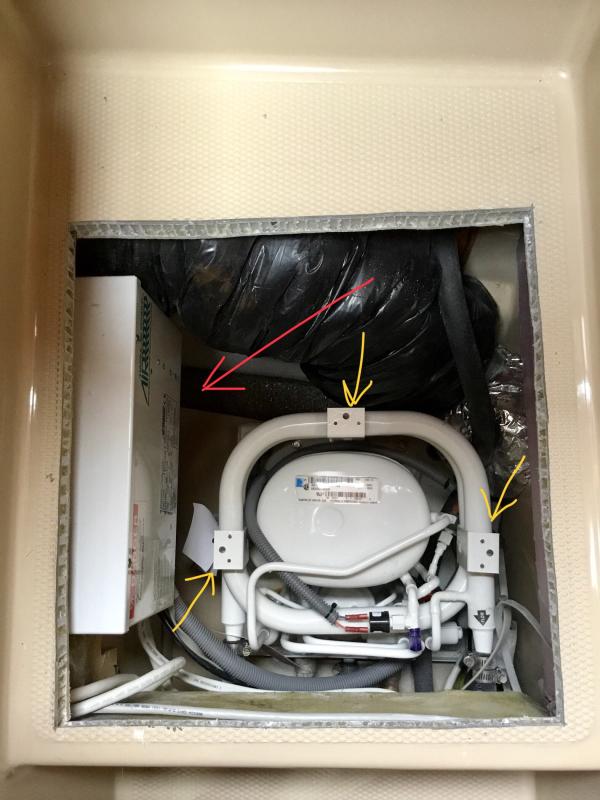
Here’s the access it provides. The red arrow points to the newly remote mounted electric box. The yellow arrows point to attach points on top of the condenser where the box was originally located.

The culprit was burnt start windings in the blower motor. What may have caused the start windings to fail was that the air conditioning control panel was programmed with an incorrect setting for the type of blower motor. The blower motor on my unit is a “Split-Capacitor High-Velocity” motor. The control was set for a “Shaded-Pole” motor. If you have Dometic A/C, you might check that setting using the cabin control panel. The instructions are in the manual for it. The factory default is for Split-Capacitor, but somehow mine wasn’t in that mode.
The blower motor itself is not available. It is part of a $750 assembly. That assembly was replaced. At least now I have the old assembly I can cannibilize for spare parts if needed in the future.
On my boat, the condensing unit and electric control box are located under the port side seat foot rest. The technician needed to get to the control box for tests. It is accessed through the cave and, needless to say, access is tight and difficult. The evaporator and blower are located under a cushion in the cuddy. Access to that is not a problem.
To facilitate this and future service, Scott’s Marine Service suggested cutting an access hatch in the foot rest. I agreed to that and they did a great job cutting a very precise square hole and crafting a stainless trim edge. They also added a stainless pull to remove the hatch when needed.
Using the new access, the A/C technician remote mounted the electric control box. The original installation had it fastened to the top of the condenser unit. With control box moved, the refrigerant charge could be easily checked. Without the hatch, that’s a very, very expensive proposition.
A discovery the technician made during replacement of the blower assembly is that the duct work for the port side air conditioning vent was partially crushed during the construction of my boat. There’s no easy way to correct it. I had wondered why the volume of air from the port vent was less than that provided by the starboard vent.
Here’s the technician working through the cave access to the condenser unit and electric control box. This picture was taken through a custom cutout for a door to the cave located underneath the microwave that the previous owner installed.
Here’s what the new hatch looks like:
Here’s the access it provides. The red arrow points to the newly remote mounted electric box. The yellow arrows point to attach points on top of the condenser where the box was originally located.