RC-21EC emergency starting, how?

Joined
Sep 18, 2014
Messages
15
Fluid Motion Model
C-24 C SE
Non-Fluid Motion Model
Vanguard Nomad 17
Vessel Name
Nemo
How can I combine the main battery and house battery together if my main battery is too weak to start the engine ? I knew the function of the IS-ACR RELAY , how can I bypass this relay if my main battery is to weak but my house still ok . Can I put a jump wire connect between two of the positive post Terminal ? I know on R-25 it have emergency parallel switch but it is not available on R-21. So sad 🙁 🙁 🙁 .
Thank you
 
I am not as familiar with the R-21, but I thought it has a 1-2-Both positions on the battery switch. If you do not have that then you can get one and wire it in. Your other choice is to carry jumper cables and just connect the batteries together.
 
Why "combine" a dead battery with a full one when looking for maximum current for starting the engine? Doesn't the dead one suck up electrons that you'd rather send to the starter? Assuming the proper switching is there, I'd want to leave the dead battery out of the circuit. OTOH, I guess the "parallel" switch on my R-27 does exactly what I'd want to avoid. Or...?
 
Even with a full load house battery, I wonder if there is enough amp available in the house battery to crank start the engine? Has anyone tried?
 
Well, as I said, I am not familiar with the R-21, but usually with a 1-2 or both you can switch between two batteries or have them both linked. At least that was the way it was on my C-Dory. So I may have misspoken. If both batteries can be used for either house or engine then switching from the dead battery to the good one should work. On my C-Dory I would use one battery ( say battery 1) while running the engine all day and use the same battery as the house at night. In the morning I would start the engine using battery 2 and use that all day and keep sequencing them. This way I knew I always had a fully charged battery to start the engine.
 
The "as supplied by the factory" R21EC does NOT offer a parallel function for engine cranking. There is no A/Both/B/OFF switch either.

The short answer is you must fabricate or purchase a short jumper from the good (house battery) to the weak start battery. Alternatively, it would make great sense to put in place an A/Both/B/OFF switch since this would let you select the GOOD battery to start the engine. This makes FAR more sense in comparison to paralleling a good battery with a dead or weak battery. Especially if something bad is in the works, like a freighter is bearing down on your position and you can't restart the engine due to a weak battery. Yikes!! No AIS transponder to broadcast your position, questionable radar signature, and weak battery in your 12VDC system could spell disaster. Remember, boating (as with LIFE) is a balance of risks (and benefits).

I've read several 'experts' who advocate for the selector-type switch rather than a paralleling switch which combines a bad battery with a good one - as CAPTCRUNCH points out above - that makes NO SENSE. Basically, one (large) bank for EVERYTHING, with a single battery as the backup. It can be selected in the unlikely event you discharge the main bank too much to crank the engine.

The 21ECs 'house' battery is plenty strong to crank its 3 cylinder diesel engine. Factory fitted 21ECs come with (2) group 24 batteries. One is a deep cycle for house loads; the other is a start battery for cranking the engine. Unless modified, there is no selector switch or way to parallel them for cranking. There may be more batteries to operate the Air conditioner, if equipped, but I'm not sure what is currently used in the new boats.

This is a good thread. It's important to KNOW your boat and what it's systems CAN and CANNOT do. The Tugs are SOLID boat's as delivered from the factory. As each owner comes to understand his/her boat and their own particular needs, changes can be carefully made to suit.

dave
 
Dave is dead on. I would change my switch configuration as he describes and feel comfortable for the future that will hopefully never happen.
 
Great information guys... Dave, can you suggest the 'switch' you would most recommend? Seems a shame that the R21 doesn't come equipped this way.

We have had some 'hairy moments' with a house battery that was dead (no electronics at all) among some other issues from the factory. The addition of a cable(s) and switch makes perfect sense...
 
Two killicks":3cbnq6b9 said:
Even with a full load house battery, I wonder if there is enough amp available in the house battery to crank start the engine? Has anyone tried?

Yes, from experience, we had the house and starting batteries reversed upon our receipt of the boat. The house battery started the tug just fine.... the starting battery - running the electronics - not so much...
 
To be fair and despite my whining, the electrical systems (dc and ac) on my 2013 R27 have never let me down (except for a blown thruster fuse in the early days). I may not know (yet) where every wire goes or why, but I've always had the right volts in the right place at the right time. Of course, my expectations may be too low; I'm comparing it to my 40-year-old auxiliary sloop, whose original electrical system ran running lights and a bilge pump, period.
 
sheral said:
can you suggest the 'switch' you would most recommend? Seems a shame that the R21 doesn't come equipped this way.

Blue Sea Systems 4-position battery switch, either M or E series. I'd think the M is sufficient for your 21. Their stuff is well designed and built. Not Perko
 
NewMoon":524xuov5 said:
sheral":524xuov5 said:
can you suggest the 'switch' you would most recommend? Seems a shame that the R21 doesn't come equipped this way.

Blue Sea Systems 4-position battery switch, either M or E series. I'd think the M is sufficient for your 21. Their stuff is well designed and built. Not Perko

Thank you! 🙂
 
Okay, we have this switch on the way, just because the price was right! ha!

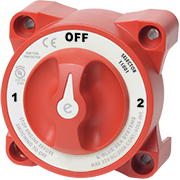
9002e e-Series Battery Switch Selector w/ Alternator Field Disconnect
Make-before-break contact design allows switching between battery banks without power interruption
Includes AFD (Alternator Field Disconnect)
CE Marked - Ignition protected - Safe for installation aboard gasoline powered boats
Case design allows surface or rear panel mounting
Meets American Boat and Yacht Council (ABYC) requirements for battery switches
3/8"-16 tin-plated copper studs for maximum conductivity and corrosion resistance, accepts 3/8" and M10 ring terminals
7/8" (22.22mm) stud length to accept multiple cable terminals - Tactile textures indicate knob position by feel only
 
NewMoon":149p7z5b said:
sheral":149p7z5b said:
can you suggest the 'switch' you would most recommend? Seems a shame that the R21 doesn't come equipped this way.

Blue Sea Systems 4-position battery switch, either M or E series. I'd think the M is sufficient for your 21. Their stuff is well designed and built. Not Perko

Yes the 4 positions switch will work. You will use only 3 of the positions, however, as discussed above it's poor practice to parallel a dead battery with a good one. Especially if that's your "emergency" start strategy. So, I've been thinking about this for a couple days. If I change my set up, I'd probably go with the 3 position switch like this
11001.png
.
The idea is to AVOID paralleling the batteries, so a switch with a "combine" or "both" function is not needed, really.

The ACR would still be in the mix. The alternator wire (charging wire) would go to one of the batteries/banks (probably the largest) with the ACR connecting that bank with the other bank. This would be wired independent of the selector switch. Charge current from the alternator would NOT pass through the selector switch as with the usual A/Both/B/OFF set up. Continuing to use the ACR on it's own circuit would keep both batteries charged and paralleled only when being charged by the engine.

Installing a new battery selector switch may be a daunting task for some. You probably want to revamp the way the battery banks are set up too. This may necessitate some new cabling, which you can buy ("made to order") from many places online. You specify the cable color (red or yellow), length, AWG size, and ring terminal sizes. I have ordered cables like this from tinnedmarinewire.com in the past with good service. Get a marine electrician involved if you are uncertain.

dave
 
Maybe parallelling is a problem if the one battery is completely dead. We've never had that situation.

But when our starting battery bank is for some reason down somewhat, such that it won't turn over our big diesel, we switch to BOTH (parallel with the house bank), and voila. As soon as the engine starts, we switch back to the starting bank and get it thoroughly charged up (10-15 minutes).

Then we switch back to the house bank (through BOTH, not through OFF), where we keep it almost all the time. Been doing this for 17 years and 6,500 engine hours, with excellent battery life. This setup and method takes very good care of the batteries, and provides good protection against being caught unable to start. We don't have an ACR - that would be slicker.
 
NewMoon":2vscbypa said:
Maybe parallelling is a problem if the one battery is completely dead. We've never had that situation.

But when our starting battery bank is for some reason down somewhat, such that it won't turn over our big diesel, we switch to BOTH (parallel with the house bank), and voila. As soon as the engine starts, we switch back to the starting bank and get it thoroughly charged up (10-15 minutes).

Then we switch back to the house bank (through BOTH, not through OFF), where we keep it almost all the time. Been doing this for 17 years and 6,500 engine hours, with excellent battery life. This setup and method takes very good care of the batteries, and provides good protection against being caught unable to start. We don't have an ACR - that would be slicker.

Hello Richard,

Your use of the A/Both/B/OFF selector is great. It certainly CAN be used to good effect - IF one remembers to switch it to preserve one good battery for starting (by switching to A or B). The ACRs are for us forgetful types. 😳 More of a "set it and forget it" strategy

I've always admired your numerous (every summer?) trips to SE Alaska. It's on my bucket list but for now I can live vicariously by reading about others' adventures. I read your book years ago just after getting started with pilot house boats.

dave
 
Back
Top