Sea water pump impeller

Status
Not open for further replies.

Stevan47

Well-known member
Joined
Nov 25, 2013
Messages
202
Fluid Motion Model
C-24 C
Non-Fluid Motion Model
Recently sold R21-EC
Hi all: Anyone changed a sea water pump impeller recently? My R21 'RHAPSODY' has a Johnson F4B - 903 model sea water pump which came fitted as part of the installed plant. Great pump - no issues to date. I have never had to remove the cover plate as yet, however I have just bought a spare impeller and O-seal kit, as a preemptive measure for the day when I need to replace the impeller. My question: other than removing the cover plate, replacing the gasket and then the O-seal, is/are there any special tools required for removing the impeller? Does it just pop out with a little pulling, or will I need to extract it with pliers/puller tool, etc? Would be good to know this before I actually need to perform surgery. Your collective thoughts, please? Stevan
 
Stevan,
I am not familiar with the R-21, but on the R-27 I use a long needle nose plier to pull out the impeller.
 
I use a hose clamp to compress the impeller before installing it into the housing. Also, observe the rotation deflection of the impeller vanes on the existing installation before you remove it. Thoroughly clean the housing and apply the lubricant usually provided with the impeller kit. On some of the covers the screw holes are not symmetrical so don't get caught fiddling with the cover like I did working blind on my generator cooling water pump. I spent 30 minutes trying to figure out why the cover screws were not aligning properly.

Pat
Ladybug, Too
 
Thanks guys, for your quick and knowledgeable response. Much appreciated. Kind regards - Stevan
 
Hello Stevan,

It's a very straight-forward procedure. Simply remove the screws on the pump cover plate and pull the old impeller with some pliers...I think I've used needle nose type. The new impeller will fit in without much fuss.

The worst part of the job for me is worrying about dropping the screws into the bilge. Someday I'll buy some extras

/david
 
Thanks David: good advice too. I always buy some spares - just in case. I always manage to drop something in the bilge. By the way, what do you think about that 'Speed Seal' cover plate, which you can buy from the UK? I went on line yesterday and had a look - seems like a good invention. Just s/s thumb screws and no spanners or screwdrivers needed. Kind regards
 
Stevan47":1tgi7fql said:
Thanks David: good advice too. I always buy some spares - just in case. I always manage to drop something in the bilge. By the way, what do you think about that 'Speed Seal' cover plate, which you can buy from the UK? I went on line yesterday and had a look - seems like a good invention. Just s/s thumb screws and no spanners or screwdrivers needed. Kind regards

The search box at the top of the page is your friend. Many questions have been asked here over the years. Most good ideas or those that seem good at the time have been tried by Tugnutters at least once and usually are documented here.

viewtopic.php?f=5&t=3130&p=23505&hilit=speed+seal#p23505

The link above will bring you to a previous discussion about the Speed Seal. It seems that the supplied hardware did not work on the bit larger Yanmar in the the 25. Not sure about your 21 though...check it out and good luck.
 
Hello, in Norway it is possible to buy a custom made cover plate for the water pump, with brass wing nuts that can be made up by one hand, blind-folded. The last screw dont come off, and the plate is hinged on this last screw. This makes it impossible to loose the plate or the nuts into the bilge. And you can change the impeller in bad weather, with one hand. These covers are custom made for Yanmar engines.
 
AArctander":1m9bay6l said:
Hello, in Norway it is possible to buy a custom made cover plate for the water pump, with brass wing nuts that can be made up by one hand, blind-folded. The last screw dont come off, and the plate is hinged on this last screw. This makes it impossible to loose the plate or the nuts into the bilge. And you can change the impeller in bad weather, with one hand. These covers are custom made for Yanmar engines.

Hello AArctander,

I have ordered the SpeedSeal Life kit for my 21EC (yanmar). It has not arrived yet but it looks like a neat system.

/david
 
My Mase 2.5 generator was overheating and showed reduced water flow after changing the impeller the mechanic installed without tightening the cover. Went hunting, the screen was clean on the input filter. There was low flow out of the inlet to the water filter with the cover removed.

I removed the hoses and filter and found the problem:


The factory used a "pump guard" thater than an proper sea chest to protect the raw water pump in the generator. The critical difference is in the pump guard setup, the inlet thru hull is necked down from 3/4" hose to 1/2" hose and a 1/2" pump guard used. Thus the hose and guard serve as a clog point - preventing the screen from ever seeing the dirt.

It takes about an hour to remove the pump guard and hoses - next time, I'll remove the bushing and install a larger inlet hose and pump guard.
 
captstu":1zhjay3h said:
My Mase 2.5 generator was overheating and showed reduced water flow after changing the impeller the mechanic installed without tightening the cover. Went hunting, the screen was clean on the input filter. There was low flow out of the inlet to the water filter with the cover removed.

I removed the hoses and filter and found the problem:


The factory used a "pump guard" thater than an proper sea chest to protect the raw water pump in the generator. The critical difference is in the pump guard setup, the inlet thru hull is necked down from 3/4" hose to 1/2" hose and a 1/2" pump guard used. Thus the hose and guard serve as a clog point - preventing the screen from ever seeing the dirt.

It takes about an hour to remove the pump guard and hoses - next time, I'll remove the bushing and install a larger inlet hose and pump guard.

Hello Stu,

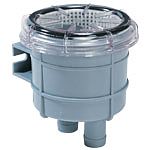
I removed a similar raw water strainer from my 21EC with Yanmar 3YM-30 engine. I installed a proper raw water strainer from Vetus with 3/4" inlet/outlet like this
Vetus-FTR140-19-3-4--Raw-Water-Strainer-1801389409341.jpg

It is sold as "Vetus FTR140/19 3/4" Raw Water Strainer" and is very user friendly to clean. Since it is designed to mount vertically (with hoses entering/exiting the bottom) you can easily view the top and see if JUNK is trapped inside the strainer cup.

The are widely available on the internets if you search.

dave
 
Hello Stevan ..... all the previous advice concerning the removal of the Johnson impeller is spot on ...... however ...... make a note of the direction of rotation of the pump so you can properly "set" the angle of the impeller vanes when installing the new impeller. Using a small amount of detergent also makes the new impeller "seat" much easier. Avoid using an oil or grease based lubricant for "seating" since only Nitrile composition impellers are truly oil resistant. A big old beach towel stuffer under the front of the engine will catch all the screws that are dropped ....... good luck with the project ...... Fran 😉
 
SGIDAVE":30tsm6eu said:
Hello Stevan,

It's a very straight-forward procedure. Simply remove the screws on the pump cover plate and pull the old impeller with some pliers...I think I've used needle nose type. The new impeller will fit in without much fuss.

The worst part of the job for me is worrying about dropping the screws into the bilge. Someday I'll buy some extras

/david

I got a tip from Herb (Willie's Tug) which was to place an old towel underneath the work area to catch errant bolts/nuts from disappearing into the dark beyond bilge. 😉 I used this tip when replacing the raw water impeller on my R-25 (Classic) and it did save me several times when bolting back the impeller housing.
 
LADYBUG TOO":27giu2lr said:
I use a hose clamp to compress the impeller before installing it into the housing. Also, observe the rotation deflection of the impeller vanes on the existing installation before you remove it. Thoroughly clean the housing and apply the lubricant usually provided with the impeller kit. On some of the covers the screw holes are not symmetrical so don't get caught fiddling with the cover like I did working blind on my generator cooling water pump. I spent 30 minutes trying to figure out why the cover screws were not aligning properly.

Pat
Ladybug, Too

It really doesn't matter about noting the impeller rotation as once the new impeller starts to rotate the vanes will align themselves easily. The vanes rotate in a somewhat circular (almost elliptical) fashion and at one point go from being bent to being straight. As soon as they move from their straight position they will bend in the proper way from that point onwards.

The main difficulty when installing a new impeller is

1) For R-25 (Classic at least) inserting the new impeller; Use hose clamp, zip tie and/or simple brute force to push the impeller into its housing
2) Making sure the O-ring is not crimp when attaching the impeller housing's face plate. If the O-ring isn't completely in its groove and gets crimped then there's the possibility of the housing leaking.
3) Be sure to close through hull valve before starting the task and wash down the work area and pump housing with fresh water to remove any salt residue after the work has been completed.
 
The impeller on the 21EC, at least the Yanmar version, is so small that it pushes in place without lubricant or any real struggle. I tried the water soluble lubricant that the first one came with and it seemed to make it more difficult (too slippery) to push into position. No zip ties, hose clamps or other gyrations necessary. I use a twisting motion as I push it in; the impeller has a stud passing through the center of the opening which has to line up with a slot in the shaft on which it mounts. Once the alignment is good it goes right into position. I'm in the same camp as Barry regarding making sure the impeller is twisted into the proper orientation when first installed. Like he says, the moment the engine is cranked, it WILL GO into the proper position without injuring the impeller.

The bigger diesels must use a physically larger impeller. Coupled with more difficult access, the job is just plain harder.

Using the towel under the work area is a good idea to prevent loss of parts. I'll have to remember that.

dave
 
Changed the impeller today on my 2014-R21 for the first time. At 500hrs all of the impeller vanes had some degree of cracking on them. Two of the vanes were cracked the full length and approximately 50-60% through the thickness. Probably would not have lasted for many more hours. Very quick and easy process to replace. Will probably inspect at the next 300-400hr mark.
 
Newf":39hqa1kg said:
Changed the impeller today on my 2014-R21 for the first time. At 500hrs all of the impeller vanes had some degree of cracking on them. Two of the vanes were cracked the full length and approximately 50-60% through the thickness. Probably would not have lasted for many more hours. Very quick and easy process to replace. Will probably inspect at the next 300-400hr mark.

Hello Newf,

What are Volvo's recommendations on impeller maintenance?

For the Yanmar engine it is recommended the raw water impeller be "inspected" every 250 hr (or 1 year) and replaced every 1000 hours (or FOUR years).

Personally, I can't imagine going that long on impeller maintenance - especially on a 21EC where you can do an impeller change in less than 15 minutes. Faster if you have the SpeedSeal system.

dave
 
Hi Dave,, The operators manual just states to check at 500 hrs. No replacement hours given. I agree that with the ease of replacement, an inspection at around 250 hrs is probably the way to go.. Much better than possibly having to changeout it out at the least opportune time..

Marcel..
 
There is a picture of the old impeller on my album (page 5) that shows the blades pointed in different directions. Based on this picture - I would not rely on the rotation of the pump shaft to orientate the blades. I used zip ties and silicone grease to establish the orientation before I put the new impeller in the housing. It is easy to "lose" a zip tie in the housing too, so be careful. I will use a hose clamp the next time...... 😳
 
Status
Not open for further replies.
Back
Top