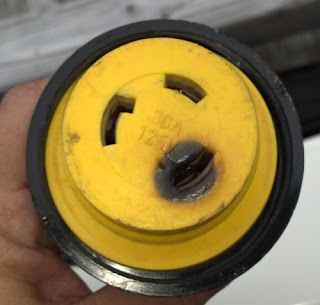
Shore Power cord burnt first time I used heat

PrettyPiggy

Member
Joined
Jun 4, 2020
Messages
8
Fluid Motion Model
C-32 C
Hull Identification Number
FMC24C17I920
Vessel Name
Blue Heron 2.0
MMSI Number
003669999
Anyone have this problem? I have a new 2020 Cutwater 24 and when I turned on the heat the first time last weekend, the shore power cord got so hot that it melted the prong from the aft plug right off and into the cord. This was at the boat receptacle, not the shore power on the dock. Both ends were tightly screwed on and I had no other issues all summer long when I had it plugged in to shore power.
 
If it is the Marinco power cable, those are notorious for arcing, causing the burned out connection. With the Marinco plug, it is possible to get two of the three prongs to touch before the third makes contact, causing that arc. I suggest replacing those with the SmartPlug (cable end and at the boat connection).

There is a technique for plugging in at the dock: plug in at the boat, turn off power at the pedestal, plug in the power cord at the pedestal, then turn the power on at the pedestal.

If arcing occurs, you may not notice it right away, but there will be more resistance at the plug, causing the overheat situation.

ElecPlug1e.jpg
 
I agree with James. The Marinco power cables are notorious for this. Whenever you connect or disconnect the cable you need to make sure all of the AC power switches in the boat are shut off. If you don't, you will get the arc. Eventually, it will destroy the boat receptacle you are plugging into as well and you'll need to replace it if you don't follow this technique. I lost 3 power cables and the boat receptacle before I figured this out.

A SmartPlug might be a good idea. Especially if you check your receptacle and it is melting as well, but I haven't tried it myself.
 
Replace with a smart plug. It is very reliable. It has positive latching to hold the plug in, more surface contact on the prongs that are very resistant to corrosion and a thermal shut off if it gets too hot. You can cut the old socket off and replace it with the smart plug. Well worth the added safety.
 
I agree with all previous post. There is another component that can cause this issue. I had the same issue as you when I used my Air unit for the first time along with a few other high amp items at the same time, hot water heater, battery charger and outlet breakers on. Not only did I notice the 120V hot receptacle prong burned I also had the ELCI trip often. The issue in my case was the boats 120 receptacle connections were loose ( screws were not tightened. This was the heat source. The loose connection causing arcing, heated the prong, burned the connector. The imbalance of amperage tripped the ELCI. I replaced the shore power chord blaming it on it but I still continued to have the issue. I removed the boats shore power receptacle and found the connector melted, oxidized and loose. This was 2 weeks after taking delivery of the boat. An easy mistake at manufacturing and an easy fix but I over looked this possibility. In your case follow the other post suggestions. I thought I would add my experience.
 
I switched to Smart Plug on my 2012 R27.

The shore power receptacle on my boat is in the lower port corner of the cockpit. Access is not convenient and the view angle is poor, especially in low light. The indexed plug/receptacle arrangement of the Smart Plug makes it very simple to plug in shore power plus the locking tabs assure a secure connection. There is zero time spent trying to line up prongs as there can be with the L5-30R plugs in a typical shore owner plug.

The down side to Smart Plug is that one cannot borrow a typical L5-30R shore power cord in case the boat’s Smart Plug cord is forgotten or missing. It has to be a Smart Plug cord. The work around is to carry a “pigtail” that interfaces a Smart Plug receptacle and non-Smart Plug L5-30R cord.
 
Changing to a Smart Plug resulted in my receiving a reduction in my insurance premium
 
Why doesn't FM install a better quality shore power plug (Smart Plug) on there boats? It appears to be a safety issue for many owners, and a fire hazard waiting to happen! Just wondering?
Stay safe out there. Bob
 
I installed my smart plug last winter and saw zero signs of the old boat side connection overheating after 10 years of use. That said, I’m glad I switched to the smart plug.
As several have mentioned, it’s really important to have every switch on the A/C panel turned off before connecting or disconnecting to shore power.
With the A/C switches off, the next step is to turn off the breaker at the marina pedestal next.
If connecting to shore power, cord is plugged into boat before connecting to marina pedestal.
If disconnecting, remove plug from marina pedestal then disconnect from the boat.
Final step is to turn on the marina breaker if you are in the connecting to shore power mode or leave the pedestal breaker off if you are departing.
All these steps should be on your checklists and always done in proper sequence.
We all know this right?
 
scross":117dfr26 said:
I installed my smart plug last winter and saw zero signs of the old boat side connection overheating after 10 years of use.
There was no sign of heat distress or corrosion on the old shore power receptacle I removed. The previous owners of my boat used it a lot and consistently. That usage style prevents many issues that plague seldom-used vessels. The exact same things happen with seldom-used airplanes. Another parallel between boating and aviation.
 
I have used the type of plug that is delivered with the RT for over 30 years on several boats without problems. The trick is to make sure after you plug it into the boat receptacle you turn it clockwise until it stops to get it into the correct position. Then lock it into that position with the locking ring. If the plug does not turn clockwise you may not have it into the receptacle all the way. I believe this is when the problem occurs with arcing. For those that are careful with making sure the plug is inserted correctly and not wanting to incur the cost of a Smart Plug, I believe these plugs are safe to use for their intended purpose.

However, having said all that I have converted my shore power cord to a Smart Plug. With the side clips and the cover which snaps down on the plug it is hard to impossible to plug shore power into the boat receptacle incorrectly.
 
If your shore power cord end(s) have been accidently dropped in salt water, the metal on the connectors can corrode, leading to increased resistance, heating, and eventually failure.

The salt water can also wick up the inside of the cord corroding the wiring as well. You won't see this in a visual inspection of the cord.

If you can get a cord out of the salt water immediately, flush it with fresh water, and spray the connector with something like WD-40, you might save the cord.

Otherwise, replace the cord immediately before it melts or causes a fire. Ask me how I know this.
 
I have bought the SmartPlug for the boat end of my R25 cord and will be installing it soon. I always adhere to the best practices, all power off, etc. Two things bother me though:
1. The marina pedestal outlet is worn out and sloppy, and there is no lock ring or threads for one at the pedestal. Everyone in the marina has ropes and bungies holding their cords in place, and most are still sagging and falling out.
2. Our pedestals do not have a breaker. Each finger has a locked box at the end which I believe contains all the breakers for the slips on that finger. Only the marina staff has access.
Is this common practice, or even legal in Canada, to not allow customers to have access to the pedestal breakers?
Have any Marinas adopted the SmartPlug for their pedestals or are we stuck with keeping the L5-30 twist lock on the pedestal forever?
I will be discussing this soon with the marina staff; just looking for some input on what is common practice.
 
Thank you for the helpful advice. I am aware of the importance of the order of plugging, unplugging, turning on/off and making sure the cord is securely fastened. Never had a problem all summer until I used the heater. Thinking it might be a similar problem that user BB marine posted. I will add that to my punch list as a brand new boat should not have this problem. I definitively think I will consider a smart plug too, much appreciate the suggestions.
 
All of the points on this tread are important. I urgently recommend that you should change out the end of your power cord with a Smartplug. Why? I have seen two boats very, very nearly catch fire that started at the connection where the power cord connects to the boat. In both events, the boats were only minutes away from catching fire.

Both times, the owners were fortunately on the boat when they smelled smoke and the power cord was warm or hot to the touch. Most boat fires are caused by electrical issues. The shore power plug and socket on the boat is one of the problem areas. Reminder, boat fires are catastrophic: fiberglass and fuel will burn very hot and very quickly. Fire Departments train that 30 boats will be damaged by one boat fire.

What can you do? Check the plug and socket on your boat for charring, keep the prongs clean, if a cord is warm-there is a problem, and switch to a Smartplug or equivalent. The work to add a Smartplug is very do-able because the instructions are very well written. I coach new boaters to move this work to the top of their list. (I have no financial interest in this recommendation.)
 
gallery2.php?g2_itemId=46212

Poor electrical contact between that pin and the receptacle and it acted like a heating element. The plug was uncomfortably hot to the touch.
Complete, sheer and total luck that I caught it. Air conditioner, computer, TV was running and I had made a pot of tea on the electrical stove.

edit: Notice that the black and white wire is melted right together.
 
Back
Top