Single Handing the Locks

linedoctor

Well-known member
Joined
Feb 15, 2011
Messages
192
Fluid Motion Model
R-29 CB
Vessel Name
Mission Drift
After 20 plus years of transiting the Ballard locks several times a year with the help of my Admiral or friends, I need to transit solo for the first time. I can't find any good advice online and I've seen single handing so rarely that I can't recall seeing it done well by others..but I have seen several pretty amusing attempts. I'd prefer not to be someone else's story....any advice?

I know the lock masters and thrusters will save me in the end but I'd like to look like I have a clue and maybe even a plan. I've had suggestions on a variety of methods...mid tie the boat through the helm window until securing the stern and bow, stern tie first and leave the boat in gear while moving to the bow, but I've not had advice from anyone that has actually done it. I assume I'll be in the small locks or rafted to someone else in the large locks.

Thanks!

Dave Leibman
Seoul Survivor II
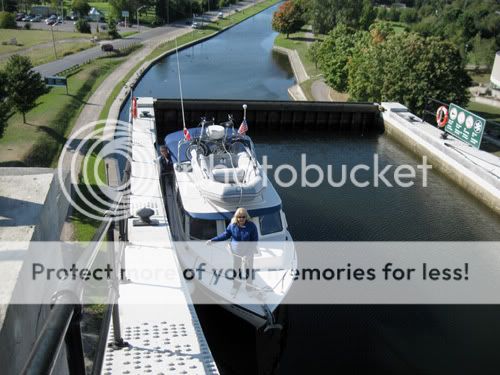
 
Dave,
Having done locks single handed, here is some advice: Each lock has different characteristics so you need to take that into account. Some have hanging ropes, some attached cables, sone fixed poles and some ladders to grab. It all depends on the region. even how they fill and empty can be different and this affects lock turbulance. Have your fenders deployed before entry. I made fender boards from 2 inch PVC and they help to protect your fenders against those sometimes ugly walls. Having oversized fenders is a good idea. Heavy duty rubber gloves help also with those sometimes ugly lines. Ease up slowly to the wall and try to be mid-wall to avoid turbulence from filling and emptying. Keep thrusters on in case you need to keep against wall. Grab rope from the helm seat window. Remember to ask for a starboard tie because you are single handed. Never secure line to boat!! It can be intimidating at first, but with a few locks you will be a pro.

Have fun,
Mike Rizzo
 
Now you have me curious. Having never been thru a lock (but would like to), you say never secure the line to the boat. Are there lines hanging on the sides of the lock? If you don't secure the line to the boat, how do you secure the boat to the lock wall? Is there some fastener that moves up and down with the boat? Just looking for the basics of how the whole process works.
 
Dave,
I had brought Karma through the locks numerous times singlehanded. The lock attendants will figure out you are by yourself when they see no one else moving about. If you position your lines in a fashion that they can grab them with a boat hook, they will take hold of them and give you the chance to get them secured.

In the event they should put you through the large lock, ask to raft next to another vessel. As long as there is another private vessel larger than yours in the lock, they normally will allow you to do so.

Remember the saying, secure the Stern line first when entering the lock, release the Lake line last when exiting the lock. Dropping down into the sound you will need to handle both the bow and stern line when exiting the lock. Going back into the lake, the lock attendant will release your bow line for you if you as them to.

It is intimidating the first time you go through by yourself but it is really very easy. Try to do it early in the day to avoid as much traffic as possible (as well as the gawkers on the wall.....).

And remember, wear your PFD........
 
My 1st mate is somewhat restricted in movement so for me it's always a one man show so to speak. I would say entering the lock with walls towering over you some 30 to 50 feet is very daunting. This is when the water level in the lock has to be raised. Rafting is obviously the best in this situation and the larger boat's crew will/should be a great help. However, if you have to tie/keep to the lock wall then throwing a line up 30 to 50 feet has to be done with care and attention to where the boat wants to move. Placing fenders on the side is essential when up against the lock wall as serious scraping damage can occur with the nasty barnacles etc. I've never gone through a lock single handed in our R25. The lock people will/should understand your situation and issue good instructions for what you need to do. They are there to help and the last thing they want to happen is for boats to be out of control. For me I would trust the lock people to help and would call out to them that you are single handling the boat.
 
Good advise from David and Barry. I know David has been through many times as have I.
Bob
 
Now you have me curious. Having never been thru a lock (but would like to), you say never secure the line to the boat. Are there lines hanging on the sides of the lock? If you don't secure the line to the boat, how do you secure the boat to the lock wall? Is there some fastener that moves up and down with the boat? Just looking for the basics of how the whole process works.

My experience on the Erie Canal, Champlain Canal and going through Okeechobee may be different than others and maybe the East coast is different, but I never heard of or have seen rafting up in a lock. When I said do not secure; I always hold on to whatever with my hand. remember the boat is either going up or down along the wall and you need to either let the line in or out so by do not secure I meant no tying, just hold on tight with your hand. I have also found that holding the line through the helm window with a push, if necessary, from the rear thruster against the wall worked for me.
 
Lots of different lock transits. The Ballard locks are different from those on New York Canal System. There is a large lock and a smaller lock. Recreational boats going through the large lock will often raft up... definitely the easiest way when singlehanding. Let them know you are singlehanding, and lockmasters will do everything possible to make it easy for you.

As far as not tying off to anything, that also varies with the lock (some have a floating dock that you are supposed to tie off to). Unless instructed different, we never make fast with a line from the lock to the boat. Our usual procedure is to run a loop of line from our boat around the lock fixture (poles, lines, cables) when appropriate. When in doubt, pull up before the lock, tie off the boat, go watch the procedure in the lock - then you for sure know how to do that specific lock.

I have never had to singlehand going through a lock. On the large lock on the Hudson River, just outside of Waterford, the lines are so far apart that we could not reach two of them at the same time on our boat... in that circumstance, I grabbed one line through the helm window, and down we went.

My first choice at the Ballard lock would be to raft up, if the timing works.

Best wishes,
Jim B.
 
If time allows, you might want to attend one of the locking through sessions hosted by the Army Corp. at Chittenden. We found this helpful and the attendants were more than happy to answer questions.

"Attend a free Locking Through program provided in the visitor center theater:
Second Wednesday January through March at 7 p.m.
Second and fourth Wednesdays April through September at 7 p.m.
Join us to learn how to successfully transit our locks. Conquer your fears and make locking through an enjoyable experience."

ws.usace.army.mil/Missions/CivilWorks/LocksandDams/ChittendenLocks/BoaterInformation.aspx

You might also put out a call for volunteers to lock through with you. Based on your intended schedule, Bruce and I might be able to give you onboard help.

Vicki Brown
Moondance R25
 
Thanks Vicki ! ( and everyone else)

I really appreciate the offer to help, but it's long past time I experienced a solo lock. I've cancelled or passed on several trips through the years when my first mate couldn't go and I didn't want to lock alone. Seeing a couple of spectaular faux pas by solo skippers early in my locking experience ruined me for all these years....but when you moor your boat in a lake and all the really outstanding boating is on the other side of a lock, sooner or later (much later in my case) ya just gotta go for it.

The class is a great idea but I'd have to question their statement that taking the class would, "make locking through an enjoyable experience."

Maybe it's just me, but maneuvering a nice boat into a contained steel-lined box along with unpredictable wind, current and sometimes many dozens of other boats being skippered by captains of unknown and often dubious skill will never be truly enjoyable! 😀

In another example of great Ranger/Cutwater service, I received a text from Kenny this morning, requesting a call on this topic. Kenny has done the solo lock thing on many occasions and helped to answer all my lingering questions.

So thanks for the advice and feedback. Tugnuts is a great resource...where else could you get not only good advice but real offers to help from friends? I'm ready for next Friday.

Dave Leibman
Seoul Survivor II
 
Hi Dave,

Glad to hear you have a handle on this. My wife and I found that we do enjoy the "experience" of the locks. Living in the Tropical Tip of Texas, the land of less than 2' tides, we have to travel a long ways to even find a lock. Our first was on the Okeechobee Waterway, and we looked forward to it with nervous anticipation. One of our goals after retirement was to cruise the Erie Canal... we did that, both ways. Then, north to the Trent-Severn, with "historical" locks (old, hand-operated), the amazing lift locks, and my favorite: the Big Chute Railway (not really a lock, but an overland passage where you are lifted out of the water on a moving railway-type car). LOVED IT! When in Puget Sound, we enjoyed the Ballard locks, as well.

I can understand the concern about locking through solo, but by planning ahead, you are prepared - a sign of a good skipper. Have fun with it!

Best wishes,
Jim B.

PeterboroughLiftLockE-1.jpg


The Peterborough Lift Lock (about 5 stories above the ground)
 
I've done it many times. My biggest suggestion is for you to have a small boat hook on hand. It makes a world of difference when you can barely reach the line. Other then that, it's really enjoyable!
 
I'm a bit surprised there are multiple assurances that single handing through a lock is always safe. I've locked many times in northern Europe and just finished the 3rd run through the Okeechobee Waterway, this last time sometimes singlehanded. (We did the Panama Canal twice. Totally different animal). The OWW locks have vertical lines dropped from above, untethered at their ends, every 20' or so along each wall. They are also the only lock system I've seen that lacks underwater valves. Instead, they just crack one gate to equalize the water level. The OWW lock masters seem to hate single handers, disparage our arrival and, unlike everywhere else I've locked, they prohibit rafting which is by far the safest method for singlehanding. Drops are usually easily handled singlehanded because little swirlingcurrent is generated. Uplocking can generate a strong swirling current along both lock walls. The consequence is that, rather than taking in the line, the push (or pull) of the current against the boat will consume all the excess line being created by the vessel rising. IOW you won't be taking in a lock's line as you rise, you'll be hanging on for the ride, hopefully with one or both lock lines turned around a cleat's horn to help you offset the drag of the boat. If another boat is near you in that direction, there's really nothing a single hander can do to prevent bumping up against it, given a strong current.

I add these thoughts in case a fellow Tugboat plans to singlehand the OWW. This year Lake Okeechobee has been at a record high, so the locks are moving lots of water. Best to take a friend, which I ended up arranging after some 'oh so close' adventures.
 
Back
Top