Stuffing Box (Packing Gland)

abcandjrc

Well-known member
Joined
Oct 10, 2010
Messages
363
Fluid Motion Model
C-24 C SE
Hull Identification Number
FMLT2160D707
Vessel Name
Little Lady (2007)
I have previous experience with stuffing boxes of the type on our R21-EC. But access to the stuffing box on it is really bad (although I see from the forum that on the R-21 "classic" it is even worse with batteries mounted above it). It appears that if about an extra inch of hose had been used, exposure to the wrenches would have been improved immeasurably. In addition, ours appears to have been installed by two apes using pipes on the wrenches to lock it up.

What I have is a couple questions and what I need is some suggestions from those who may have conquered theirs. I have tried everything I knew to try and am still stumped. Right now it is soaked with PB Blaster until I can try again. I hope someone will tell me some magic way to get the adjustment components unlocked.

1. On others I have worked, the lock nut and the packing nut were both threaded on the same housing. On this one it appears that what I think would be the lock nut (the thin, aft one) is threaded onto the housing but the packing nut is threaded onto it. Is that correct?

2. Are the all the threads conventional right-hand threads? They appear to be when I stare at them but they defy all my attempts to move anything.

3. Which of the two nuts is the actual lock nut? I would guess at the thin, aft one, but all attempts to move it have been futile.

5. In what sequence did you "crack" the lock apart? Hold the thin, aft one and turn the forward nut, or the opposite?

6. If all else fails, it appears that if I take off the hose clamps the unit should slide forward over the shaft. That would possibly let me get a couple pipe wrenches on the two nuts. Does that make sense? Is it do-able?

Thanks for any suggestions, particularly from those who have actually done the job on an R-21.

 
I had a 21' classic and relocated the batteries for more room to do the work. If I follow your questions the following is I remember.
!.They are both threaded on the same housing. The aft one is to tighten down on the gland. The forward one is the lock nut to snug down on the aft nut after you tighten it on the gland. ( do not tighten too much. it should still drip a drop about each 20 seconds to lube and cool the shaft)
2. I think they are right hand threads and you have to hold both with two wrenches to break the lock nut loose. I bought BIG channel locks since I could not get wrenches in there.
3. Hold the gland nut (aft one) and then break the lock nut loose. After you break the lock nut loose you will tighten down the gland nut clockwise (not too much) and then tighten the lock nut up to the gland nut. some people put a little anti seize on the lock nut threads before tightening down.
4. The hard part of this job is to break the lock nut loose the first time. A trick to use is to take a small drill bit and drill a little indent on the shoulder of the lock nut where you can take a small punch and tap the lock nut. This tap will break it loose and it is easy to back off then. you only need a small indent on a shoulder of the nut to keep the punch from sliding off.
 
Thanks, Ron. I'll get back with a picture as soon as this thing will let me post one. I resized it as demanded, it showed it in preview, then when I tried to submit it it hollered about the size again and refuses to take the message.
 
Thanks, Ron. What you describe is pretty much what I expected, but look at the photo and note the fine threads which appear to go into the forward nut. Not what I expected.

Looks to me like turning the forward nut counter clockwise while holding the aft nut should work. And it would only have to fight one thread. Turning the aft nut clockwise while holding the forward nut means it has to move on two threads. And all of them are somewhat corroded.

PC070002600wide.jpg


I do like the idea of using a punch to break the lock, but there is little room to get at it and right now I am not sure which way to whack it. I will study that a bit.

(I am familiar with having to have the gland weep a few drops a minute. I generally aim for 10 or so. This one is at about 2 a second though, and leaks even when the shaft is stationary. While it keeps the shaft cool, the bilge pump tends to wake me up a couple times a night. It has so few hours that I suspect the packing is still fine, but some adjustment is surely needed.)
 
abcandjrc,

Ron's memory is pretty good. My wife and I bought his 21 Classic back in the summer of 2009.

As for your conundrum, the forward larger "nut" is the packing gland containing the Teflon impregnated rope packing. The aft smaller nut is the lock nut and can only be moved after the packing gland has been loosened (this is also the nut that ultimately makes the drip rate adjustment). From your photo it is clear that there is some corrosion at play here. PB Blaster is a good product but you want to avoid spraying this stuff on any rubber components as it can degrade the rubber. As you have surmised, if you are facing aft and looking at the large packing nut you will turn it counter-clockwise to loosen it from the smaller lock nut. The first time I did this on my vessel I had to put a piece of pipe on each of the 2 wrenches that I was using in order to generate the necessary leverage to break things loose. Some folks here on TugNuts have spoken of the need to apply heat to this fitting to get it to break loose but I would try anything else that might work first. It is imperative that you have the right wrenches (ones that fit without slipping) so if you don't have a pair that meets this standard then go buy them as they will be part of your tool kit from now on.

From your photo I also see that the hose clamp around the rubber tubing that holds the stuffing box assembly to the stern tube appears to be rusted. You should remove all of the clamps in this area and replace them (assuming that the boat is on the trailer) with new stainless steel hose clamps as a failure of one or more of these clamps while underway would create some excitement. I would also completely loosen the packing gland and carefully slide it forward on the shaft so that you can inspect the prop shaft in the area where the packing normally rides. It appears that you may have the onset of crevice corrosion and the shaft itself may be pitted which will contribute to a high drip rate and a leaking condition that may not be corrected by tightening the packing nut adjustment.

I hope that this helps.

Eric
 
Thanks, Eric,

That is about how I figured it, but it is nice to have some sound experience to back up intuition. Boat stuff is expensive if you mess up. And it sounds like the two apes that tightened mine must have tightened yours. Someone should take away their pipes and tell them to use a longer hose to move the fitting forward an inch or so.

I have not seen a packing gland like this before. One of our boats had a packing gland more as Ron described, with the locknut and the adjustment "nut" riding on the same fitting. And I could reach straight in to adjust or even pack it. Bigger boat, of course. (My favorites were ones on another boat which just had pair of plates around the shaft which compressed the packing and you used two box wrenches to tighten or loosen two bolts, one on either side of the plates. And I could lie on the carpeted walkway in the engine room and adjust them in comfort. Ah, the good old days.)

I considered heat as a last resort but it will almost certainly ruin the packing. It is essentially impossible to get the wrench on the lock nut properly because the aftermost nut is well under the cockpit sole and that requires that the wrench be at a significant angle to the nut and it is only about 1/8" thick. I considered grinding some of the handle off the wrench but then the leverage gets really bad. I hate to just jam it against the keel.

I believe I need to just clean up the shaft a bit (as far as I can see that is mainly salt, rather than serious corrosion on the shaft) and slide the whole gland forward. Has anyone on here done that? I believe if I ever need to pull the shaft I will use a slightly longer hose to improve access. What a mess!
 
Go to Harbor Freight... Buy an open end wrench(s) that fits each of the nuts... Use (beg/borrow) an acetylene torch and a large bench vise to heat the shaft of the wrench right next to the open end until it glows bright red and then bend the shaft to the angle that allows you to get it on the nut(s) and have some wrenching room... Let the wrench handle air cool (still air) to avoid making it brittle... For the open end fitting the thin jam nut head, grind the thickness of the wrench until it fits into the space...
There is nothing precious about wrenches and making them fit the job is done every day in heavy industry, oil drilling platforms, bulldozer repair shops, etc... I have a bent and ground set for the mounting nuts on O-320 Lycoming Cylinder heads for my airplane engine...

cheers
 
Rather than bending some wrenches, which become single purpose tools, I recommend getting some crows foot wrenches. They are used in conjunction with ratchets and are the perfect tool for this situation. He is a link for some reasonably priced crows foots. You can do a google search for other styles and sizes
http://www.northerntool.com/shop/tools/product_200012174_200012174
 
Quoting an excerpt from my original post:
abcandjrc":3exx1zpg said:
I have previous experience with stuffing boxes of the type on our R21-EC. But access to the stuffing box on it is really bad (although I see from the forum that on the R-21 "classic" it is even worse with batteries mounted above it). It appears that if about an extra inch of hose had been used, exposure to the wrenches would have been improved immeasurably. In addition, ours appears to have been installed by two apes using pipes on the wrenches to lock it up.

.................................................................................................

6. If all else fails, it appears that if I take off the hose clamps the unit should slide forward over the shaft. That would possibly let me get a couple pipe wrenches on the two nuts.

Today after trying any combination of wrenches I could, including one I made myself to fit the lock nut, I still had no joy on this. I decided 6. was necessary in light of Ranger saving 53 cents by not using a hose an inch longer. I removed the salt from the shaft, loosened the hose clamps on the stuffing box, and slid the unit forward. Now I could grip both nuts and the whole thing opened up as it should. It still took some muscle, but having the wrenches in the open and at the proper angle was key to the process.

I will be sure to keep a bit of grease on the threads, since the locknut was pretty solidly bonded to the main body of the stuffing box. It will still be a bit of a reach to make adjustments, but I feel that I can get in there now even with the unit back in place and make adjustments as long as I don't overtighten the locknut as it had been.

I will also replace the hose with that added 53 cents worth if I ever have to pull the shaft for any reason. :evil:
 
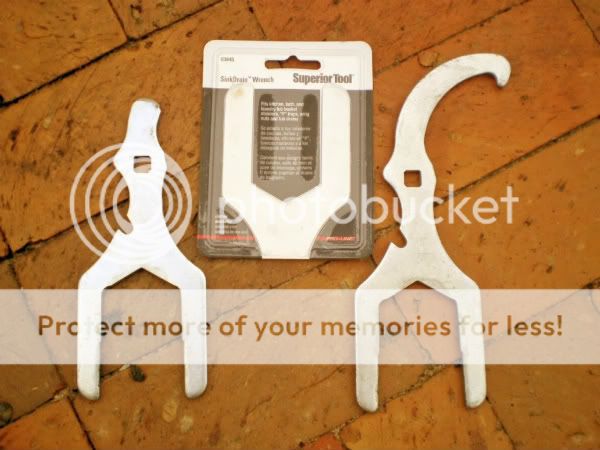
Here is my final set of wrenches. They are standard items available at hardware or building supply stores. Unfortunately, they do not fit the stuffing box as purchased, but some judicious grinding/fitting got them to fit the two nuts. You can also see that I shortened the one for the lock nut so that I can get it in at the proper angle even though the nut is under the sole. (Which I will correct, as mentioned, if I ever have to pull the shaft for any reason.)

Note that they can also be used as crows-foot wrenches for extra power since they have a punch-out for a 3/8 drive tool. They are also much easier to stow than the standard stuffing box wrenches, and much less costly. No adjustment, as with those wrenches, but it doesn't matter for my use on a single boat.

P2210001.jpg
 
Back
Top