While towing

JudgeG

Member
Joined
Sep 11, 2020
Messages
15
Fluid Motion Model
C-28
I just read a wealth of wisdom about towing our Tugs on another thread. Great information and this resource is much appreciated.
So as not to hijack "the towing speed" thread, I make these inquires here:

With so many experienced "towing" captains here, and banking what I've learned about tow speeds, here is my scenario.....
Soon 😀 , We're picking up and bringing home our new Ranger Tug 2021 27 OB (Sweet Sandy Lynn). Upon completion of our 2 day orientation in Pensacola, we'll take her for a short-week shakedown cruise eastbound of Pensacola ....
Afterwards, we'll tow it back to the Georgia Coast (Jekyll Harbor Marina) at the 60 mph max or slower! With anchor secured, a couple of extra straps, a rearview camera on the trailer and the canvas removed.
So, what about DOT weight and inspection stations? Does one need to stop for them. It would be my guess that the answer is "yes", but this is my first bigger boat and trailer. By the way, I have the factory recommended Flote-On and a 2020 Chevy HD 3500 with diesel, 4x4 single rear axel. Should be fine there.
And finally, fueling the tow truck.... Do most of you folks just pull in for fueling at truck stops in the 18 wheeler lines due to overhead clearance concerns? That would seem prudent instead of trying to get the and tall lengthy rig in an auto line at a convenience story/filling station?
 
Congratulations on your new Ranger Tug, you’re going to love it! While I don’t consider myself an expert I did just complete a 650 mile trip towing our 27 classic. The answer is no to the truck weigh stations you’re not a commercial carrier. In Florida you’re going to have the agricultural inspection stations too. I’ve stopped at those towing our RV but have been told in didn’t need to by the inspector. The only other thing I highly recommend is a good TPMS system for the trailer and hopefully Float-on is using Goodyear Endurance tires by now. For the TPMS valve sensor I also recommend metal valve stems. There’s a very informative thread I started about towing long distances and I got a tremendous amount of good information from our community, just search “towing speed sweet spot” and you’ll find it. Good luck and enjoy your new boat!

Tim and Donna
Gratitude
 
Also yes on using the truck stops for diesel. I use the Truckers Path App for fuel locations. Some credit cards may not work at the pump so you may have to go inside.
 
I have towed to/from Florida from Kentucky three times and have made several other long tows with my R27.

Hopefully, this is not the first time you’ve towed a trailer. If it is, here’s the best piece of advice I got when I started towing: Always think about where the trailer wheels are going to go when you turn in tight spaces where sharp turns are necessary. They’ll always go inside path of the front wheels of your truck. Wide oversteering in those situations is essential.

Be ready for other drivers to do dumb stuff. I’ve found that people tend to pull out in front of me when I’m towing, I guess they don’t want to get behind a vehicle that they think will delay them or one that’s tall and impossible to see around. Whatever the reason, anticipate it.

For fueling, I often use the semi-truck pumps for diesel because the auto lanes are too confined for my tastes. The downside is having to walk inside to pay (at times it’s a hike) because most trucker lanes don’t take consumer credit cards. Some of the large truck stop fueling plazas have dedicated RV diesel lanes that do take consumer cards.

When looking for a hotel for overnight stays on a tow trip, to ease parking drama, I look for places using Google Maps that have large parking lots or dead-end frontage roads alongside the hotel. Some folks “boaterhome” and use RV campgrounds for overnight stays. I have not yet done that. Maybe someone will chime in with the specifics of that.

Welcome to the world of “trailer trawling”!
 
I think truck stops gouge the non commercial driver when getting diesel and give truckers a special rate - no info on that but that’s my hunch. So what I do is look for good prices on GasBuddy and then use google earth to look at the layout of the station. There are many that are easy for us to get into and out. With smaller stations, the diesel pumps tend to be on the outer pumps, making it easy to access. Also, the smaller stations do not generally have the big nozzles like truck stops have which can be a pain since one must hold the trigger very precisely in order to not get too much flow. Some of the new, huge stations like Buc-ees and Valero have great prices, easy access and more than enough food to satisfy.
 
We have been towing up and down the West Coast for years and started using a TSD Logistics fuel card program about 3 yrs ago. It takes a few weeks to get set up and basically this allows you to get the commercial fuel prices in the truck lane for RVers and boats without having to go inside.
 
Brian B":3vf85iuo said:
Also yes on using the truck stops for diesel. I use the Truckers Path App for fuel locations. Some credit cards may not work at the pump so you may have to go inside.

I joined TSD Logistics fuel program after reading about it on various RV sites. While not technically, think about it as a co-op for non-professional drivers to get discounts on diesel fuel and DEF at truck stops. They send you a card and you can use it at the pump saving the hassle of going inside. I just received my card so I can't provide personal experience but fuel prices are comparable to what you'd find at a local station with competitive pricing without having to deal with maneuvering in a standard fuel station lot.

https://www.facebook.com/TSDLogistics/p ... 310357690/

Franco
 
CaspersCruiser":2rj5odc5 said:
When looking for a hotel for overnight stays on a tow trip, to ease parking drama, I look for places using Google Maps that have large parking lots or dead-end frontage roads alongside the hotel. Some folks “boaterhome” and use RV campgrounds for overnight stays. I have not yet done that. Maybe someone will chime in with the specifics of that.

I second the use of Google Maps. I've saved myself from a few bad choices doing so. Calling the front desk is often useless unless the person answering knows the challenges/needs of towing a trailer.

I'd also try to avoid towing at night. It's just harder to see in your mirrors and the edge of the road with lights shining toward you. Now, if going through a super congested area, night towing might be preferred but I don't have that option with my 10' beam.

Franco
 
I have never used the truck stop truck lanes for fueling. I just pay attention to the layout of the station and carefully pick stations with decent access. The overhead covers are plenty high enough here in the Midwest in the regular auto lanes
( I suspect they take that into account when building them or U-haul trucks would hit them all the time). With your 8.5 foot beam you should have no problem and need not do the weigh stations. Old gas stations in small mountain towns can sometimes be a different story. (I love my new F350 diesel with its 48 gallon fuel tank because I can fill before I leave home and drive al day without buying fuel.)
 
I was notified today via email that a Pilot/Flying J commercial fueling card is headed to me via FedEx. I have a Florida tow in the works so I’ll get to try it out.

RV and auto lanes are still my first choice, but if there is any doubt about maneuvering room, I head for the truck lanes. When I tow, I don’t eat at fueling stops. I have food on the boat and make lunch and eat at rest areas on the boat. Sometimes, I eat at a Cracker Barrel located at an Interstate exit. Almost all of them have RV parking. Avoid the Cracker Barrels near malls and such on the outskirts of town. A lot of those do not have RV parking.
 
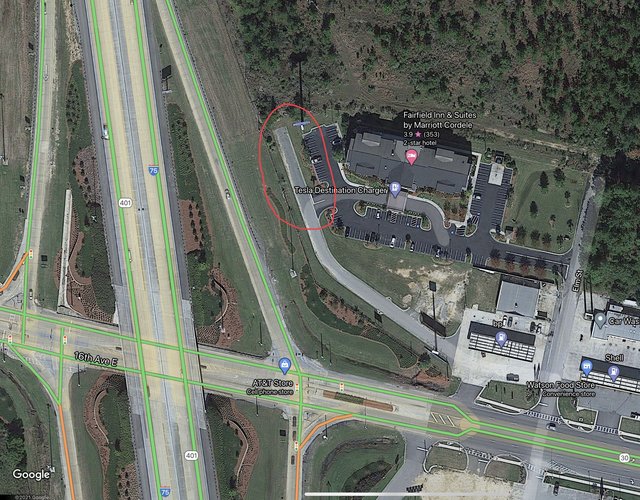
Here’s an example of a type of hotel layout I look for when needing one. It is a Fairfield Inn located just off I-75 at Cordele, Georgia. The parking lot is not especially large, but there is a dead-end frontage road that’s perfect for parking a long tow rig. I’ve used it and have steered other Tug towers to it.

 
At crossroads with islands, remember to always be in the outside lane to make the turn, otherwise, you will drag your trailer wheels over the island, which is very bad for your tires and rims and not good for the trailer bunks or the innards of the Tug, always swing wide! Also, remember to remove the stove burners on your propane stove, they will bounce off and score the stainless topsides, I have a Princess Stove. I place a lock on the trailer hitch and on the truck hitch to keep them from coming off and to prevent possible theft. You may also want to consider a hitch in the front of your truck as it will help if you have to maneuver in tight backup spaces. A couple of 4 x 4 x 12" blocks of wood to place under the jack stand of the trailer, helps reduce the wind-up and down-time of winding the jack. Wheel blocks to keep the trailer still after you unhitch it. If any of the tie downs rub on the gel coat, place old towels around the straps and tie-wrap them in place or they will move leaving your gel coat to be scratched by the vibrating straps. I tie wrap my bimini bows so they don't move, check all the bimini bolts, and set screws to make sure they are tight. Anticipate other drivers' short-sightedness and allow for extra space for stoping and maneuvering. After a couple of hundred miles, you will not even notice your towing, it becomes second nature. Have fun this is another new adventure and you will love your TUG 😀
 
Back
Top