Getting to the bow

OffIslander

Member
Joined
Nov 30, 2025
Messages
7
Fluid Motion Model
R-25 (Outboard)
Hull Identification Number
US-FMLT2532
Vessel Name
Off Islander
We just bought a new R-25. My wife is a bit leery of using the narrow side deck ledge to get to the bow for line handling tying up. She misses being inside the lifelines of our previous, bigger boat. Has anyone found a way to make going forward less scary…besides a harness with carabiner?
 
I worry about that too. I just bought some shoes that I will only wear while on the boat. They are "court" shoes but I like them because they grip well, are sturdy and compact. I haven't tried them yet but I hope they will give me a surer footing on the side rails.
 
Just tying to a dock, I don't walk on the narrow side ledge. Get off at stern by the cockpit steering (not swim deck), tie stern while on dock, then tie bow while on dock. Position front fenders so that they can be reached thru side windows. When boat is cruising, fenders just rest on ledge. I try to limit going on bow when away from dock, except mooring to buoy or using anchor.
This works well for 2017 R29.
 
The Admiral does NOT want to go forward! However, the Captain does frequently. On our R27OB I have found that the side deck “extender” makes the space seem much wider than its actual dimensions.

I scoot sideways / sidestep going forward and aft. The abundant handholds make things feel secure. We’re on a mooring and I need to release the bow or tie up the bow.

Good boat shoes are a must. Last Summer I had to go to the bow while in 2 - 3 foot seas: no issues.

We are in our ‘70’s and, while the side decks are not a wide passage, I find them workable. That being said, our docking routine uses stern and mid-ship (helm) cleats.

Happy New Year!
 
The Admiral does NOT want to go forward! However, the Captain does frequently. On our R27OB I have found that the side deck “extender” makes the space seem much wider than its actual dimensions.

I scoot sideways / sidestep going forward and aft. The abundant handholds make things feel secure. We’re on a mooring and I need to release the bow or tie up the bow.

Good boat shoes are a must. Last Summer I had to go to the bow while in 2 - 3 foot seas: no issues.

We are in our ‘70’s and, while the side decks are not a wide passage, I find them workable. That being said, our docking routine uses stern and mid-ship (helm) cleats.

Happy New Year!
Thanks!
 
Just tying to a dock, I don't walk on the narrow side ledge. Get off at stern by the cockpit steering (not swim deck), tie stern while on dock, then tie bow while on dock. Position front fenders so that they can be reached thru side windows. When boat is cruising, fenders just rest on ledge. I try to limit going on bow when away from dock, except mooring to buoy or using anchor.
This works well for 2017 R29.
Thanks!
 
The Admiral does NOT want to go forward! However, the Captain does frequently. On our R27OB I have found that the side deck “extender” makes the space seem much wider than its actual dimensions.

I scoot sideways / sidestep going forward and aft. The abundant handholds make things feel secure. We’re on a mooring and I need to release the bow or tie up the bow.

Good boat shoes are a must. Last Summer I had to go to the bow while in 2 - 3 foot seas: no issues.

We are in our ‘70’s and, while the side decks are not a wide passage, I find them workable. That being said, our docking routine uses stern and mid-ship (helm) cleats.

Happy New Year!
Thanks!
 
Just need to pay attention, go slow, and be deliberate. There are numerous solid handholds to make the journey safely. If there is concern about going in the water, wear an inflatable life jacket whenever out of the cabin. They are not so bulky as to restrict movements.
 
I think a carabiner and harness will just makes things confusing and dangerous. The last thing you want to have happen is to be hanging from the side by a carabiner. My wife is blind in one eye and thus has depth perception issues yet still prefers the walk up the side decks over driving from the helm. She always wears her life jacket and uses the multiple well place handrails that Ranger Tug has installed. When it was time to upgrade from our R25 to our R29 the slightly wider side decks were a factor that we used to justify the additional expense, but we still found the R25 side decks possible to travel. Once the dock lines and fenders are in place at the bow, she returns to the cockpit for the docking experience until the stern is tied. Frequently someone on the dock will grab a bow line and do a temporary tie until I leave the helm and do the final ties. If not, with the remote control for the bow thruster, I can keep the bow in place until I get it tied as long as the stern is tied.
 
I think a carabiner and harness will just makes things confusing and dangerous. The last thing you want to have happen is to be hanging from the side by a carabiner. My wife is blind in one eye and thus has depth perception issues yet still prefers the walk up the side decks over driving from the helm. She always wears her life jacket and uses the multiple well place handrails that Ranger Tug has installed. When it was time to upgrade from our R25 to our R29 the slightly wider side decks were a factor that we used to justify the additional expense, but we still found the R25 side decks possible to travel. Once the dock lines and fenders are in place at the bow, she returns to the cockpit for the docking experience until the stern is tied. Frequently someone on the dock will grab a bow line and do a temporary tie until I leave the helm and do the final ties. If not, with the remote control for the bow thruster, I can keep the bow in place until I get it tied as long as the stern is tied.
 
I mostly single-hand. I don’t have any problem with the side decks on an R25SC but I am cautious about ending up in the drink and getting separated from the boat. Docking alongside is no problem as others have indicated. That remote control for the thrusters makes life so easy. For safety at a mooring I attach to the buoy using a long pendant with a carabiner on one end and a large eye splice on the other. Photos are in my album. I attach the eye at the bow before leaving the dock and lead the pendant back to the cockpit. The pendant is not long enough to reach the prop! When I bring the boat up alongside the buoy it is simple to attach the carabiner. I can then do the walk to the bow and shorten the pendant knowing that, should I go overboard, the boat cannot move too far from the buoy.

I am amazed at the number of boats I see approaching a mooring with one crew member poised on the bow with boat hook in hand. When they do get a hook on the ring they are faced with the dangerous task of trying to get back to the cockpit. To disconnect I let out the pendant and then drive toward the buoy, bringing it alongside the cockpit. Of course, in rough weather, I could always reach the bow through the forward hatch.
 
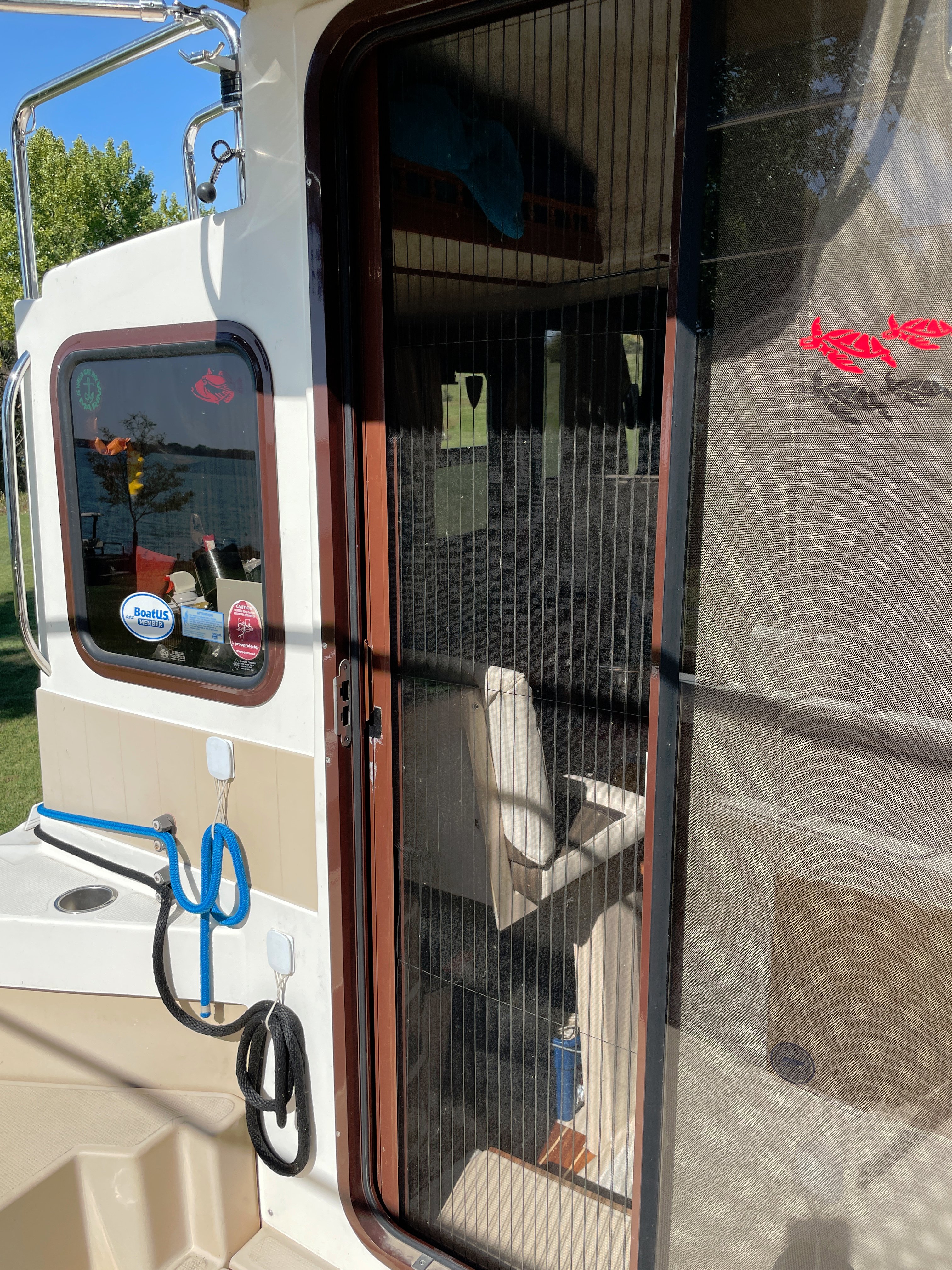
We do not go to the bow for docking. We only go to the bow when retrieving the anchor. For docking, we have lead lines from the bow (blue) and the mid-ship cleat (black) to the cockpit where they are lead to cam cleats and stored on "button line hangers." When docking, the mate passes one or both lines to folks on the dock or steps off the boat with lines in hand. That way the mate stays safely in the cockpit and can handle the stern line (red) also. We did the Loop with this arrangement and never had any issues. The photo shows the port-side line arrangement. Starboard side is similar. This also allows the Captain to easily tell the mate which line to pass by color - not all mates are equally sea-worthy and the color coding mostly eliminates confusion. Note also the screen door, which is probably the best thing we have added to the tug.
 
You may want to consider Seadeck or Raptor decking along the gunnels for a better grip (even when wet).
 
There were some posts previously about someone(s) who had added a ladder in the v-berth area to make going in and out of the forward hatch viable.
 
I built at ladder to go out the forward Hatch on my 2011 RT 27. The Ladder is hinged in the middle and folds up to fit on the sole under the bunk when we want to make up the bunk. Handy for access to recover the anchor or using the foredeck for Sailboat Race Committee. No walking the Plank for me.
20230605_153107.jpg
 
I mostly single-hand. I don’t have any problem with the side decks on an R25SC but I am cautious about ending up in the drink and getting separated from the boat. Docking alongside is no problem as others have indicated. That remote control for the thrusters makes life so easy. For safety at a mooring I attach to the buoy using a long pendant with a carabiner on one end and a large eye splice on the other. Photos are in my album. I attach the eye at the bow before leaving the dock and lead the pendant back to the cockpit. The pendant is not long enough to reach the prop! When I bring the boat up alongside the buoy it is simple to attach the carabiner. I can then do the walk to the bow and shorten the pendant knowing that, should I go overboard, the boat cannot move too far from the buoy.

I am amazed at the number of boats I see approaching a mooring with one crew member poised on the bow with boat hook in hand. When they do get a hook on the ring they are faced with the dangerous task of trying to get back to the cockpit. To disconnect I let out the pendant and then drive toward the buoy, bringing it alongside the cockpit. Of course, in rough weather, I could always reach the bow through the forward hatch.
Interesting, Chimo - I have a very similar mooring buoy routine on my C26: a mantus mooring shackle at the bitter end of a bridle (which I clip to cockpit canvas frame pending deployment), a kong mooring hook links the eye ends to midway post on the bow rail. Sail up to the mooring buoy, clip on the mantus, then up thru the escape hatch (my "ladder" is a mere float-cushion) to the bow to unclip the eyes and attach to their respective cleats. Docking - lines coiled at-the-ready, no need for clambering around. Fenders - aft one tossed out the cockpit on approach, forward fender dropped by reaching out the side window - I keep it tucked between cabin post & first bow rail post, holds it firmly. Climbing out of the cockpit to sidestep up the narrow gunwale on the C26 is just too risky. Would still love to contrive a gunwale "extension" like the newer models.

/Diatom
 
To make retrieving / picking up a mooring, we rigged a 1/2” line from the bow cleat to the cockpit. The Admiral picks the mooring pennant from the cockpit, slips the bitter end of the bow line through the mooring line, and I casually walk the line to the bow.

While the Admiral used to pick the mooring up at the bow of our prior sailboats, the process we now use on our R27OB is easier, safer, and less stressful. Admittedly, the Admiral doesn’t get to play “Titanic” at the bow anymore, but I’d rather keep her on the boat!

We also use headsets so that we can talk normally. We never want to be that couple who shouts / yells at each other. OK, maybe some sign language, but won’t admit it!! ;-)

Bottom line for us is to move about the boat safely. The side decks on our R27 are sufficient for how we use our boat.
 
in the Coast Guard we were taught “Three Points of Contact.” Two feet and one hand, two hands and one foot, two feet and your butt, you get the idea. If you didn’t maintain three points on a check ride, you risked losing your qualification.
 
in the Coast Guard we were taught “Three Points of Contact.” Two feet and one hand, two hands and one foot, two feet and your butt, you get the idea. If you didn’t maintain three points on a check ride, you risked losing your qualification.
I was wondering if someone would mention "Three Points of Contact." That is very good advice and we practice it. Does not leave a hand open to carry anything up to the front so if needed the Admiral will hand me things through the side window or the hatch. Speaking of the Admiral. She has only been on the front deck once and that was when we practiced "escaping" through the hatch in an emergency. She came back to the cockpit via the side rail with no problem but she is not crazy about that route. Someone else said to be "deliberate." Also very good advice!
 
Back
Top