Fuel Leak at Filter Manifold (6BY2-260)

fishheadbarandgrill

Well-known member
Joined
Jul 15, 2018
Messages
670
Fluid Motion Model
C-288 C
Non-Fluid Motion Model
Sunfish; Vespa GTS 300 Super
Vessel Name
Sea Shanty
MMSI Number
368069690
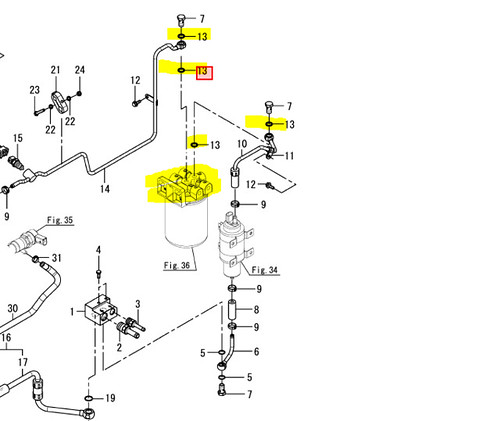
Thought I would pass along what I've discovered with my 6BY2-260 Yanmar engine fuel leak. Back in March I was doing my fuel filter changes. The engine mounted spin on filter was leaking at the mating surface with the manifold (called a filter head). What I discovered was corrosion on the mating surface of the manifold. The corrosion caused he paint to lift and give me an uneven mating surface. I was cruising in FL at the time I was able to use a combination of razor blades and emory paper to get as smooth of a surface as possible. No leaks after really torquing to filter tight. My plan was to replace the filter head at the next fuel filter change but after taking the boat out today, I smelled, then found a leak at the filter mating surface. A new manifold will cost about $500. Ugh. luckily, it appears to be an easy fix with a couple of banjo bolts on top and mounting bolts into the block.
50677101016_9247109b40.jpg
 
I remember a few years ago another tug with the same problem on a 4BY2 180. When I change my filters I use a mirror to look up at the mating surface and make sure it’s clean. You may need to replace #13 when you remove the Banjo bolts. While you have that off check the clamps on the fuel pump (#34), they are known to fail. Good luck with the repair.
 
Brian B":3gvf0ecp said:
I remember a few years ago another tug with the same problem on a 4BY2 180. When I change my filters I use a mirror to look up at the mating surface and make sure it’s clean. You may need to replace #13 when you remove the Banjo bolts. While you have that off check the clamps on the fuel pump (#34), they are known to fail. Good luck with the repair.

I’ve got 4 washers (#13) coming as well. Thanks for the heads up on the pump.
 
I assume you found the problem, but let me tell you what happened to me. Same exact symptoms. And I did the same fix, cleaned the surface that looked corroded. I reinstalled the filter torqued it tight and all was good for a while. Then a bit afterwards it started leaking again. After another careful look what I discovered was a bad filter seal at the top of the filter. I am not talking about the rubber seal I am talking about the seam at the top of the filter made during manufacturing. Take a careful look and maybe it is your filter. A filter change is a lot less expensive. Let us know the outcome.
 
knotflying":2klioga9 said:
I assume you found the problem, but let me tell you what happened to me. Same exact symptoms. And I did the same fix, cleaned the surface that looked corroded. I reinstalled the filter torqued it tight and all was good for a while. Then a bit afterwards it started leaking again. After another careful look what I discovered was a bad filter seal at the top of the filter. I am not talking about the rubber seal I am talking about the seam at the top of the filter made during manufacturing. Take a careful look and maybe it is your filter. A filter change is a lot less expensive. Let us know the outcome.

That's a really good point. I'll look at that. I may not be able to confirm a filter defect until after I remove the filter. Even before the leak I was contemplating swapping out the manifold because of the overall condition (corrosion). I'll certainly keep that in mind on future filter changes.
 
This extends to another subject. Filter quality ! Many DIY folks try to use after market parts because the cost of OEM is expensive. It would be an incorrect statement to say that a manufacturing defect will not happen to a OEM part because it can. I can say from experiences that aftermarket quality is not always as good as OEM parts. The parts in many cases are made by the same manufactures but to different specifications and labeled with a different trade mark. I just had a long conversation with a ZF transmission repair center. I was talking to him about the discovery of some metal particles in the metal mesh transmission filter. His first question was what filter did you use? I always use OEM. In this case OEM was Volvo not ZF. I told him the OEM Volvo. He said who makes Volvo filters? My answer ???? He then gave me the visual checks to confirm it was made to ZF specs. He stated " just because it cross references doesn't mean it is made to manufactures specifications". The specifications are not always just filtering quality. The specifications can be canister thickness, sealing area, thread quality, even material used (quality of material).

Mikes point is a well taken point. We over look the simple fix when an issue rises. Sometimes it is the QC or specifications of the parts used that cause issues. Chances are Bob's assessment of the issue is spot on and his repair will be the fix.

I'm a OEM user unless the after market component is designed to enhance the quality of product. Proven to add longevity and performance. I will pay the price of OEM.

Bob, sorry for putting a curve in the thread. Your post was awesome with the illustration and explanation .
 
Brian's point is well taken. However, the bad filter I had was supposedly OEM. With that said, I use several sources for parts. Some from a Yanmar dealer some on e-bay. It could be possible that the e-bay product is a knockoff and you have no way of telling. The other day I received an oil filter ordered from e-bay in a yanmar box. The price was good and the yanmar o-ring was in the box, but it was a Mann filter. Buyer beware.
 
It looks like the filter head is a removable part in the diagram. If it in fact needs replacing, the mating surface to the filter quite possibly could be fly cut by a local machinist or possibly honed by you to restore the mating surface rather than replacing it. Something to consider before spending 500.
 
Back
Top