inboard to outboard conversion

Niels Hansen

Active member
Joined
Nov 10, 2024
Messages
29
Non-Fluid Motion Model
hewescraft 210 sea runner
I have a 2009 ranger tug with the Yanmar 4 cal Diesel engine. I am investigating converting to either a single or dual Yamaha engines. has anyone done this or have you any thoughts on the topic?
 
IMO, the Inboard, especially the Yanmar is the way to go! I have over 50 years of Diesel Engine experience ,so I maybe a little bias. Everything else aside, I like the appearance of the IB vs the OB! There are several other benefits that I should mention, 1. Better "Weight Distribution" both on the Water and while trailering! 2. Obviously Fuel Mileage, although it not a Game Changer in my application. Also, I like the access to a Dingy off Swim Platform, this is big! The negatives, as I see them are the availability of "Good Reliable Diesels" at a Cost affective compared to OBs. The Extra Storage you get with an OB, is a Big Strong Point. but I don't think it out weighs the other positives of the IB.
I would never consider an OB/IB Conversion, it kills the Resale Value!
 
I have a 2009 ranger tug with the Yanmar 4 cal Diesel engine. I am investigating converting to either a single or dual Yamaha engines. has anyone done this or have you any thoughts on the topic?

Here are my thoughts...

1. Hull shape of your RT is not designed for the speed you are expecting to travel with an outboard. I'm presuming you want to go faster, otherwise, whey consider the switch.
2. The transom is not designed to mount an outboard so I guess you'd be looking at a pod or twin pods to mount the engine(s). Should be a fun COG calculation.
3. I'm sorry, but the outboard RTs are just plain funny looking. A Classic RT with an outboard would look even funnier.
4. If you want to really do this, just buy another boat would be my ultimate recommendation.
 
I agree with fishheadbarandgrill. The inboard boats are semi-displacement hulls, you'll notice that when Fluid motion switched to the outboard boats they changed the hull design to one with less keel and a flatter stern for planing. Even with a big outboard you'll still be doing semi-displacement speeds and not truly planing. Then there is the center of gravity that moves significantly aft if you switch to outboard, meaning you would need to add additional buoyancy aft which would require a hull extension. And then what do you have? Unless you have a naval architect design it and perform stability calculations you're left with a very expensive Frankenstein boat that most reasonable people won't want to touch.
 
would you also apply the Frankenstein look and very expensive qualities to a new 25 ft ranger with an outboard or two ?the bracket needed to mount an outboard, if built correctly,. provides offset flotation for the change in weight placement.i will be basing this boat at telegraph cove on Vancouver Island where there is no diesel available. this will be primarily a fishing boat not a slip queen or center for social gatherings. I picked this boat up for $8900 with a bad diesel motor. that kind of changes the cost calculation and notion of just buying another boat. I am an engineer by trade and not afraid to tackle projects others shy away from. I also do not like to be the last one there. you made interesting points and I appreciate your input. I would welcome more input, especially from someone who has already investigated this or better yet has already done it. I am still open to keeping an inboard but not a lame 110 hp diesel.
 
Yes, the conversion can be done. Do a sanity check. Why do you really want to do it. It will be hard to come out ahead performance and cost wise, even if your time and boat is free. Can you easily insure the boat. Can you convert existing diesel tank to gas and be safe. Can you eliminate rudder easily.
 
would you also apply the Frankenstein look and very expensive qualities to a new 25 ft ranger with an outboard or two ?the bracket needed to mount an outboard, if built correctly,. provides offset flotation for the change in weight placement.i will be basing this boat at telegraph cove on Vancouver Island where there is no diesel available. this will be primarily a fishing boat not a slip queen or center for social gatherings. I picked this boat up for $8900 with a bad diesel motor. that kind of changes the cost calculation and notion of just buying another boat. I am an engineer by trade and not afraid to tackle projects others shy away from. I also do not like to be the last one there. you made interesting points and I appreciate your input. I would welcome more input, especially from someone who has already investigated this or better yet has already done it. I am still open to keeping an inboard but not a lame 110 hp diesel.
Assuming Speed is your objective, maybe you should consider a Cruiser rather than a Tug. I don't understand how Ranger can call their boats Tugs when the newer OB's go that FAST! I would love to find Ranger with a bad Yanmar.
 
I'm sure you can do it, and if you can only get gasoline where you will keep it that's a compelling reason. Just don't be surprised when you put a 250 HP outboard on there and still only cruise at 15 knots getting about one mile to the gallon. I see the 250 burns 23.5 GPH max, so it may be less than 1 MPG. I ran an R25 recently with the 180 HP Yanmar diesel and it topped out at 18 knots at WOT (4000 RPM).
 
Here are my thoughts...

1. Hull shape of your RT is not designed for the speed you are expecting to travel with an outboard. I'm presuming you want to go faster, otherwise, whey consider the switch.
2. The transom is not designed to mount an outboard so I guess you'd be looking at a pod or twin pods to mount the engine(s). Should be a fun COG calculation.
3. I'm sorry, but the outboard RTs are just plain funny looking. A Classic RT with an outboard would look even funnier.
4. If you want to really do this, just buy another boat would be my ultimate recommendation.
Interesting that you mentioned the Hull shape as being different between the OB/IB. As a newbie to Ranger Tugs, I've only recently become aware of this design difference, thanks. This was pointed out to me during a conversation regarding a "Dry Stack Boat Storage Facility." I was told they couldn't handle a R25 with a IB because of the Hull shape, but the OB was fine.
 
Why has Ranger Tugs, and I think other Boat manufactures, switched to OB as compared to IB?
Is it the cost of IB vs OB? Is it the perceived higher maintenance costs of IB? Is it the improvements in OBs overall performance and reliability?
 
Why has Ranger Tugs, and I think other Boat manufactures, switched to OB as compared to IB?
Is it the cost of IB vs OB? Is it the perceived higher maintenance costs of IB? Is it the improvements in OBs overall performance and reliability?
Probably a question best answered by Ranger Tug representatives, but I'll still offer my thoughts. Yes, the modern electronic fuel injected four stroke outboards have proven themselves to be far superior to the older outboards, so it's not the same comparison that builders were making 15 years ago. Customers want to go faster, and the outboard with planing hulls do that in a way that's harder with an inboard diesel. Up to 31' these are easily trailer-able boats, so the lighter weight of the outboards make sense. The cost of repower is less, and the labor involved in a repower significantly less. As you mentioned the dry storage option of the outboard is more practical, although plenty of places can still rack store the inboards they just need deeper bunks for the keel.

The early inboard diesel boats, which I have and love, are more of a 'downeast' style and a hybrid between the slow trawler and faster cruising boat. Advantages: improved fuel efficiency and reliability. Drawbacks: slower and more difficult to do the maintenance because the engines are crammed in a tight space, as well as slightly deeper draft.

I don't think the outboards are less maintenance, but it's easier to do the maintenance.

One of the most asked questions is "how many hours will the engine last?" As a surveyor I've learned that hours mean very little relative to the maintenance done and the efforts to keep corrosion at bay. Sure, diesels can run 10,000 to 15,000 hours easily and they do all the time in commercial operations but on recreational boats they often die after a few thousand hours, which may take 30 years to put on. Outboards are lasting 1500-2000 hours regularly now (the old 2 strokes had an average lifespan of about 500 hours), so about 20 years the way the average boater uses their boat. That's plenty, then swap it out. Why spend the extra money for a diesel engine that won't live to see it's full potential? (that's the thinking, anyway)

It's not just Fluid Motion, most other builders like Formula, Pursuit, etc. are going away from the inboards and I/O's and moving to outboards. The customers seem to want it, but that also puts a floor under the resale value of the inboard diesel boats because you can't get them anymore. We're seeing boats with outboards up to 50, 60 feet now which is something that was unheard of 20 years ago. Outboards also allows joystick controls without having to install complicated/high maintenance pod drives on your inboard diesels.
 
Last edited:
great replies! I still have not heard sufficient reason for me not to convert from diesel inboard to outboard(s), rear flotation pods/engine mounts are readily available and with the right dimensions are not too difficult to install. the fuel tank does not care if it dispenses diesel fuel or gasoline. no real changes needed there. my last 3 boats have had either a Yamaha or Honda outboards and have been absolutely reliable and trouble free. I can even find parts for them on northern Vancouver Island! I would still like to hear from some brave soul who has already done what I am likely going to do. nothing like standing on someone else's shoulders and learning from their experience.
 
Yes, the diesel tank will still dispense gasoline but the boat won't meet the USCG legal requirements for an ignition protected space. You can read through the USCG regs for the specifics, but basically the entire cabin would need to be ignition protected because of where the fuel tank is on the diesel boats forward of the engine and below the cabin sole. Might be able to do some creative fiberglass work to seal the area but that's a safety issue I wouldn't ignore.
 
Yes, the diesel tank will still dispense gasoline but the boat won't meet the USCG legal requirements for an ignition protected space. You can read through the USCG regs for the specifics, but basically the entire cabin would need to be ignition protected because of where the fuel tank is on the diesel boats forward of the engine and below the cabin sole. Might be able to do some creative fiberglass work to seal the area but that's a safety issue I wouldn't ignore.
great replies! I still have not heard sufficient reason for me not to convert from diesel inboard to outboard(s), rear flotation pods/engine mounts are readily available and with the right dimensions are not too difficult to install. the fuel tank does not care if it dispenses diesel fuel or gasoline. no real changes needed there. my last 3 boats have had either a Yamaha or Honda outboards and have been absolutely reliable and trouble free. I can even find parts for them on northern Vancouver Island! I would still like to hear from some brave soul who has already done what I am likely going to do. nothing like standing on someone else's shoulders and learning from their experience.
Ok, I've had ideas that were "Out of the Box" also, and at the time I was convinced they made sense, even though those ideas were somewhat controversial, I was able to justify them in my head, even though the advice from others was contrary. BTW, I am glad I didn't follow through with my idea!
I would suggest that you make a "Written Outline" of the Project and assign both a Dollar amount and the Time required to finish it, i.e. a "Cost Analysis." This exercise should be helpful in determining if the Project "Holds Water" or will it sink, no pun intended.
Please share your list with the group, I think it will be worthwhile for all.
 
Last edited:
... I am still open to keeping an inboard but not a lame 110 hp diesel.
The Island Gypsy 32's are equipped with engines as small as 120hp (up to 225hp) in a 16000 pound boat and manage a top speed of about 9kts. Given that it's not a planing hull and never going to be as fast as the OB, the 110 might not be as lame as you think.
 
It is Boat Show season. Rather than cut up a boat to do the change over I would look to trade, and you might find a Outboard owner who is lusting after your Diesel.
 
I will be picking up my 2009 ranger next week. if anyone is lusting for an old Yanmar diesel I expect will have one to sell. my house, cars ,truck, motor home and my hewescraft 210 are alll paid for. I don't have an extra $300,000 to buy a new ranger tug with a 300hp Yamaha outboard. the Yanmar diesel argument is a weak one. it falls in the category of still liking buggy whips and carburetors. while a 850 Holley carb works great on my 68 corvette, it is old technology and yesterdays way of doing things. there are reasons why the ranger tug company and most others have given up on them and why Yanmar is no longer in existence. for what it is worth my hewescraft has a fully enclosed cabin with a 75 gallon gas tank directly under the floor in that cabin. before you ask me why I want a ranger tug when I have a perfectly good boat with an OB, I am perfectly located on the northern tip of Vancouver Island to do the inside passage all the way up to glacier national park...and it is on my bucket list .the marine head is also a welcome addition. anyone looking for a really nice 2016 hewescraft?
 
I will be picking up my 2009 ranger next week. if anyone is lusting for an old Yanmar diesel I expect will have one to sell. my house, cars ,truck, motor home and my hewescraft 210 are alll paid for. I don't have an extra $300,000 to buy a new ranger tug with a 300hp Yamaha outboard. the Yanmar diesel argument is a weak one. it falls in the category of still liking buggy whips and carburetors. while a 850 Holley carb works great on my 68 corvette, it is old technology and yesterdays way of doing things. there are reasons why the ranger tug company and most others have given up on them and why Yanmar is no longer in existence. for what it is worth my hewescraft has a fully enclosed cabin with a 75 gallon gas tank directly under the floor in that cabin. before you ask me why I want a ranger tug when I have a perfectly good boat with an OB, I am perfectly located on the northern tip of Vancouver Island to do the inside passage all the way up to glacier national park...and it is on my bucket list .the marine head is also a welcome addition. anyone looking for a really nice 2016 hewescraft?
Yanmar is still very much alive and well ... they sell all sorts of amazing Diesels for marine use. Sounds like you are set on an outboard re-power however so good luck with the project. I recently had the same debate with my 2008 Ranger and ended up installing a new Diesel inboard. It's the best fit for the boat IMO and fit the requirements I had personally .... but those are not sounding like the same requirements you may have. All I can offer for advice is take the number everyone tells you for the project and DOUBBLE it. You can look at my post history if you want to see the route I went with the Kubota based Betamarine. I am located in SE Alaska and needed fuel economy and absolute solid reliability along with easy access to parts. Kubota engines are EVERYWHERE and parts are easy to source, so that fit the bill.... for me.

Every boat is a compromise, just know what you are giving up going into your re-power with the engine choices you make. Good luck and god speed!
 
Last edited:
tell me more about the replacement diesel you used on your 2008 R25. was it a Kubota and what were the hp numbers ? why did the old engine fail?
 
tell me more about the replacement diesel you used on your 2008 R25. was it a Kubota and what were the hp numbers ? why did the old engine fail?
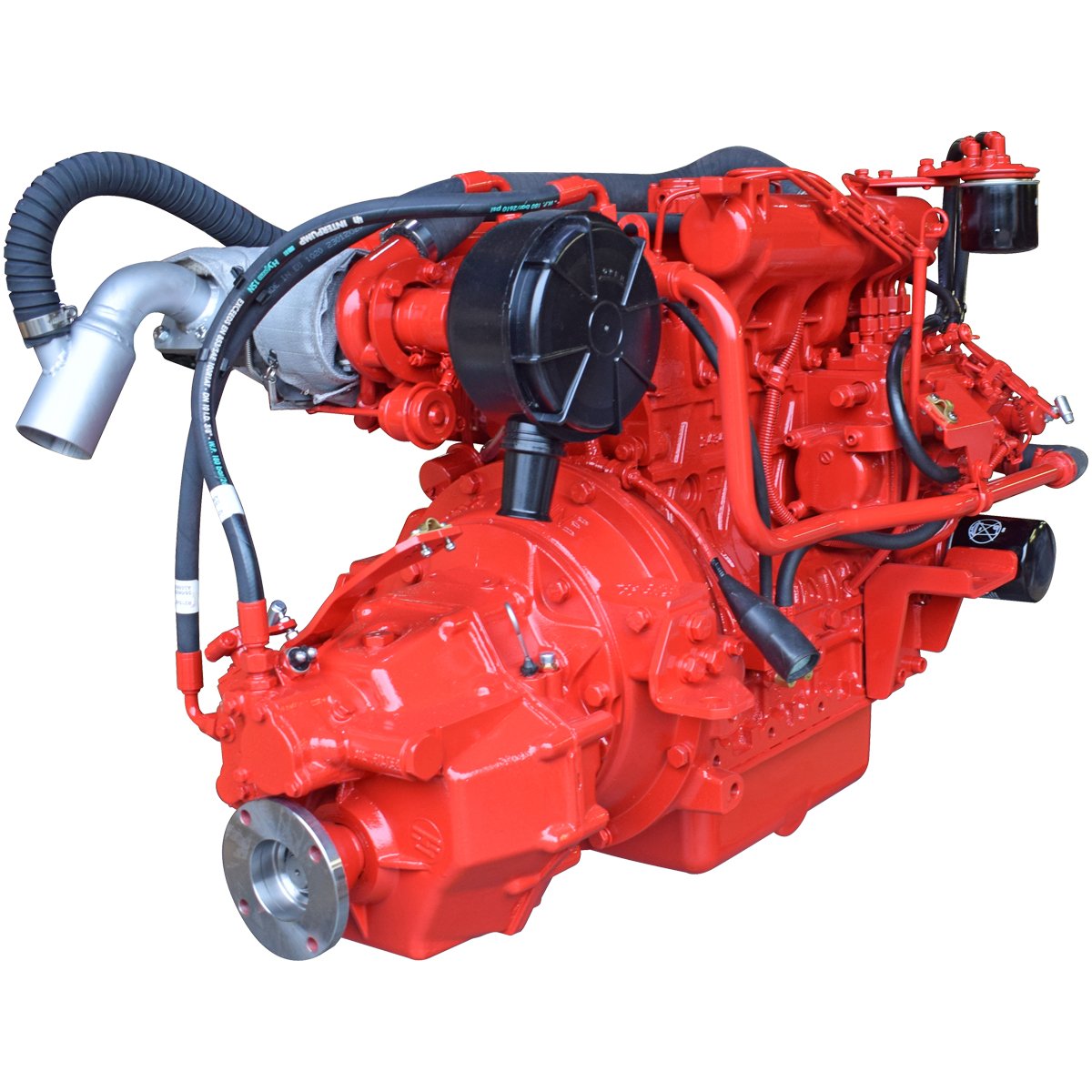
Original to boat was 150 QSD (2.0 "Cummins" .... aka 80's BMW block converted by VM motori in Italy and resold through a Cummin Mercruiser deal in USA ) , it had been repowered after many hours by the original owners with a 130 QSD ( same engine de rated to 130hp ) , I purchased a few years after that but the second owners didn't have a clue about how to care for a boat let alone a Diesel inboard. It had been used and abused but much of it was missed during survey at purchase .... needless to say it was suffering excessive blow by, rear main leaks, etc shortly into my tenure with it .... it was my problem at that point so it was re-powered with a Betamarine 62T (2.4L) that I custom ordered and installed in 2024. Original engine 150hp would cruise at 12-13kts from what I've been told, 130hp would cruise at 9-11kts per my experience, now the 62hp Turbo Betamarine which is a Kubota 2403-m-t-eu4 engine cruises at 6-8kts all day.

Our use case was 95% of the time at hull speed so 6-7kts based on math for the R25c, so it works well for us and SIPS the fuel .... sub 1gph at hull speed. I love the change and would do it again. I fully plan to get a faster boat when the time is right but for the family here in SE a slow boat is all that's needed for getting out and enjoying the area now. I could have gone with a Yanmar 110hp diesel but the waitlist was 18months and I am not a fan of overcomplicating marine situations with electronics. Plus per the math I would have only gained 1-2 kts max. The power required to increase speed over your hulls mathematical speed increases exponentially. You quickly realize that you have to toss a LOT of power aka fuel problem to go just a little faster. The new engine is rock solid old school mechanical ... aka EMP proof if that type of thing floats your boat, lol.

I really considered the outboard pods and doing smaller twins on it ..... it just was not cost effective once I looked into it deeply and started adding everything up. I would have also had to add a secondary fuel tank where the old engine was to compensate for the increased fuel burn outboards would have vs inboard Diesel. All that and I would have lost my engine heated cabin heat exchanger and hot water heater ... along with the Diesel source for my cooktop / aux cabin heater. Not that those things could not be fixed, I just decided it was not worth the effort for what I really wanted in the end.

Im interested to see what you end up doing! Good luck.

Link to Beta engine I used with some custom stuff ordered also. Checkout my profile posts for photos of my install. TMC345A gearbox, shallow sum oil pan, rear PTO driven raw water, remote oil filter , British green paint since I dislike the red color, etc ....


last re-power followup thread of mine .... with photos.

 
Last edited:
Back
Top